






by Caleb Nickerson
Tucked away off of chemin Kawartha in Breckenridge sits the home of Raymond Desjardins and his wife, Anne. If you saw him walking up the street, you could be forgiven for mistaking Desjardins for any other senior citizen on the block, but that presumption would be way off the mark.
Behind the kindly eyes and unassuming tone, is the mind of an internationally recognized academic and one of Canada’s foremost research scientists, specializing in the field of micrometeorology and climate change. On March 14, Dr. Desjardins became a Member of the Order of Canada at a ceremony with Governor General Julie Payette, in recognition of his lifetime of research.
“It’s the first time I’ve ever rented a tuxedo,” he noted with a laugh. “I wish I bought one when I got married, I could have used the same one.”
Desjardins said he was impressed with Payette, herself an accomplished engineer and astronaut, and discovered they even had a mutual colleague, Piers Sellers, who was a member of NASA Group 16.
“We had something in common because one of my good friends was an astronaut and he trained at the same time as our Governor General trained,” he said.
At the age of 79, Desjardins is still a working scientist, contributing to our knowledge of greenhouse gas emissions and the carbon footprint of numerous agricultural products. But Desjardins didn’t arrive where he is without a few twists and turns along the way.
He grew up in the small Francophone town of Carlsbad Springs, Ont., on a 200 acre farm. His father had only a sixth grade education and one leg but regardless, managed to provide for his family.
“I used to milk 12 cows a day by hand,” Desjardins recalled. “Compared to now, it’s changed quite a bit, but my father was quite successful. He was probably one of the only farmers around who didn’t have to have [a second job].”
The junior Desjardins wasn’t without his own challenges either. Though he was a diligent student and got good grades, a government inspector held him back a year before secondary school due to the language barrier.
“I failed grade eight, there were only English high schools and I couldn’t speak English,” he said.
He couldn’t know it at the time, but this setback resulted in Desjardins meeting his wife several years later when they were both attending the University of Ottawa. Raymond was in his fourth year of a bachelor of physics when he met a first year science student named Anne.
“I was giving a lot of talks around to the young kids … you know, don’t get too discouraged if something bad happens to you,” he said. “In my case at least, something good happened, we’ve been married now for almost 54 years.”
While completing his undergrad, Desjardins worked for several summers in agro-meteorology for Agriculture and Agri-Food Canada.
“I started at the Experimental Farm in ‘61 as a student, so I’ve been at the same place since then,” he said. “I lived on a farm so agriculture and meteorology [are] quite relevant. It’s a bit of luck when you pick, but I picked the right one.”
He completed a Masters in Meteorology at the University of Toronto in 1965, the same year he got married, and was offered full-time employment back in Ottawa. He had a PhD in mind, but spent two years mulling over which field of study to pursue.
He eventually chose the field of micrometeorology and received his doctorate from Cornell University in 1972. He credits his father-in-law, an accomplished physicist with the National Research Council, as a great mentor while choosing and completing his PhD.
“To interact with a scientist during my PhD thesis was very helpful,” Desjardins said. “He was helping me, proofreading what I was doing. It was not his field, but he was a smart scientist. Having somebody like this was really helpful.”
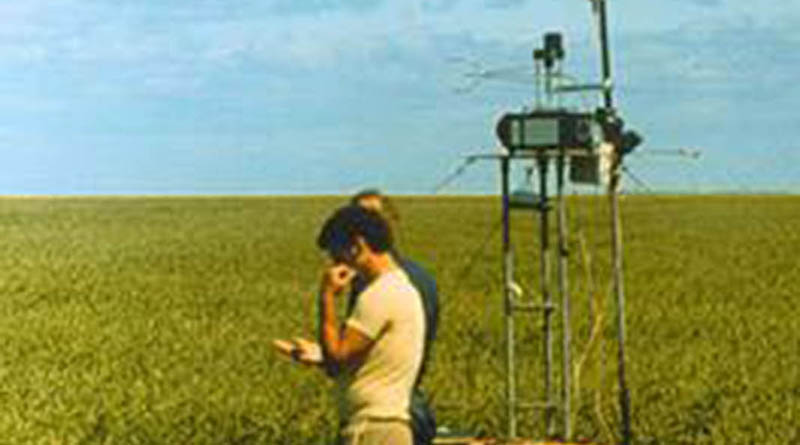
For his thesis, he pioneered a technique for measuring carbon dioxide levels, a technique to measure crop growth. Little did he realize, his techniques would have major applications down the road when climate change went from an obscure topic of academia to a mainstream concept.
“It was developing a technique of measuring the rate of growth of crops,” he said. “I modified an instrument to measure carbon dioxide. People have done that for measuring evaporation before but I was the first to use this technique to measure carbon dioxide flux.”
“I developed systems that did not exist before. My professor was doing it a completely different way,” he continued. “Now, the way that I did it during my thesis is done worldwide, [though] they have better instruments.”
He pioneered the use of aircraft to measure carbon dioxide flux over vast swathes of many different ecosystems, from the grasslands of Kansas to the boreal forests of northern Canada. This technique graced the cover of the May 14, 1982 edition of Science magazine.
“The aircraft gives us a tool that nobody else has to measure how the ecosystem responds to the environment,” he said, noting that regional scale measurements allow for more accurate predictive models.
He has also worked closely with agricultural groups, such as the Dairy Farmers of Canada, the Canadian Pork Council and the Canadian Cattlemen’s Association to increase awareness about the impacts of climate change on farming communities. He helped publish a book on the subject, Better Farming, Better Air – A Scientific Analysis of Farming Practice and Greenhouse Gases in Canada, which came out in 2008.
“At the same time we built a greenhouse gas calculator that’s still in use,” he said. “Any farmer can use it, it’s all on the internet.”
More recently, Desjardins has turned his attention to calculating the carbon footprints of various agricultural products.
“At the end of the month we’ll have a paper on greenhouse gas emissions compared to the food guide,” he said. “If you’re going to calculate the carbon footprint of an agricultural product, you must count [everything] up to the farm gate, up to the processing plant.”
He noted that Canadian farms are among the most efficient in the world in terms of emissions per litre of milk or kilogram of beef produced.
In addition to his membership in the Order of Canada, Desjardins is a Fellow of the Royal Society of Canada and was the co-recipient of the Nobel Peace Prize in 2007 for his work with the UN Intergovernmental Panel on Climate Change.
He continues to work with and mentor scientists from across the globe, but he reserved his highest praise for the partner that was with him through it all.
“Having a fantastic wife is probably the most important thing of all because [she’s so] supportive,” he said.