







Chris Lowrey
CLARENDON Sept. 27, 2018
With the Quebec government’s plan to phase out organic waste from landfills by 2020, municipalities are under the gun to form a plan for managing organic waste.
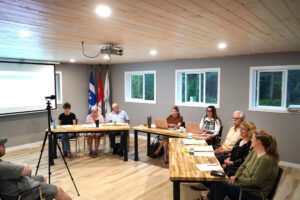
Although waste management is a responsibility of municipalities and not the MRC level, the MRC Pontiac hosted an information session for residents curious about reforming their waste disposal practices.
The event was hosted by the Outaouais Regional Council for the Environment and Sustainable Development (CREDDO) at the Little Red Wagon Winery in Clarendon.
The goal of the event was to educate people in the region about environmental issues and how they can be proactive when it comes to waste management.
The presentation, which was made by CREDDO employees Geneviève Carrier and Ayoub Hammoudi, started with a deeper analysis of why the Quebec government is imposing a restriction on lanfilled organic waste.
The main reason is the limited capacity of the province’s landfills to accommodate more organic waste. According to the province, 420,000 tons of municipal organic waste were landfilled or incinerated in 2015. This represents a recycling rate of 51 per cent despite the provinces goal being set at 60 per cent.
The industrial sector fared much worse. In 2015, the province’s industrial sector sent 700,000 tons of organic waste to landfills or incinerators. This represents a recycling rate of just 34 per cent despite a target of 60 per cent. The main reasons cited for the shortfall include a lack of collection services and an abysmally low recycling rate – just three per cent – of food waste from the industrial sector.
Additionally, Carrier and Hammoudi noted that landfills contribute to soil contamination, water pollution and air pollution thanks to the amount of greenhouse gasses emitted by them.
Another impetus for the government to enact this plan is the high cost associated with landfilling waste. For instance, the City of Gatineau pays $98.60 per ton of household waste that goes to the landfill. For comparison’s sake, Gatineau spends $18.84 per ton on recycling and $83.40 on composting costs.
Most people are familiar with the Three R’s: Reduce, reuse and recycle. Well there is now a fourth “R” – rot.
This alludes to the compost process for organic materials. The goal is to turn all those food scraps collected from households into compost, which can then be resold.
The presentation also went over, in fine detail, what can and can’t be recycled. Some eyebrows went up throughout the crowd when they were informed that things like household glassware cannot be recycled because of the mixture of materials – like crystal – that go into them.
The crowd was also made aware of a fifth “R” that can help them cut down on the amount of waste they produce: Refuse.
By refusing things like plastic straws, grocery bags or putting up “no soliciting” stickers to avoid things like flyers, the amount of waste we generate will be reduced.