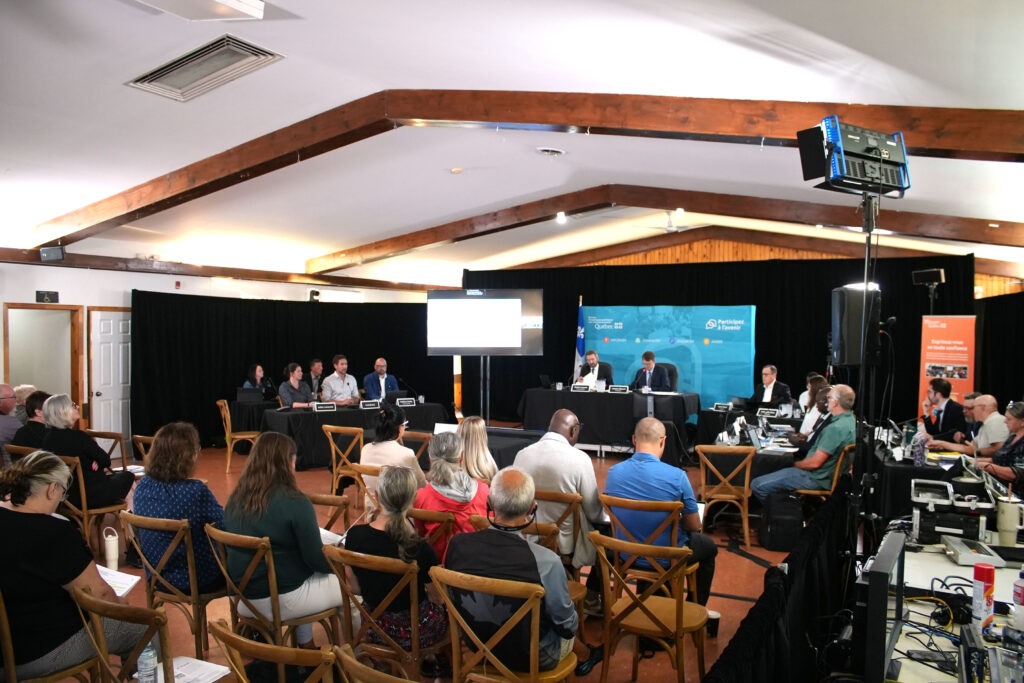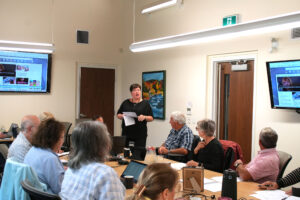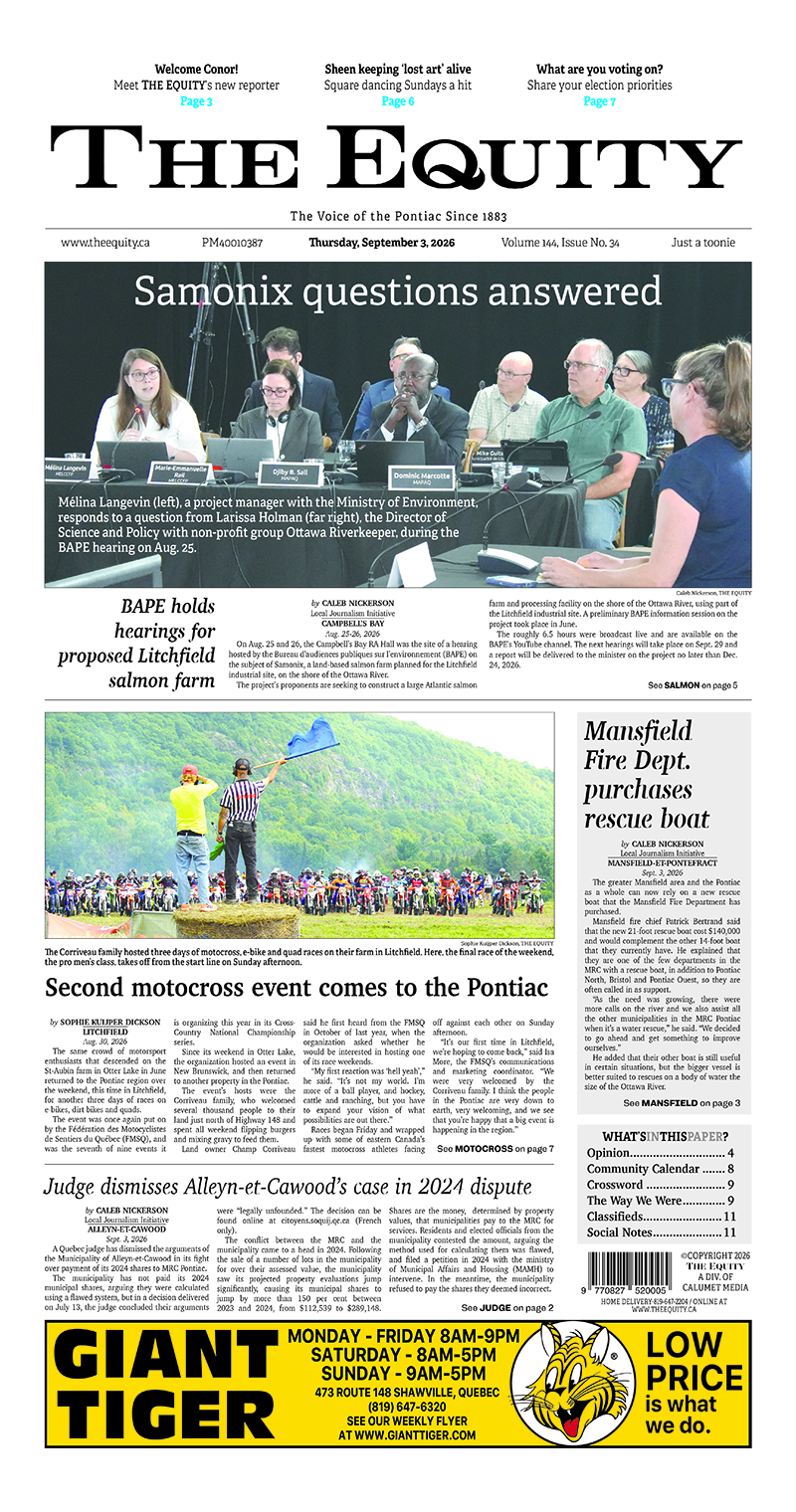



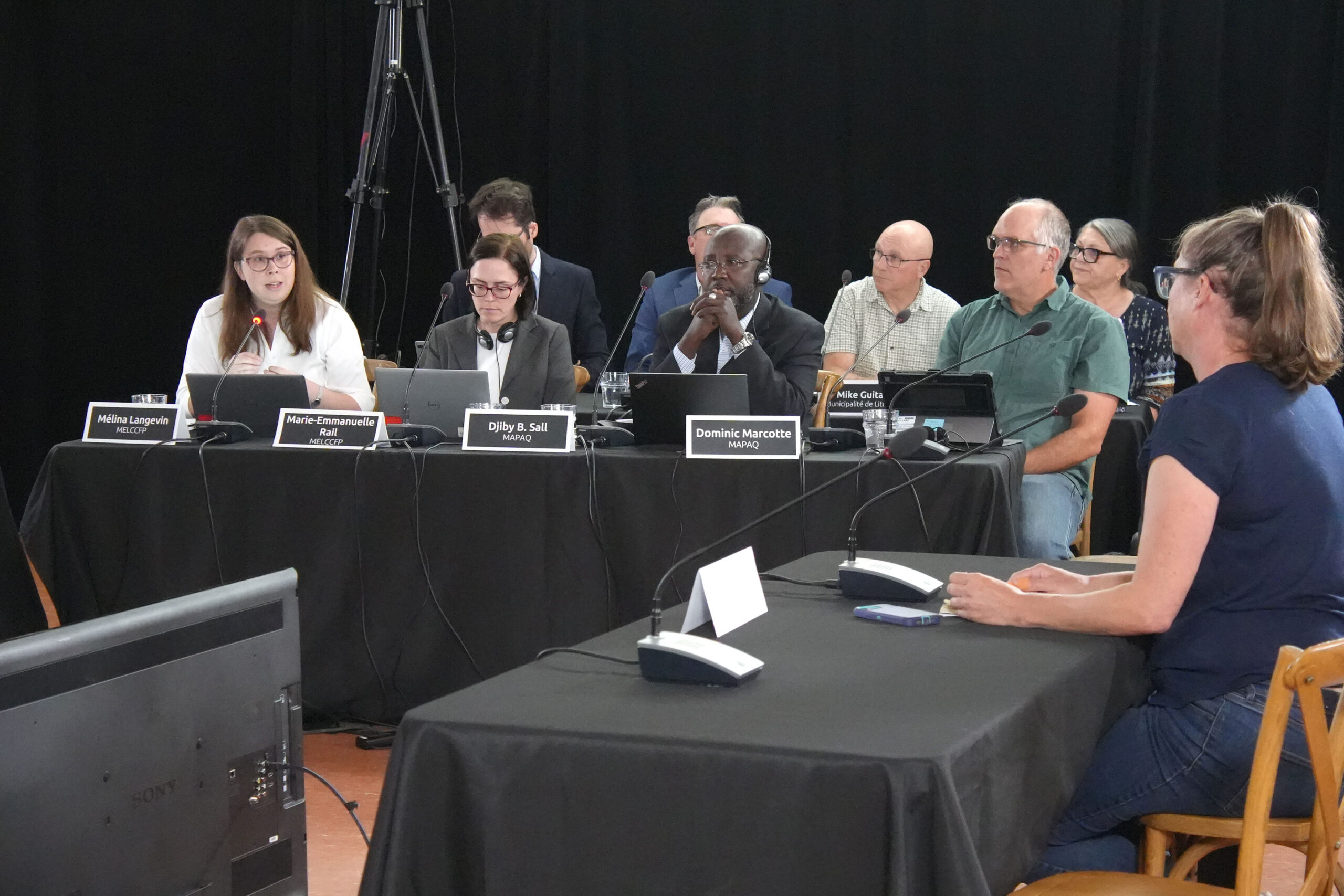



On Aug. 25 and 26, the Campbell’s Bay RA Hall was the site of a hearing hosted by the Bureau d’audiences publiques sur l’environnement (BAPE) on the subject of Samonix, a land-based salmon farm planned for the Litchfield industrial site, on the shore of the Ottawa River.
The project’s proponents are seeking to construct a large Atlantic salmon farm and processing facility on the shore of the Ottawa River, using part of the Litchfield industrial site. A preliminary BAPE information session on the project took place in June.
The roughly 6.5 hours were broadcast live and are available on the BAPE’s YouTube channel. The next hearings will take place on Sept. 29 and a report will be delivered to the minister on the project no later than Dec. 24, 2026.
The meeting was presided over by the BAPE’s Jacques Bénard and Martin Lessard. The event featured a panel on one side with several Samonix employees, as well as another panel on the opposite side with representatives from the Ministry of Environment, Ministry of Agriculture and Fisheries (MAPAQ), Santé Quebec, MRC Pontiac and the Municipality of Litchfield. Simultaneous translation was provided via headsets to anyone who required it.
There were more than a dozen questions and several presentations over the course of two roughly three-hour sessions, covering a wide variety of issues related to the project.
The project
The Samonix project is aiming to harvest roughly 10,000 metric tons of Atlantic salmon annually, with a maximum capacity of 12,000 metric tons. Company documents presented at the meeting state that the nearly three million fish harvested every year to meet these metrics would be farmed and processed in a 5.6 hectare land-based facility. The overall project cost is estimated at $300 million USD (roughly $418 million CAD).
The farm will use a water recirculating system (RAS) and Samonix technical director Fred Brisco said that they were aiming to not use any antibiotics on their fish, instead relying on strict sanitation procedures.
CEO Mathieu Farley is the owner of an audit and management consulting firm, as well as a construction firm in Chelsea.
Below are a selection of the questions and responses from various stakeholders:
Environmental monitoring
Several questions had to do with the level and scope of environmental monitoring.
Larissa Holman, the Director of Science and Policy with non-profit group Ottawa Riverkeeper raised concerns about the Ministry of Environment’s monitoring practices.
“It’s been our experience when receiving environmental reports regarding environmental infractions, the ministry has been slow to respond, or has downloaded these responsibilities to municipalities,” she said.
Mélina Langevin, a project manager with the Ministry of Environment, responded by explaining how the ministry monitors projects, stating that they prioritize new and large projects for visits. She added that the results of their followups will be publicly available.
She said that there is also a similar land-based Atlantic Salmon farming project called AquaBoreal planned in Quebec’s Côte-Nord region which had its own BAPE hearing last summer.
Brisco gave a detailed breakdown of their effluent diffuser system, which he said would be deliberately placed in a fast-flowing part of the river to disperse the treated effluent as quickly as possible.
“We have many very, very in depth studies from Canadian professional firms, reputable firms that have gone through every element, including ideal placement of the diffuser in areas of the river where water is moving rapidly,” he said, noting that according to their models, the effluent is diluted seven times within two metres. He added that their effluent water is treated to a high standard before being released.
He also spoke about the studies that had been conducted on the flow of the river in that area, induding studying historical data about low and high flow events as well as other metrics.
“We are very fortunate to have NGOs like Ottawa Riverkeeper who does extensive water quality testing, not all watersheds, not all rivers do. But Ottawa Riverkeeper, for example, has historical data on the river testing a huge amount of parameters,” he said. “So most areas of the river have historical data on almost anything you can imagine that would be relevant.”
Later in the meeting he said that they had done modelling to show that effluent would not accumulate in Miller Bay, a slower-moving area of the river near the site.
Freshwater vs. salt water, and why salmon?
Thorne resident Christine Anderson asked why the company had chosen salmon as opposed to a species that’s native to the region, and also questioned why they would be using freshwater from the river to raise a saltwater fish.
Farley explained that even in salmon farms that draw their water from a saltwater source, they typically reduce the salt content significantly when the fish are small, so starting with fresh water isn’t a disadvantage.
“There’s actually a research centre in the U.S. that’s been raising Atlantic salmon in freshwater only for many years, so it’s been demonstrated and favoured by aquaculture projects to actually raise salmon in low salinated water for the growout,” he said.
He added that a higher level of salt in the waste sludge (excrement) that the farm produces would be an issue and make it more difficult to dispose of.
Farley also said that they chose Atlantic salmon because of the market for it that wasn’t being supplied locally.
“In North America, we eat 750,000 metric tons of Atlantic salmon and produce 100,000 tons on the East coast of Canada and on the West coast of Canada and we sell most to the U.S.,” he said. He explained that Ontario and Quebec import most of their salmon from Norway or Chile and the distances involved make it difficult to get fresh, which is where they hope to have an advantage in the market.
MAPAQ representative Dominic Marcotte gave a presentation on the market for salmon in Quebec. He said that there are currently no salmon farms in production in the province, and that land-based aquaculture is primarily for varieties of trout. There are 84 facilities permitted for land-based aquaculture in Quebec, and 11 per cent of them are located in the Outaouais region.
He said that Quebec consumes about 13,000 tons of Atlantic salmon, which requires a production of about 25,000 tons of fish to account for the weight lost during processing.
Around 56 per cent of the farmed fish in the province are destined for the supermarket, and 44 per cent are sold live for activities like stocking lakes.
He said there were about 10 operating facilities in the province using a similar RAS system to the one used by Samonix.
Emergency measures, fish waste removal
Portage-du-Fort councillor Nicole Thompson asked about the potential impacts on nearby municipalities, including if there was an incident where waste was emitted above the levels set out by the Ministry of Environment.
Farley said that they are required by the Ministry of Environment and the MAPAQ to have measures in place for a wide variety of emergencies, including accidental waste emissions. He said that it was laid out in their documentation what the protocols for such an event would be, such as which authorities to contact.
The concerns about impacts on health in a “worst case scenario” were also echoed by another Portage-du-Fort councillor, Dominic Bisson.
In response, Brisco explained that they are not a heavy industry that’s disposing of complex molecules that are difficult to break down, comparing the facility to a “very, very large aquarium”. He said that the waste they are treating is very similar to that in a municipal water treatment plant, with the bonus that they have tighter control over what gets put into their system. He added that they are several kilometres away from any drinking water sources, and any waste emissions would be diluted quite rapidly.
In response to a similar question the following day, he said that their systems had layers of redundancy built in.
“Everything I said, due to the scale of the water treatment, is highly redundant. We have five bio-security zones that are exact copies of each other,” he explained. “We could have a piece of equipment go down and it only affects five per cent of the total water treatment because everything’s modular.”
Ministry of Environment representative Langevin confirmed that they have penalties in place for companies that don’t comply with their standards.
Municipality of Pontiac resident Katharine Fletcher asked about the solid waste that the facility would produce.
Farley explained that they would be sending their solid waste, primarily made up of fish excrement, roughly 250 kilometres to a biomethanization plant in the Monteregie region, where it would be used for electricity generation and then used as agricultural fertilizer. The company they send it to has the authorizations to disperse the sludge once it’s treated, and Farley said it would likely be dispersed on fields closer to the treatment plant, but they had no control over that.
Animal welfare
One question related to the humane treatment and slaughter of the fish that would be raised at the facility.
Farley said that land-based farming offers better conditions than open-net farming in the sea.
“For us, land-based farming is actually a way of ensuring the well-being of salmon. Right now the open-net pens in the sea, the salmon are facing very harsh conditions and parasites,” he said. “They have to give them a lot of antibiotics for fighting diseases. The mortality rate is very high. In our facility the mortality rate would be very low [ . . . ] Of course they end up on a plate and being eaten, so at the end of the day it’s the same result, but during the time when they’re growing, they would be growing in the best water quality possible, compared to any other farming in the sea at the moment.”