





She wakes up. It’s the middle of the night. Her legs can’t move even an inch.
“Not again,” she thinks.
Her brain tells her body to move — to get out of this stranglehold — but it doesn’t work.
So she settles in, mentally preparing herself for the next 20 minutes of pain. Or five minutes. Or three hours. She has no idea how long her body will be stuck like this.
She knows the drill. Unable to move a muscle, she will be fully conscious of everything that’s happening to her body.
And there’s not a thing she can do about it. All she can do is sit there and pray it’s a short one.
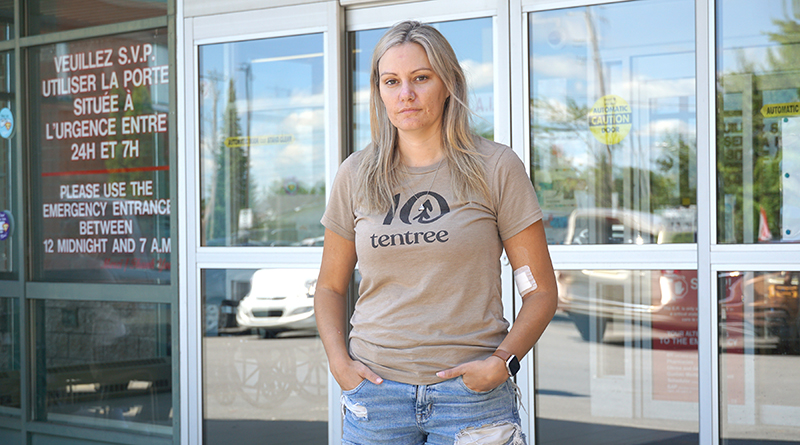
Jessica Forgues has stiff person syndrome (SPS), a rare neurological condition that recently gained more attention when Quebec singer Céline Dion shared she had been quietly battling the disorder for years.
SPS causes the body’s muscles to seize up at random times. These seizures, sometimes called episodes, can be triggered by stimuli like harsh light or intense sound, and can last anywhere from a few minutes to a few hours.
“It’s kind of like you’re the tin man. Nothing works. You can tell your body to move, but it can’t,” Jessica told THE EQUITY from a chair at the Pontiac Hospital where she goes to receive treatment once a week.
The condition affects her every day. Sometimes, her legs seize up. Other times, it’s her arms.
“Every single cell in your body is on fire. All the time, 24 hours a day, seven days a week. Your muscles never stop being in a constant state of spasm.”
But Jessica said the facial spasms are the worst. They can lead to lockjaw, and sometimes she can be stuck like that for days if she can’t find anyone to treat it.
SPS is a never-ending battle for Forgues. She doesn’t go out as much anymore because she is nervous she will have an episode, a radical change from the very active, community-oriented lifestyle she used to lead.
Growing up in Fort Coulonge, she started working in tourism at a young age. Then in her twenties, she got a job at Esprit, a local whitewater rafting business. Later, she started her own business and was elected director general of the Pontiac Chamber of Commerce.
Before she got diagnosed with SPS, Jessica was a parliamentary assistant for the former Pontiac MP Will Amos for five years, and worked as a server and bartender on evenings and weekends.
In her free time, Jessica loved being out and about, whether exploring the great outdoors, going to concerts, or working out at the gym.
Life was busy, and she liked it that way.

While this disorder has put her out of commission, she hasn’t missed a beat. She is taking it in stride as yet another opportunity to give back to her community – advocating for awareness about the condition that upended her life completely.
Her condition has only recently begun to get visibility.
Dr. Marinos Dalakas, Professor of Neurology at Thomas Jefferson University, is one of a few experts on the disorder in North America.
He said patients with SPS often suffer from decreased quality of life because they’re anxious about going out in public.
“People are sometimes hesitant to go out in public because they’re afraid of walking,” he told THE EQUITY adding that the episodes happen at random.
He said right now there are two treatment options, including symptomatic ones that can reduce muscle spasms and the anxiety that come with them, as well as immunotherapy, which addresses the root cause of the condition, but its effectiveness decreases over time.
In other words: there is no cure for the condition, only ways to make it more bearable.
He also said the condition can be hard to diagnose.
Unless people with SPS are having an episode, they appear completely normal, with no external signs of illness.
Jessica said when she told her family doctor about her spasms when she first started to get them in 2020, the doctor thought she was making it up.
“To say that you have a disease that’s completely invisible and that they can’t see, and that they’ve never heard of, is difficult to explain to people.”
It was during a routine visit to the chiropractor that she discovered she might have a neurological condition.
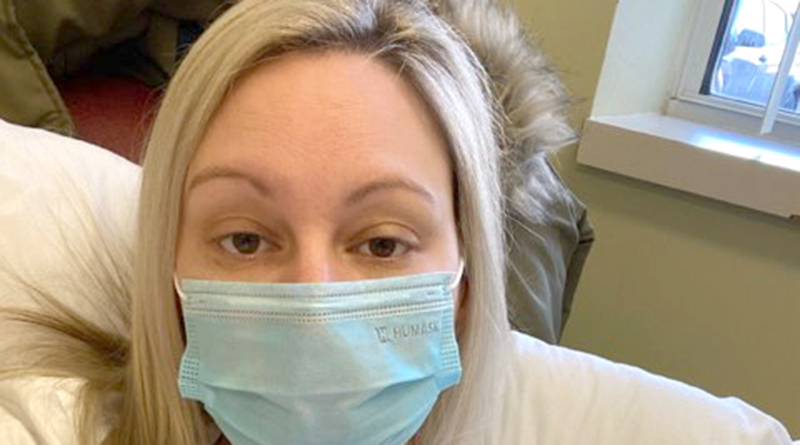
Forgues was finally diagnosed with SPS in 2021. Since then, she’s been receiving treatments once a week at the Pontiac Hospital and up to three times a week in Gatineau, which have helped to localize the spasms and reduce the number of episodes.
When Jessica got diagnosed, it was hard for her to adjust to not being on the go all the time.
“I considered myself to be invincible. I thought I could take on the world and there was nothing I couldn’t do. I had an amazing career. I volunteer, and I was doing 100 hours a week. That was my personality.”
Now, she spends most of her weeks driving to and from appointments, treatments, and specialist visits. She’s busy, but not the kind of busy she enjoys.
“It’s a full-time job to be sick Monday to Friday. I’m doing more scheduling now than when I was on Parliament Hill,” she said, only half joking.
Having SPS takes up a lot of Jessica’s time, but it also costs a lot of money.
Between the gas money for getting to all of her appointments, the medications, which alone cost almost $300 a week, and an expensive consultation for a surgery to repair damages to her lower jaw caused by the facial spasms, the bills are adding up quickly.
Jessica had savings that she had been using to pay for her treatments, but the well started to run dry.
She applied to Retraite Québec, the government body responsible for evaluating disability claims, and after waiting nearly a year for her application to be processed, she will soon start receiving disability payments.
But the $900 she will receive every month won’t even be enough to cover her medications, let alone the rest of the expenses.
Retraite Québec told her she hasn’t paid enough into the pension plan for her to receive more money.
Jessica feels like she is slipping through the cracks of the system, and she wants to see the government give more money to people like her who are out of work due to a rare medical condition.
“I’m not choosing to do this. Nobody would choose this,” she said.
“It seems unfair to me that there isn’t a basic amount that people deserve regardless of their age when you have a disease such as this. But there’s no cure, there’s no getting better . . . the best you can hope for is to stay stable.”
In a statement to THE EQUITY, translated from French, a spokesperson from Retraite Québec said the amount of money a disability claimant receives varies on a case-to-case basis.
While they did not comment on Jessica’s specific situation, they said: “When a person less than 60 years old is deemed ‘disabled’ by the medical team of Retraite Québec, the amount they will receive varies according to their situation.”
Each person, no matter the situation, receives $583.29 a month, while the rest of the amount is evaluated according to the person’s employment earnings. In 2024, the maximum amount a person can receive per month is $1,606.75.
On June 19, Jessica’s mom started a GoFundMe page to help her daughter pay for her expenses.
The page, which has raised $8,932 at the time of writing, has helped her cover some of her costs, and since its launch, she’s been getting messages from other community members who want to help her cause.
Jim Coffey, owner and director of Esprit Whitewater Rafting, first met Jessica about 15 years ago when she worked for him.
He has been encouraging people to donate to her GoFundMe by offering a free whitewater rafting trip at his business to anyone who gives over $200.
Coffey wanted to do this because he believes Jessica has been a mogul in the community, and he wants to do what he can to give back.
“Jessica was always a Pontiac-first, community-focused team builder,” he said, adding that her passion for the region helped his business blossom and gain recognition both within the Pontiac and beyond.
He said about five people have taken him up on the offer, totalling about $1,000 in donations to Jessica’s fund, and he hopes he can use his reach to get some more.
Jessica has been overwhelmed by the support from the community, but a part of her felt guilty for accepting the help.
“It’s been an adjustment because I was someone who’s always in control [ . . . ] admitting weakness and vulnerability was very, very difficult. Admitting I couldn’t handle this disease.”
But over time she learned to rely on other people, whether it was her nurses, her doctors, or her friends and family.
Now, she is more grateful than ever to have a strong social support network.
When she can’t move, her dad will come walk her dog. Her friends will swing by her place with some home-cooked meals, or they will come lay in bed with her and watch a movie.
“I wouldn’t be able to do it without them,” she said.
Stiff person syndrome has been getting more visibility lately with the release of I Am: Celine Dion, a documentary released on Amazon Prime last month chronicling the singer’s battle with the disorder.
Jessica has seen the documentary and said it is an accurate depiction of what it is like to live with the disorder.
In the film, Dion says losing her voice was like losing the conductor of her life; in other words, her guiding purpose, or raison-d’être.
Jessica knows that feeling well. With her diagnosis, she lost the ability to do what she loved most – community advocacy.
“If I could have made a career out of volunteering, that’s what I would have done, so losing that was definitely the hardest part for me,” she said. “I lost a very large piece of my identity.”
Slowly, though, Jessica is coming to terms with not being able to do everything she used to. She can’t work anymore, but she can still channel her energies toward a new fight: raising awareness about the disorder that now dominates her life.
“Advocating for the Pontiac, that chapter of my life is closed [ . . . ] now I’m going to take a stab at advocating for my unknown, very rare neurological disorder.”
She notes that while Dion is a great advocate for the condition, the celebrity has the luxury of being able to afford some of the best doctors to treat it, and most people don’t have that.
Jessica’s dream is to start a foundation for SPS to help connect people living with the disorder with the financial and social support resources they need.
She also thinks it is a great opportunity to connect people across large distances who have this rare condition.
“I’ve never even met anyone with my disease.”
Even after all the stress and the pain, Jessica keeps a positive perspective on life and somehow, she managed to have a sense of humour about it all.
As she sits in a chair at the Pontiac hospital, she jokes about the medical equipment that she had installed in her heart for her IV treatments.
“Once I got used to being a little bit bionic, this part was very easy,” she said wryly. “I guess I’m no longer a stock version. I now fall into the modified class.”
While she can’t go out as much as she used to, she doesn’t just sit around and let the disease wear her down.
She still tries to do things that make her happy. Just last weekend, she was at the Pontiac Country Festival enjoying some live music – one of her favourite pastimes.
But for Jessica, having fun doesn’t come without consequences.
“If I go to a two-hour concert, my legs won’t work for the next two days,” she said. “I’m going to suffer immensely for having pushed myself to the limit to feel normal for those two hours of going to a concert. But those two hours of going to a concert give me a reason to keep fighting every day, so it’s worth it to make the sacrifices worth it.”
Jessica loves life, and she loves the Pontiac.
She could move to the city, where it would be more convenient for her to receive medical treatments.
But she said she’s not going anywhere.
“I’ll be here forever, even though it would be much easier for me to live in the city,” she said. “All of my services are available there, but then I’d have to give up this, and I’m not ready to do that,” referring to the Pontiac’s beautiful landscape and friendly people.
“I’ll be here until the day I die.”