






A Pontiac woman is being celebrated for her years of advocacy for a rare genetic disease and accessibility in her community.
Bristol native Jenna Keindel is set to receive the Dr. Katie Manders Courage to Inspire Award from Muscular Dystrophy Canada (MDC) at a gala in Montreal in June. The announcement was made on April 12 to coincide with National Volunteer week. The announcement was made on April 12 to coincide with National Volunteer week.
The award is given to an individual or group that has a long-term relationship with MDC through lifetime giving or through the organization of a special event. The award is named in memory of Dr. Katherine Manders, a psychiatrist who lived with MD and sat on the national board of directors for MDC for many years. She sadly passed away in early 2016.
“It’s a little humbling,” Keindel said. “I was thrilled to have been considered.” Keindel was diagnosed with MD when she was 16 and has long been involved with raising awareness and fundraising for research. She has been involved with the annual Outaouais Walk for Muscular Dystrophy for many years and recently stepped up to organize the event. “Last year was the first year I chaired the planning committee, but I’ve been doing the walk in Gatineau for probably five years now,” she said. Keindel participated in the Ottawa walk as well, and over the past 14 years, her fundraising team of family and friends has raised over $120,000 for the cause. Marie-Hélène Bolduc, a Mission Director with MDC and the person who nominated Keindel for the award, called her a “great asset” and leader in the organization. “Jenna is good at [raising] awareness and helping people,” she said. Despite this, Keindel said she was surprised to be recognized by the organization.
“They announced the award the week of volunteer week,” she said. “I was overwhelmed by all the comments.”
She said that MD is often confused with multiple sclerosis, due to the similar abbreviations, and since it is a rare disorder, there is still much work to be done in terms of awareness and research. There is currently no cure.
MD is actually a large group of diseases that results in the degeneration of muscle tissue in various parts of the body. Keindel explained that while her doctors have speculated that she has limb girdle MD, which primarily affects her shoulders, upper arms and thighs, it’s difficult to diagnose her specific subtype or to predict its progress.
“My limb girdle MD is completely different from someone else who has limb girdle MD,” she said. “There’s no prognosis; nothing to tell me where I’ll be in five years, ten years.”
She said that the lack of clarity around the progression of her MD has had serious impacts on her life and livelihood.
“For my 31st birthday I bought myself a brand new car and by 32 I couldn’t get in and out anymore,” she said. “My parents were driving me around. We found out I would need a wheelchair because I wasn’t able to walk around that well anymore.”
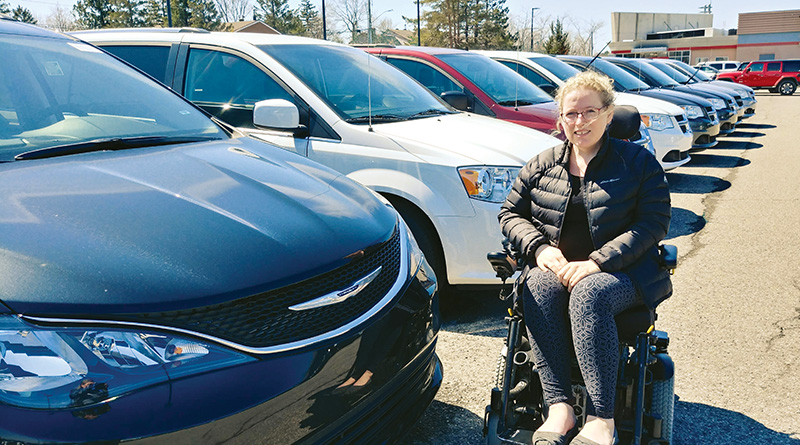
Keindel currently uses a power wheelchair to get around and has an adapted van with power ramps and a space for her to lock into the passenger seat. When she first started using a wheelchair, she let her driver’s licence lapse, but recently she has been on a long journey to get it back.
After some appointments with the SAAQ in Gatineau and assessments by occupational therapists in Montreal, Keindel was given a green light, as well as an opportunity.
“They determined I was quite capable of driving with the equipment that they had available,” she said. “However, [they] also told me at the time that I would be a perfect candidate for what are called high tech controls.”
Unfortunately, the controls, which are specialized systems for people with disabilities, weren’t available in Quebec as the SAAQ had placed a moratorium on the technology. One of the occupational therapists that Keindel knew from the Constance-Lethbridge Rehabilitation Centre in Montreal, Dana Benoit, had been advocating for the moratorium to be lifted for more than a decade. That lit a fire in Keindel’s belly.
“I said, ‘That’s not very fair,’” she explained. “If Ontario, BC, Europe and Americans can have these controls, then I think we should too.”
Keindel approached then-Transport Minister André Fortin about the issue and within weeks, the SAAQ was contacting her to test the technology with other candidates in Montreal.
She said that the presidents of several companies that manufacture the controls flew in for the event, and even sat in the back seat while she tested them out.
“It worked to my advantage that I drove from [age]16 to 30,” she said. “I got to drive the two vans and did three different road tests.”
SAAQ engineers eventually approved one system manufactured in Switzerland named Joysteer, and Keindel will be the second person in Quebec to take it on the road.
“It’s not going to work for everybody but it’s certainly a good advancement in our options for driving,” she said.
Keindel is still awaiting final word from the province, but was excited to get back in the driver’s seat.
“Hopefully in the next couple of weeks I’ll be vehicle shopping,” she said, noting that she’s limited to a handful of vehicle models that will accommodate the technology. “Then it gets sent away for six to eight weeks [to be retrofitted].”
“I’ll have to go to Montreal to have it fine-tuned, but hopefully I’ll be driving by summertime, which will be nice,” she added.
Keindel said that Benoit was flabbergasted with the progress Keindel made on the file in such a short time and commended her for all the hard work in researching and advocating for the controls.
Looking ahead, Keindel said that she will continue to be a voice for the MD community in Quebec and Canada, and said that she hopes to eventually start a campaign in her home, the Pontiac.
by Caleb Nickerson