


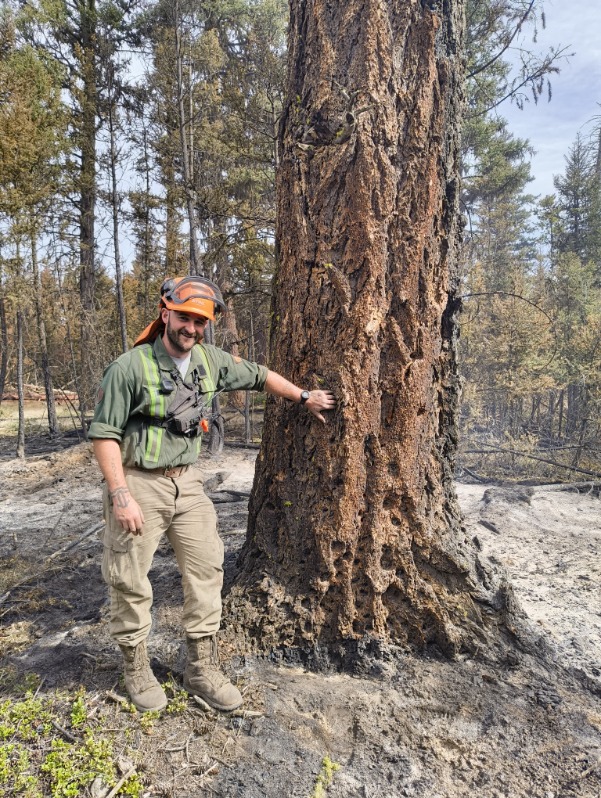



A Pontiac native is among the teams of firefighters fighting the raging wildfires in British Columbia this summer.
When THE EQUITY caught up with Jeremiah Bastien in late July, he was working near 100 Mile House, where there were several fires active.
“Oh man, you wouldn’t believe the smoke I’m in,” he said.
Originally from Shawville, Bastien moved to Arnprior in grade 6 and upon graduation found work out west in tree planting, which he did for around five years.
He explained that the tree planting company he worked for also tapped its personnel for firefighting, which is how he got his start in the industry.
“You tree planted until it got to the point of demand, or when the season was over you switched over to firefighting,” he said. “I did that with them [for several years] . . . then took a break from it for a few years.”
On the recommendation of a friend, he joined his current employer, Carmanah Wildfire, and is in his second year with them. He said that the company sets a high bar when it comes to safety and professionalism, pointing to the fact that they have a five-day boot camp before every season.
“Carmanah has the intention of doing things better, we train our people to higher standards,” he said.
Bastien said a full shift is typically 14 days straight of 12-hour days. “It is probably one of the hardest things I’ve done.”
He added that within the crews, there is a wide variety of roles, from operating chainsaws to directing aircraft, to coordinating logistics.
Bastien works as a crew lead and a power saw operator. He said that in addition to learning technical skills, they’re also given leadership training.
“In order to run a crew because it’s a high-stress environment, you have some level of leadership course, just the logistics of working with people, the emotional side of it, how to avoid burnout, how to recognize burnout, and just ways to work with people for a high-stress environment for a long time,” he said.
This year, the fire season started May 1, which Bastien called “terrifyingly early.” At the time he spoke with THE EQUITY, conditions were ripe for fires forming.
“We’re at the point where every day there’s something called crossover, where the temperature is higher than the relative humidity,” he explained. “When that happens, fire danger is very high. With repeated days of crossover, there’s also thundercells, we’ve been having tons of cells . . . that’s what we attribute most of our starts at this point. If you have crossover and you get hit with lighting, nothing’s going to stop that fire from forming.”
Based in Duncan, B.C., on Vancouver Island, Carmanah responds province-wide, and even takes contracts in other provinces and territories.
Bastien explained that once a fire is spotted, provincial authorities will send in a team to conduct an initial assessment.
“The ministry will send an initial attack. If they can’t handle it or suppress it themselves, they’ll send back a request for resources, either more people or aircraft, depending on the situation,” he said. “If the request for resources is a service request to our company, we’ll jump on it and drive right there.”
Bastien said the work he does typically involves cutting a strip called a fireguard through the forest to impede the fire’s progress by removing fuel sources. It also acts as a path for fire crews to get hoses and equipment closer to where they need to be, but only once it’s been decided that it’s safe for humans to move forward and attempt to contain the fire.
“If the fire’s too hot we’ll leave it to aircraft only until it calms down. We don’t put anyone in danger unnecessarily,” he said. “If it is workable, we’ll wrap it, so we’ll try and establish the entire perimeter of the fire and wrap it in hose, so that we can access any part of the fire with water.”
He said that they often work in close coordination with aircraft while on the scene, from helicopters to larger water bombers. He added that once a fire is contained, they move in and hose everything down.
“Once we suppress it enough, to the point where it’s not actively burning, we’ll start working the land a little bit more thoroughly, not just the major hotspots but we’ll be hosing every area,” he explained. “We’ll have a scan above, with drones or helicopters looking for heat, they go at night and they scan it.”
Another aspect of the job that he’s gotten into is fire mitigation, which he did for Carmanah in the off-season, in Keno City, Yukon. He said it usually involves pruning trees, removing deadwood and moving potential fuel sources away from houses.
“There’s a whole other side to firefighting that doesn’t exist when there’s fires, which is fire mitigation, firesmarting,” he said. “Preparing land and homes to make it a little more fire resilient. We do a lot of that in the offseason.”
He recommends that anyone interested in forest firefighting try out some forestry related work to see if they are up for the challenge.
“Bushwork in general is a good way in, and it would give you an idea of the standard,” he said.
“It’s a very fulfilling job and very seldom do you meet bad people. [ . . . ] I can’t speak for other people, there’s definitely some yahoos out there, but it’s a hard-working industry with really good people if you want to get into it.”
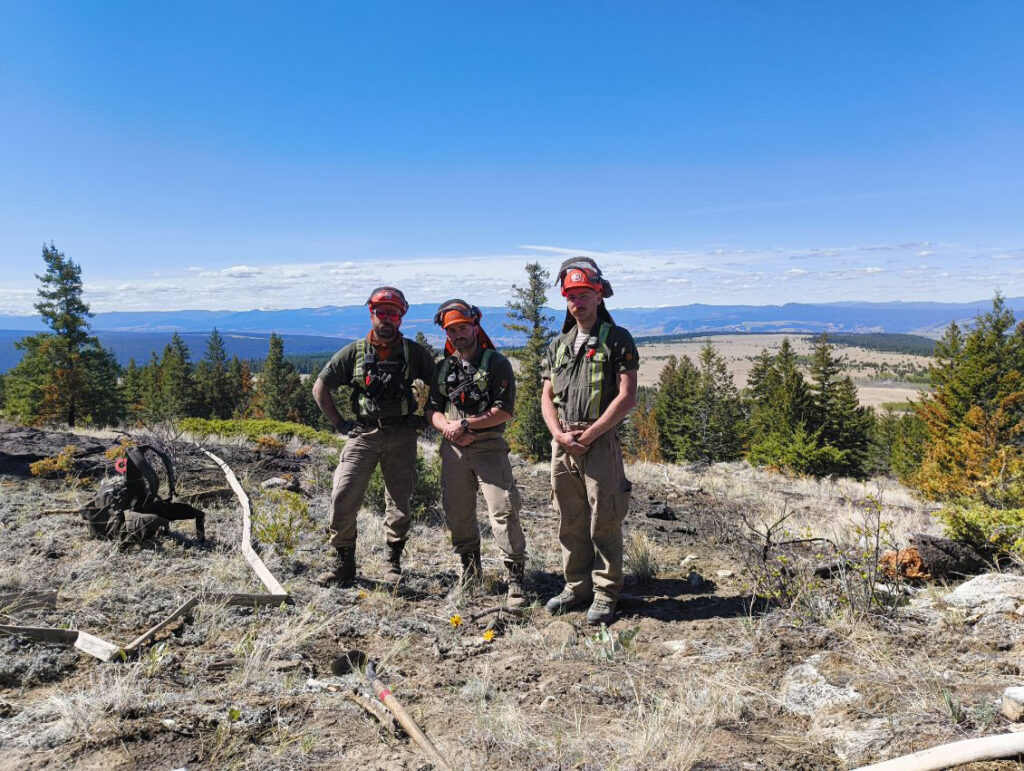
Un originaire du Pontiac fait partie des équipes de pompiers qui combattent les incendies de forêt dévastateurs en Colombie-Britannique cet été.
Lorsque THE EQUITY a rencontré Jeremiah Bastien fin juillet, il travaillait près de 100 Mile House, où plusieurs feux étaient actifs.
« Oh là là, vous ne croiriez pas la fumée dans laquelle je me trouve », a-t-il dit.
Originaire de Shawville, Bastien a déménagé à Arnprior en 6e année et, après avoir obtenu son diplôme, il a trouvé du travail dans l’Ouest dans la plantation d’arbres, ce qu’il a fait pendant environ cinq ans.
Il a expliqué que l’entreprise de plantation d’arbres pour laquelle il travaillait faisait également appel à son personnel pour la lutte contre les incendies, ce qui lui a permis de faire ses débuts dans l’industrie.
« Nous plantions des arbres jusqu’à ce que la demande soit trop forte, ou une fois la saison terminée, nous passions à la lutte contre les incendies », a-t-il dit. « J’ai fait cela avec eux [pendant plusieurs années] . . . puis j’ai fait une pause pendant quelques années. »
Sur la recommandation d’un ami, il a rejoint son employeur actuel, Carmanah Wildfire, et en est à sa deuxième année avec eux. Il a dit que l’entreprise met la barre très haut en matière de sécurité et de professionnalisme, soulignant le fait qu’ils organisent un camp d’entraînement de cinq jours avant chaque saison.
« Carmanah a l’intention de faire les choses mieux, nous formons notre personnel selon des normes plus élevées », a-t-il dit.
Bastien a dit qu’un quart de travail complet dure généralement 14 jours consécutifs de 12 heures. « C’est probablement l’une des choses les plus difficiles que j’aie faites. »
Il a ajouté qu’au sein des équipes, il existe une grande variété de rôles, allant de l’utilisation de scies à chaîne à la direction d’aéronefs, en passant par la coordination de la logistique.
Bastien travaille comme chef d’équipe et opérateur de scie mécanique. Il a dit qu’en plus d’acquérir des compétences techniques, ils reçoivent également une formation en leadership.
« Pour diriger une équipe, car c’est un environnement très stressant, on a un certain niveau de formation en leadership, juste la logistique du travail avec les gens, le côté émotionnel, comment éviter l’épuisement professionnel, comment le reconnaître, et simplement des façons de travailler avec les gens dans un environnement très stressant pendant une longue période », a-t-il dit.
Cette année, la saison des incendies a commencé le 1er mai, ce que Bastien a qualifié de « terriblement tôt ». Au moment où il s’est entretenu avec THE EQUITY, les conditions étaient propices à la formation d’incendies.
« Nous en sommes au point où chaque jour il y a ce qu’on appelle un « crossover », où la température est supérieure à l’humidité relative », a-t-il expliqué. « Lorsque cela se produit, le risque d’incendie est très élevé. Avec des jours de « crossover » répétés, il y a aussi des cellules orageuses, nous avons eu des tonnes de cellules . . . c’est à cela que nous attribuons la plupart de nos départs de feu à ce stade. Si vous avez un « crossover » et que vous êtes frappé par la foudre, rien n’arrêtera cet incendie de se former. »
Basée à Duncan, en C.-B., sur l’île de Vancouver, Carmanah intervient dans toute la province et prend même des contrats dans d’autres provinces et territoires.
Bastien a expliqué qu’une fois qu’un incendie est repéré, les autorités provinciales enverront une équipe pour effectuer une évaluation initiale.
« Le ministère enverra une première attaque. S’ils ne peuvent pas le gérer ou le supprimer eux-mêmes, ils enverront une demande de ressources, soit plus de personnel, soit des aéronefs, selon la situation », a-t-il dit. « Si la demande de ressources est une demande de service à notre entreprise, nous nous y rendrons immédiatement en voiture. »
Bastien a dit que le travail qu’il fait consiste généralement à couper une bande appelée coupe-feu à travers la forêt pour entraver la progression du feu en éliminant les sources de combustible. Cela sert également de chemin pour que les équipes de pompiers puissent acheminer les tuyaux et l’équipement plus près de là où ils doivent être, mais seulement une fois qu’il a été décidé qu’il est sécuritaire pour les humains d’avancer et de tenter de contenir le feu.
« Si le feu est trop intense, nous le laisserons aux aéronefs seulement jusqu’à ce qu’il se calme. Nous ne mettons personne en danger inutilement », a-t-il dit. « Si c’est gérable, nous l’encerclerons, nous essaierons d’établir tout le périmètre de l’incendie et de l’entourer de tuyaux d’arrosage, afin que nous puissions accéder à n’importe quelle partie du feu avec de l’eau. »
Il a dit qu’ils travaillent souvent en étroite coordination avec les aéronefs sur place, des hélicoptères aux avions-citernes plus grands. Il a ajouté qu’une fois qu’un incendie est contenu, ils interviennent et arrosent tout.
« Une fois que nous l’avons suffisamment supprimé, au point où il ne brûle plus activement, nous commencerons à travailler le terrain un peu plus en profondeur, pas seulement les points chauds majeurs, mais nous arroserons chaque zone », a-t-il expliqué. « Nous aurons un balayage aérien, avec des drones ou des hélicoptères à la recherche de chaleur, ils y vont la nuit et le balayent. »
Un autre aspect du travail dans lequel il s’est engagé est la mitigation des incendies, qu’il a fait pour Carmanah hors saison, à Keno City, au Yukon. Il a dit que cela implique généralement l’élagage d’arbres, l’enlèvement du bois mort et le déplacement des sources de combustible potentielles loin des maisons.
« Il y a tout un autre côté à la lutte contre les incendies qui n’existe pas quand il y a des feux, qui est la mitigation des incendies, la prévention incendie », a-t-il dit. « Préparer les terrains et les maisons pour les rendre un peu plus résistants au feu. Nous faisons beaucoup de cela pendant l’entre-saison. »
Il recommande à toute personne intéressée par la lutte contre les incendies de forêt d’essayer des travaux liés à la foresterie pour voir si elle est prête à relever le défi.
« Le travail en forêt en général est une bonne porte d’entrée, et cela vous donnerait une idée de la norme », a-t-il dit.
« C’est un travail très gratifiant et il est très rare de rencontrer de mauvaises personnes. [ . . . ] Je ne peux pas parler pour les autres, il y a certainement quelques têtes brûlées là-bas, mais c’est une industrie qui travaille dur avec de très bonnes personnes si vous voulez vous y lancer. »