





Caleb Nickerson
CHALK RIVER July 11, 2017
Last Tuesday, several local mayors and MRC officials participated in a guided tour of Canadian Nuclear Laboratories’ (CNL) property in Chalk River Ont. In recent months, many local citizens groups have been up in arms over a proposed Near Surface Disposal Facility (NSDF) that is being planned at the site, about a kilometer from the Ottawa River.
The NSDF would be an engineered containment mound roughly 16 hectares in size that would eventually take on one million cubic meters of low- to intermediate-level waste.
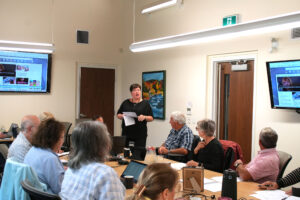
The morning was taken up with presentations from various staff about the safety precautions and environmental monitoring at the site.
CNL employee Jim Buckley, who works directly on the NSDF project, went over the details of the plan.
Ninety per cent of the waste would originate from the Chalk River site, but an additional ten percent would be shipped in from other CNL sites like Whiteshell Laboratories in Manitoba or commercial clients like hospitals and universities.
Buckley repeatedly stressed that much of the waste would come from the demolition of several older buildings at Chalk River, as well as contaminated soil and legacy waste that is currently elsewhere on site.
“We do have waste that’s been stored on this site for decades, as we’ve mentioned, as well as suitable waste from future operations,” he said.
He covered the safety features of the mound, which will feature two meters of base liner, made up of layers of stone, compacted clay and geomembranes to prevent leakage into the surrounding area. Once an area of the mound is filled, a two meter cap of liners, stone and other materials will cover the waste.
“The waste water treatment facility is another major component,” Buckley explained. “We have a facility that’s designed to treat any water that’s come in contact with waste during our operations. It will remove contaminants, both hazardous and radiological from the water.”
Many critics of the site have questioned the precautions put in place for extreme weather events like flooding or an earthquake. Buckley said that the NSDF has been engineered to withstand a seismic event up to 6.0 on the Richter scale and has enough capacity to contain 15,000 cubic meters of waste water in the event of a 100 year storm. The site also sits on a ridge with significant elevation above the river.
Martin Klukas, who works in the environmental protection surrounding the NSDF project, pointed out that CNL collects about 5,000 water, air and soil samples annually, from sites surrounding Chalk River Labs and on both sides of the river downstream.
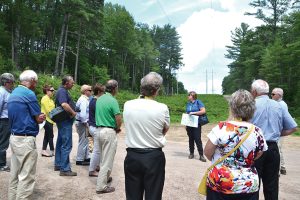
Following the presentation, the group took a tour of the proposed NSDF site, which is currently just a heavily wooded ridge. Annie Morin, who works in environmental protection at CNL, went over the precautions they had undertaken to protect species of bats, birds and turtles that call the area home.
Comments on the project can be sent to the Canadian Nuclear Safety Commission via their website or by snail mail until Aug. 16. CNL is aiming to begin construction on the project next year and to have the site operational by 2020.