


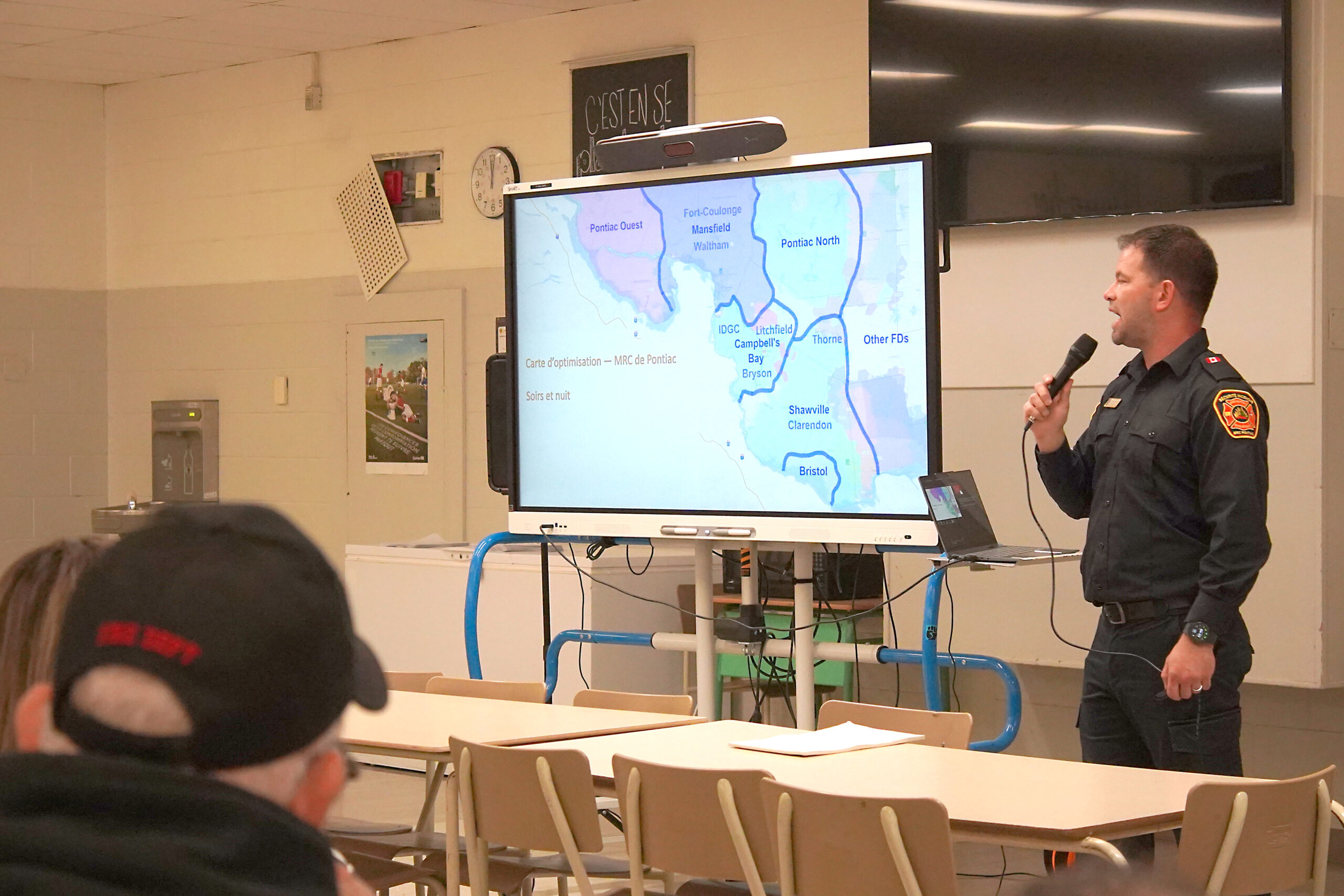



On Wednesday and Thursday evening, MRC public security coordinator Julien Gagnon delivered public presentations in Mansfield and L’Isle-aux-Allumettes on the integration of fire services in Pontiac.
Over the past few months Gagnon has been delivering similar presentations to councils across the Pontiac with information from his research. Wednesday night was the public’s first opportunity to hear the presentation and there will be a third meeting at 6:30 p.m. on Oct. 23 at the Campbell’s Bay RA Hall.
“We’d like to offer some information that has been circulating, trying to [dispel] some of the rumours,” he said at the meeting in L’Isle-aux-Allumettes.
“Obviously a lot of things have circulated, especially at this end of the MRC with fire services. I just want to make sure everybody understands where we are coming from and what we can do as a group collectively to find a solution.”
“The purpose of the meeting is to explain why some form of regionalization is being explored, what would and would not change and how residents can give their input,” he continued. “The goal: faster reliable services across municipal boundaries while keeping services close to home.”
Costs, administrative burden increasing substantially
According to Gagnon’s data, over 23 years from 2002 to 2025, the total budget for fire protection in the MRC increased from $453,546 to $2,651,755.82 (485 per cent). Meanwhile, municipal budgets increased only 199 per cent in that time ($14 million to $41.8 million).
The average age of the firetrucks across the MRC is currently 21.3 years which is up from 18.1 in 2017.
“[There’s] as many as 10 vehicles that may not need to be replaced,” Gagnon said. “If they’re aging more and more, municipalities need to think about replacing them.”
He also said that cohesion in long-term planning could be better if decision-making wasn’t splintered among nine different departments. This applies especially to long-term investments like fire halls and trucks.
“[Municipalities] don’t look at it from a top-down perspective at a regional level, because they only manage their own fire service,” he said. “But if I tell you that the municipality of Fort-Coulonge paid near a million dollars for that firetruck [with financing taken into account], well there are six other firetrucks within a few kilometers. The question should be asked, was that responsible, was it fiscally responsible, was it adequate, was it necessary. Those questions should be asked, I’m not here to answer them.”
Of the region’s roughly 233 firefighters, less than a quarter (50) are available during the daytime on weekdays. Gagnon said that while the overall firefighter numbers are great, the lower daytime availability has necessitated the current patchwork of inter-municipal aid agreements.
“There are nine fire departments in MRC Pontiac and seven of the nine require mutual aid,” he said. “They do not have enough firefighters during the day, during the week because of their staffing, everyone works out of town. We need help. Why aren’t we using help with firetrucks as well? Three of those nine departments actually require that mutual aid 24 hours a day, seven days a week.”
Gagnon added that there’s an increasing administrative burden as well.
“It’s important to consider the role of a fire chief in Quebec is almost becoming an exclusively administrative one,” he said. “In 2025, multi-station responses are the new normal. They’re no longer an option, we’re required to do so. How do we share those costs, that’s the question.”
Following the updating of the Quebec fire code in May 2025, there were changes to how services respond to calls. Gagnon explained that departments are now required by law to call neighbouring municipalities for assistance if they can’t respond with the minimum number of firefighters for a structure fire.
“The MRC is responsible to ensure that the municipalities follow the optimization process, which is essentially ensuring that the quickest firetruck arrives to the scene of a fire no matter where it’s situated, no matter where the municipal boundaries are,” he said.
“Each municipality, based on the history of calls, must give the MRC the number of firefighters it has available [. . .] and the time that it takes those firefighters [to mobilize],” he added later in the talk. “The MRC’s role in that is to ensure that those numbers get met every time there’s a fire call, for the benefit of the residents [ . . . ] Ultimately at the end of the day, if you do not meet those numbers that are self-imposed, the municipality exposes itself to liability.”
Costs also vary wildly between municipalities, depending on numerous factors such as if they contract their service out or have a larger tax base to pay for expenses. For example, Rapides-des-Joachims and Alleyn-et-Cawood residents contract out their fire services and pay 3 cents per $100 of evaluation on these services. Bryson residents pay 22 cents per $100, Fort-Coulonge residents pay 17 cents.
“There’s a big disparity. Obviously we would like to see that more standardized,” he said.
Possible configurations
Gagnon gave several options as far as strategies for integrating services. The first would be to have one central service run by the MRC, with chiefs responsible for various jurisdictions or other duties. The second would be for several municipalities to form a “régie”, or fire services board to govern their operations. The third option would be to expand existing inter-municipal agreements, which would entail the most administrative burden and complexity going down the road.
“What I’ve seen in Quebec, when you have two or three municipalities together, an inter-municipal agreement’s fine. When you get to four, five and six, a régie is a little more realistic, or a little more achievable. When you get to 15, 16, you look at the MRC option.”
He emphasized that the goal was not to erase the individual fire halls but to standardize procedures and ensure efficiency.
“Integration should be seen as strengthening the fire service and not erasing it,” he said.
Currently there are eight fire chiefs across nine departments in the MRC – four full-time and four part-time. Gagnon said that the timing was “kind of right” for a change in how services are structured, as several of those chiefs are approaching retirement age.
Next steps
Councils were asked to nominate candidates for a regional fire service committee, which is expected to study the issue once the new slate of officials are elected. An online survey is available for residents to provide input. Any questions can be emailed to Gagnon at j.gagnon@mrcpontiac.qc.ca.
With files from KC Jordan.
Le mercredi et le jeudi soir, le coordonnateur de la sécurité publique de la MRC, Julien Gagnon, a présenté des exposés publics à Mansfield et à L’Isle-aux-Allumettes sur l’intégration des services d’incendie dans le Pontiac.
Au cours des derniers mois, M. Gagnon a présenté des exposés similaires aux conseils municipaux de l’ensemble du Pontiac, avec les informations issues de ses recherches. Le mercredi soir était la première occasion pour le public d’entendre la présentation et il y aura une troisième réunion à 18 h 30 le 23 octobre à la salle de l’AR de Campbell’s Bay.
« Nous aimerions offrir des informations qui ont circulé, en essayant de [dissiper] certaines des rumeurs », a-t-il déclaré lors de la réunion à L’Isle-aux-Allumettes.
« Évidemment, beaucoup de choses ont circulé, surtout à cette extrémité de la MRC concernant les services d’incendie. Je veux juste m’assurer que tout le monde comprend d’où nous venons et ce que nous pouvons faire en tant que groupe, collectivement, pour trouver une solution. »
« Le but de la réunion est d’expliquer pourquoi une forme de régionalisation est explorée, ce qui changerait et ne changerait pas, et comment les résidents peuvent donner leur avis », a-t-il poursuivi. « L’objectif : des services plus rapides et fiables au-delà des frontières municipales, tout en gardant les services près de chez soi. »
Les coûts et le fardeau administratif augmentent considérablement
Selon les données de M. Gagnon, sur 23 ans, de 2002 à 2025, le budget total de la protection incendie dans la MRC est passé de 453 546 $ à 2 651 755,82 $ (485 pour cent). Pendant ce temps, les budgets municipaux n’ont augmenté que de 199 pour cent durant cette période (de 14 millions de dollars à 41,8 millions de dollars).
L’âge moyen des camions de pompiers dans l’ensemble de la MRC est actuellement de 21,3 ans, contre 18,1 ans en 2017.
« Il y a jusqu’à 10 véhicules qui n’auront peut-être pas besoin d’être remplacés », a déclaré M. Gagnon. « S’ils vieillissent de plus en plus, les municipalités doivent songer à les remplacer. »
Il a également déclaré que la cohésion dans la planification à long terme pourrait être meilleure si la prise de décision n’était pas fragmentée entre neuf services différents. Cela s’applique particulièrement aux investissements à long terme comme les casernes de pompiers et les camions.
« [Les municipalités] ne l’examinent pas d’une perspective descendante au niveau régional, car elles ne gèrent que leur propre service d’incendie », a-t-il dit. « Mais si je vous dis que la municipalité de Fort-Coulonge a payé près d’un million de dollars pour ce camion de pompiers [en tenant compte du financement], eh bien il y a six autres camions de pompiers à quelques kilomètres. La question devrait être posée : était-ce responsable, était-ce financièrement responsable, était-ce adéquat, était-ce nécessaire. Ces questions devraient être posées, je ne suis pas là pour y répondre. »
Sur les quelque 233 pompiers de la région, moins d’un quart (50) sont disponibles en journée en semaine. M. Gagnon a déclaré que si le nombre total de pompiers est excellent, la faible disponibilité pendant la journée a rendu nécessaire l’actuel ensemble hétérogène d’accords d’aide intermunicipale.
« Il y a neuf services d’incendie dans la MRC de Pontiac et sept des neuf nécessitent de l’aide mutuelle », a-t-il déclaré. « Ils n’ont pas assez de pompiers pendant la journée, pendant la semaine, en raison de leur effectif, tout le monde travaille à l’extérieur de la ville. Nous avons besoin d’aide. Pourquoi n’utilisons-nous pas l’aide des camions de pompiers également ? Trois de ces neuf services ont en fait besoin de cette aide mutuelle 24 heures par jour, sept jours par semaine. »
M. Gagnon a ajouté qu’il y a également un fardeau administratif croissant.
« Il est important de considérer que le rôle d’un chef de pompiers au Québec est en train de devenir presque exclusivement administratif », a-t-il dit. « En 2025, les interventions multi-stations sont la nouvelle norme. Elles ne sont plus une option, nous sommes tenus de le faire. Comment partageons-nous ces coûts, c’est la question. »
Suite à la mise à jour du code de sécurité incendie du Québec en mai 2025, des changements ont été apportés à la manière dont les services répondent aux appels. M. Gagnon a expliqué que les services sont désormais tenus par la loi d’appeler les municipalités voisines pour obtenir de l’aide s’ils ne peuvent pas intervenir avec le nombre minimum de pompiers requis pour un incendie de structure.
« La MRC est responsable de s’assurer que les municipalités suivent le processus d’optimisation, ce qui consiste essentiellement à s’assurer que le camion de pompiers le plus rapide arrive sur les lieux d’un incendie, peu importe où il est situé, peu importe où se trouvent les limites municipales », a-t-il dit.
« Chaque municipalité, en fonction de l’historique des appels, doit donner à la MRC le nombre de pompiers dont elle dispose [. . .] et le temps qu’il faut à ces pompiers [pour se mobiliser] », a-t-il ajouté plus tard dans la discussion. « Le rôle de la MRC est de s’assurer que ces chiffres sont respectés chaque fois qu’il y a un appel incendie, au bénéfice des résidents [ . . . ] En fin de compte, si vous ne respectez pas ces chiffres auto-imposés, la municipalité s’expose à des responsabilités. »
Les coûts varient également énormément entre les municipalités, selon de nombreux facteurs, tels que le fait qu’elles sous-traitent leur service ou qu’elles disposent d’une base fiscale plus importante pour couvrir les dépenses. Par exemple, les résidents de Rapides-des-Joachims et d’Alleyn-et-Cawood sous-traitent leurs services d’incendie et paient 3 cents du 100 $ d’évaluation pour ces services. Les résidents de Bryson paient 22 cents du 100 $, ceux de Fort-Coulonge paient 17 cents.
« Il y a une grande disparité. Évidemment, nous aimerions voir cela plus standardisé », a-t-il dit.
Configurations possibles
M. Gagnon a présenté plusieurs options en ce qui concerne les stratégies d’intégration des services. La première consisterait à avoir un service central géré par la MRC, avec des chefs responsables de diverses juridictions ou d’autres fonctions. La seconde serait pour plusieurs municipalités de former une « régie », ou un conseil des services d’incendie pour gouverner leurs opérations. La troisième option serait d’élargir les accords intermunicipaux existants, ce qui entraînerait le plus grand fardeau administratif et la plus grande complexité à l’avenir.
« Ce que j’ai vu au Québec, c’est que lorsque vous avez deux ou trois municipalités ensemble, une entente intermunicipale, c’est bien. Lorsque vous arrivez à quatre, cinq et six, une régie est un peu plus réaliste, ou un peu plus réalisable. Lorsque vous arrivez à 15, 16, vous examinez l’option de la MRC. »
Il a souligné que l’objectif n’était pas d’effacer les casernes de pompiers individuelles, mais de standardiser les procédures et d’assurer l’efficacité.
« L’intégration devrait être perçue comme un renforcement du service d’incendie et non comme son effacement », a-t-il dit.
Actuellement, il y a huit chefs de pompiers pour neuf services dans la MRC – quatre à temps plein et quatre à temps partiel. M. Gagnon a déclaré que le moment était « propice » à un changement dans la structure des services, car plusieurs de ces chefs approchent de l’âge de la retraite.
Prochaines étapes
Il a été demandé aux conseils de nommer des candidats pour un comité régional des services d’incendie, qui devrait étudier la question une fois que la nouvelle liste d’élus sera en place. Un sondage en ligne est disponible pour que les résidents puissent donner leur avis. Toute question peut être envoyée par courriel à M. Gagnon à l’adresse j.gagnon@mrcpontiac.qc.ca.
Avec les dossiers de KC Jordan.