






CALEB NICKERSON
SHAWVILLE April 3, 2018
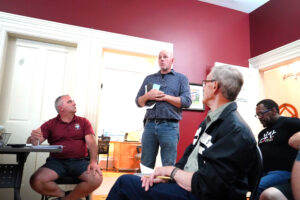
On April 3, a briefing was held at Shawville Town Hall with three of the owners of the abattoir slated for construction in Shawville.
Mayor Sandra Murray started the meeting off by explaining that there would be a public information session scheduled at some point in April. The exact time was later confirmed for April 30 at 7 p.m. at the Shawville R.A. Hall.
There were officials representing several different organizations in attendance, in addition to Shawville council members and local media.
The three owners present were Alain Lauzon, Gilles Langlois, and Sofiane El ketroussi. They explained that there is also a fourth owner, Ibrahima Diagne, who was unable to be present.
The public information drive comes after a handful of concerned citizens came to the March 27 council meeting, demanding further details on the project.
Lauzon said they had been looking at the land on the outskirts of Shawville for about a year and a half.
“I think Shawville is a centre for the area,” added Langlois. “Everybody is 15 minutes from Shawville.”
They both went on to explain that much of the funding for the project came from working with the economic SWAT team, and would come in the form of a loan.
“Out of the $3.5 million, there’s $36,000 coming from a grant,” Langois explained. “The rest is a conventional loan guaranteed by the owners.”
Lauzon went on to clarify a misconception that people might have about the group’s plans to sell Halal-certified products.
“The Halal market is only a niche, it’s not a Halal slaughterhouse,” he said, adding that El ketroussi was their expert on the practice.
El ketroussi said that the percentage of Halal and regularly slaughtered animals would depend on the market.
“We, as owners, have thought to put in place a slaughterhouse for the community first and there is a niche for the Muslim people that want Halal,” he said, adding that he was also looking at the option of bringing in a Rabbi to conduct Kosher slaughter as well.
“The Halal way, the Kosher way, and the Canadian way, by the law, are pretty much the same from the beginning to the end,” he said, explaining the main ways they differ.
The person slaughtering the animal must be a Muslim, man or woman. With Kosher, it must be a Rabbi.
“The cut for Canadian and Halal law are the same, the only difference is that the Halal slaughter man must say, ‘By the name of the Lord’ before the cut,” he said. “[The] Halal certification that we have put in place is worldwide recognized.”
Lauzon stressed that there were no religious requirements for any of the other workers on the production line, and that he would aim to hire as many local people as possible. He said they had a meeting scheduled with the local Centre d’emploi in order to put out a call for ten butchers, with the aim to add more once up and running.
“It might not be ten guys [working full-time] right away, but we’re going to train ten. We’ve got to start at the bottom,” he said. “I think we’re going to start with around six but the other guys will be on call right away. They’ll have their training and everything.”
“The big thing is not only about the jobs inside the slaughterhouse, it’s about what it’s going to create outside with all the farmers and security of the price, the selling, all that,” he added.
When asked about citizens concerns regarding smell and noise, El ketroussi stressed that everything would take place indoors and be in compliance with federal and provincial regulations.
Shawville’s waste water treatment facility, he explained, has the capacity to handle a facility twice to three times as large.
“If you want an amount, technically we will give them [up to] 18 [cubic] metres per 24 hours,” he said.
In addition, there will be a veterinarian and inspector on site, with full access to the operation, during slaughtering days.
“It’s called continuous inspection,” El katroussi said. “They have their own office [in the building] and there is no killing without a vet or inspector present.”
He added that they already had letters of intention from several farmers for 500 head of beef and 500 lambs per year.
All three were looking forward to the project getting underway.
“Hopefully, we’re trying to start the project, beginning of May … technically it’s the due date for digging,” Langlois said. “Everything is in place, all the certifications, everything has been approved in every way: money-wise, environment, everything.”
Lauzon was adamant that this project would be a great benefit to the local farming community.
“All our beef is going to Cobden or Greely, the lamb is the same too, mostly anyways,” he said. “The beef is going to stay here, the money is going to stay here.”