



Nineteen-sixty-five was an eventful year.
Lester Pearson was elected Prime Minister of Canada, defeating John Diefenbaker. Muhammad Ali knocked out Sonny Liston, producing an iconic photo. The Catholic Church began allowing Mass in languages other than Latin.
That same year, a young physician fresh out of the University of Ottawa by the name of Earle Potvin arrived in Shawville to begin his career. The rest is history.
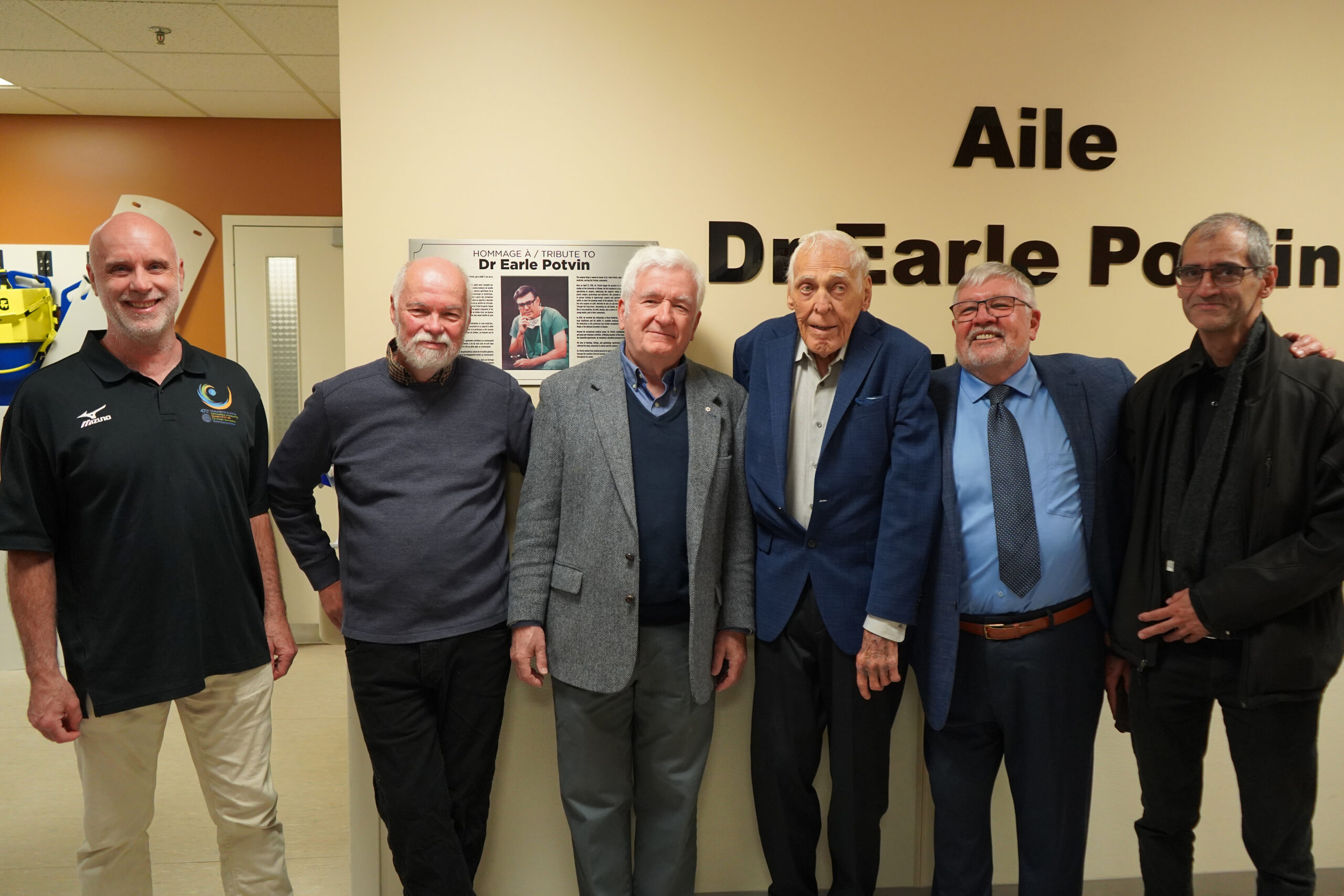
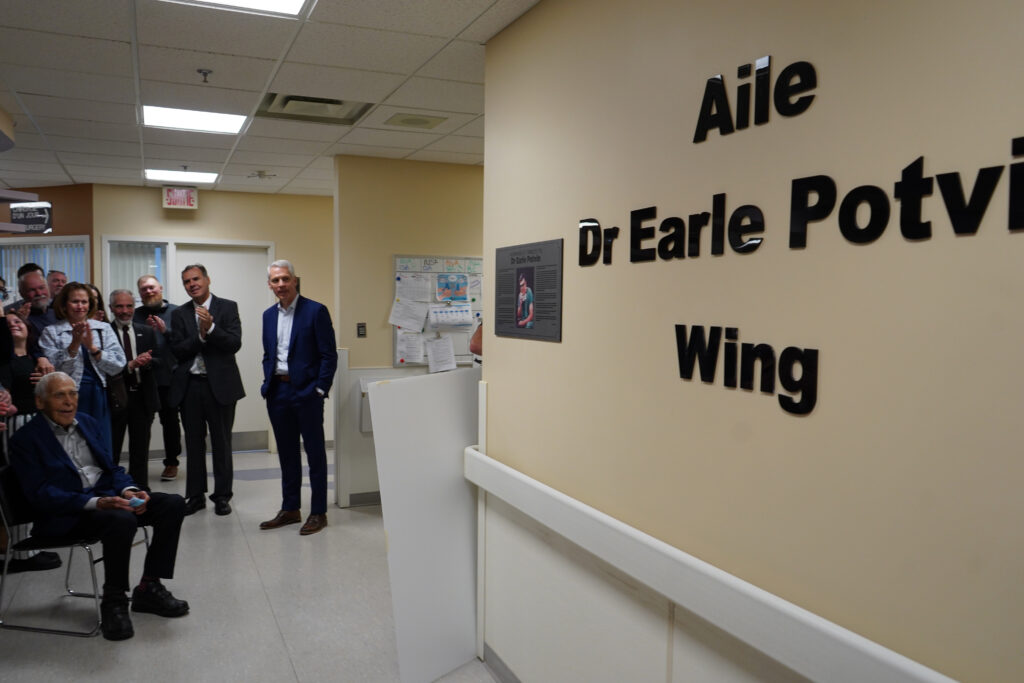
On Sunday afternoon, the surgical wing at the Pontiac Hospital was named in Dr. Potvin’s honour after 57 years of service to the community. A reception followed at the Little Red Wagon winery, where dozens of friends and family gathered to tell stories, and reminisce about the mark he left on local health care.
Prior to the wall unveiling, Dr. Potvin spoke to his assembled family and colleagues and said his arrival in the area as a young physician was a happy accident.
“Coming to the Pontiac was a stroke of good luck,” he recalled. “I didn’t know what was happening. We had no money, Bonnie and I. She was a nurse, and a nurse isn’t paid enough, yet.”
“Never did I ever think that what I was doing was that important,” he concluded.
The news of Dr. Potvin’s arrival made the front page of THE EQUITY in September 1965.
“Dr. Potvin has found the Pontiac Community Hospital staff very helpful, excellent in fact, and has told THE EQUITY they are ‘a good crew to work with,’” it reads.
Dr. Thomas O’Neill, a local anesthesiologist and a colleague of Dr. Potvin’s for more than 40 years, told a story about one particularly memorable home visit when Potvin first arrived. Local Ford dealer Ray Sheppard had lent him a shiny black car to test drive on the way to see a patient in Bristol. Returning with a urine sample on the dash, the young doctor unfortunately put the car in the ditch and required the help of a local farmer to get back on the road.
“He attached a chain to the back of the vehicle and pulled it out, unfortunately removing the exhaust at the same time,” O’Neill said. “Driving back [ . . . ] this black car is now a grey colour, it smells of urine, and it sounds like a second world war Panzer tank. So he drives into see Ray Sheppard expecting hell. He says “Not a problem doc, we’ll have it all fixed up before you know it.’ To this day I’ve never seen Earle in anything but a Ford vehicle.”
Potvin settled into the Pontiac region as a general practitioner with his young family but quickly assessed that the community needed a surgeon, and left in 1972 for four years to train in Ottawa.
Dr. William Potvin, Earle’s eldest son, spoke on behalf of the family and said that his father’s decision to travel to the city to upgrade his skillset wasn’t an easy one with four young boys and a wife at home.
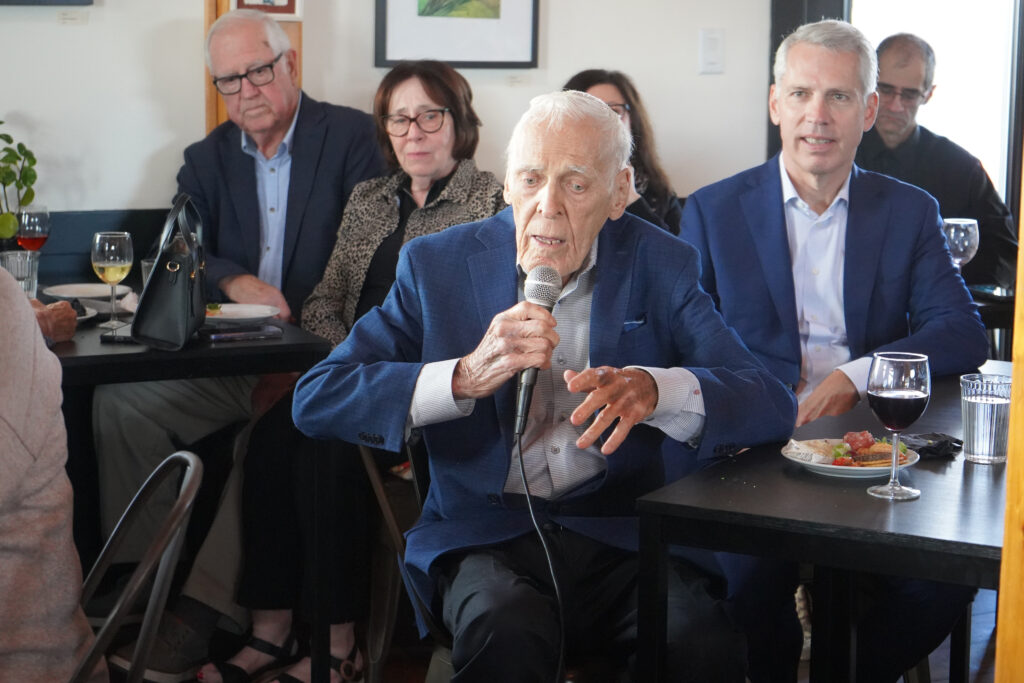
“It can’t be understated, it wasn’t easy, leaving behind his young family and his patients, but he did it because he saw what the community needed,” the junior Dr. Potvin said. “And true to his nature, he came back, bringing with him knowledge and skill that would go on to save countless lives here. Shawville, and by extension the whole Pontiac, has always been more than a place where he lived, more than a place where he worked. It’s where he belonged.”
Dr. O’Neill said that Potvin kept expanding his training based on what was needed, from obstetrics and gynecological procedures to orthopedics and plastic surgery. He pointed out that Potvin’s complication rate for major surgeries was well below the average, a testament to his excellent abilities.
Dr. William Potvin said his dad’s love for his craft was evidenced by his vast skillset, which made him both a lynchpin for the hospital, and also incredibly difficult to replace.
“He jokes, because I’m a family doctor, that he found being a GP too stressful,” he told THE EQUITY. “He did general surgery, c-sections, plastics, trauma, I mean it’s hard for the layperson to understand, but when he retired they don’t train physicians like him anymore. It’s not a skillset that exists anymore. To try and recreate that took five different surgeons.”
Prior to the wall unveiling, the CEO of regional health authority CISSSO, Dr. Marc Bilodeau, thanked Dr. Potvin for his service, calling him a “surgeon of great skill and humanity.”
“As the President CEO of the CISSS de l’Outaouais, I consider it my responsibility and obligation to take every opportunity to express my appreciation for the excellent work carried out by our health care professionals,” he said.
Shawville mayor Bill McCleary and MRC Pontiac warden Jane Toller were on hand for the presentation, and Nicole Boucher-Larivière, the CISSSO’s Pontiac manager, said they approached her after a citizen requested something be done to honour Dr. Potvin’s career. Having known Dr. Potvin since she was 17 years-old, growing up friends with the Potvin boys, she handled preparations along with Dr. O’Neill.
Natalie Romain, the administrative clinical coordinator at the Pontiac Hospital and a colleague of Potvin’s for nearly 35 years, recalled being in awe of him when she was starting her nursing career. As she rose through the ranks to be an assistant head nurse, taking notes when Potvin did his rounds, she grew to know the man behind the legend.
“I remember being in awe of his knowledge, his calm presence, and most of all the deep respect he showed for every patient,” she said. “I also remember being so intimidated by him. After all, I was only a young nurse still wet behind the ears.”
Romain said Potvin often got away with behaviour that others could only dream of, which caused some anxiety when she moved into management and was in charge of enforcing rules. She recalled her husband, also a hospital employee, running into Potvin at work, in an anecdote that exemplified his silly side.
“He said, ‘Oh, I saw Dr. Potvin today. I was in the elevator with him,’ to which I replied, ‘Please, please, please do not tell me he was smoking in the elevator. I don’t want to know.’”
Potvin interjected with a quick (and unconvincing) “Wasn’t me,” to much laughter.
“To which my husband replied, ‘No, no, Dr. Potvin just said, ‘Hey you’re Natalie’s husband right?’ ‘Yes I am.’ ‘Well I’m the big cheese around here,’ that’s what he replied to my husband. No truer words have ever been spoken.”
Romain said that the dedication of the surgical unit was a long time coming.
“I’m originally from the Pontiac, and for me to see this, having worked alongside this great man and knowing some of the stories, just to see him finally recognized, it warms my heart,” she said. “I’ve always been proud to be working at the Shawville Hospital, it makes me even prouder to see this.”
There were also many fond memories retold of Potvin’s beloved wife Bonnie (née Fetterly) who passed away in 2017. Many co-workers recalled the parties that the couple would throw at their home for the operating room staff.
“There was never a Dr. Potvin without Bonnie,” said Trenna Derouin, a nurse who worked for 37 years at the Pontiac Hospital, 27 of those in the OR with Dr. Potvin. “Bonnie made us feel welcome as well and opened her home to us and we adored her very much.”
Romain recalled one time early in her career when ‘Dr. P’ asked her if she was married yet, and she jokingly replied that she was waiting to marry a doctor.
“He said, ‘Don’t do it. It takes a special woman to marry a doctor, you just ask my wife.’ And I think he was right.”
Derouin added that in addition to being a dear colleague for years, the nature of Dr. Potvin’s work was far more intimate than other professions, even within the medical field.
“I’m thankful for him being a general practitioner, as he delivered my husband,” she said. “I’m thankful for him being a general surgeon as he delivered my son by cesarean-section on the 28th of December, which I believe is his anniversary or very close to it. So when he got the call on a stormy night in December, he never said anything to me that night but later on he kept reminding me, ‘Do you realize that I got called in for your c-section on my anniversary?’”
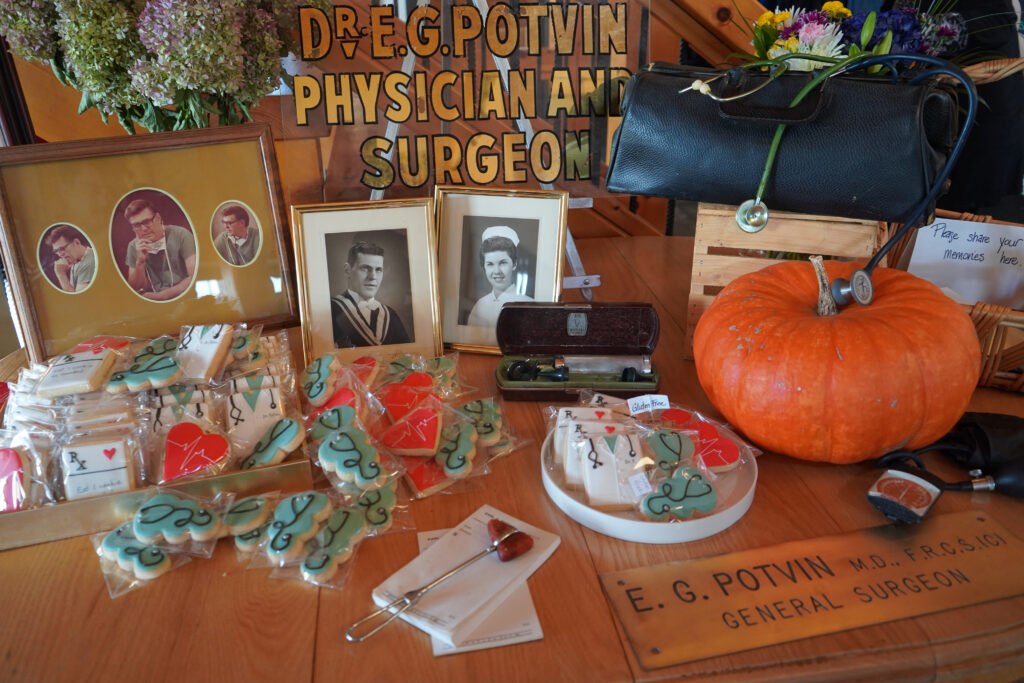
The afternoon’s reception continued on with many stories and laughs, including highlighting Potvin’s passions for growing giant pumpkins, fireworks of questionable legality, and serving with the local Lions Club. His deepest passion however, was clearly for his family, who were well represented in the crowd.
Earle’s grandson David spoke about the kind of person his “g-pa” was, noting that despite such a heavy workload, he was a family man at his core.
“I’m sure that there were a lot of sacrifices that g-pa had to make, and g-ma had to make, as anybody who does anything really exceptional with their career has to, but as his grandchildren we didn’t feel any of that,” he said. “We grew up in an extremely warm house with our g-ma and g-pa, and g-pa was very active in our lives at Christmases, Thanksgivings, Easters [ . . . ] We never felt you were missing.”
Potvin’s son Derek recalled how they all adapted to the chaotic schedule of a rural surgeon, who for much of his career was on call 24/7. One Christmas Derek was out shoveling snow and asked his father about his work day when he returned. The answer was, “Derek I feel alive.”
“On Christmas, father did his rounds every year, no matter what time we got up on Christmas, we couldn’t open any gifts until he had gone to the hospital and done his rounds,” he said. “Often enough with the things that he was doing, because he was the only surgeon, Christmas morning turned into Christmas lunch, turned into Christmas evening or sometimes even later. It was not something we regretted or held as a negative. It’s just that was our life as the son of a rural surgeon.”
With hundreds of years of Pontiac health care experience gathered in one room, attendees were invited to reflect on the impact Dr. Potvin’s legacy will have on the next generation of Pontiac doctors and health care professionals.
“It’s fitting that his name will live on in the surgical wing where his hands and heart made such a difference over the many years,” said son Dr. William Potvin. “Dad never sought recognition. He was always more comfortable in the operating room than in the spotlight. But today we get to put his name on the walls as a reminder of what true service looks like. The surgical wing will carry not only his name, but the legacy of his skill, kindness and unwavering commitment to the people of the Pontiac. I hope that generations to come, young doctors, nurses and patients will see that name and be inspired by what it represents. A life spent in service to others.”
L’année 1965 a été riche en événements.
Lester Pearson a été élu premier ministre du Canada, battant John Diefenbaker. Muhammad Ali a mis Sonny Liston K.-O., produisant une photo emblématique. L’Église catholique a commencé à autoriser la messe dans des langues autres que le latin.
La même année, un jeune médecin tout juste diplômé de l’Université d’Ottawa, du nom d’Earle Potvin, est arrivé à Shawville pour commencer sa carrière. Le reste appartient à l’histoire.
Le dimanche après-midi, l’aile de chirurgie de l’Hôpital du Pontiac a été nommée en l’honneur du Dr Potvin, après 57 ans de service à la communauté. Une réception a suivi au vignoble Little Red Wagon, où des dizaines d’amis et de membres de la famille se sont réunis pour raconter des histoires et se remémorer l’empreinte qu’il a laissée sur les soins de santé locaux.
Avant le dévoilement de la plaque, le Dr Potvin s’est adressé à sa famille et à ses collègues réunis et a déclaré que son arrivée dans la région en tant que jeune médecin était un heureux hasard.
« Venir dans le Pontiac a été un coup de chance », se souvient-il. « Je ne savais pas ce qui se passait. Nous n’avions pas d’argent, Bonnie et moi. Elle était infirmière, et une infirmière n’est pas encore assez payée. »
« Jamais je n’aurais pensé que ce que je faisais était si important », a-t-il conclu.
La nouvelle de l’arrivée du Dr Potvin a fait la une de THE EQUITY en septembre 1965.
« Le personnel de l’Hôpital communautaire du Pontiac s’est montré très serviable, excellent en fait, et a dit à THE EQUITY qu’il formait « une bonne équipe avec qui travailler » », peut-on lire.
Le Dr Thomas O’Neill, anesthésiologiste local et collègue du Dr Potvin depuis plus de 40 ans, a raconté l’histoire d’une visite à domicile particulièrement mémorable lorsque Potvin est arrivé. Ray Sheppard, concessionnaire Ford local, lui avait prêté une voiture noire brillante pour un essai routier en route pour voir un patient à Bristol. Revenant avec un échantillon d’urine sur le tableau de bord, le jeune médecin a malheureusement mis la voiture dans le fossé et a eu besoin de l’aide d’un agriculteur local pour reprendre la route.
« Il a attaché une chaîne à l’arrière du véhicule et l’a tiré, retirant malheureusement l’échappement en même temps », a dit O’Neill. « En revenant [ . . . ] cette voiture noire est maintenant de couleur grise, elle sent l’urine et elle fait le bruit d’un char d’assaut Panzer de la Seconde Guerre mondiale. Il se rend donc chez Ray Sheppard en s’attendant au pire. Il dit : « Pas de problème doc, tout sera réparé avant que vous ne vous en rendiez compte. » À ce jour, je n’ai jamais vu Earle dans autre chose qu’un véhicule Ford. »
Potvin s’est installé dans la région du Pontiac en tant que médecin généraliste avec sa jeune famille, mais a rapidement évalué que la communauté avait besoin d’un chirurgien, et est parti en 1972 pendant quatre ans pour se former à Ottawa.
Le Dr William Potvin, le fils aîné d’Earle, a parlé au nom de la famille et a déclaré que la décision de son père de se rendre en ville pour améliorer ses compétences n’avait pas été facile avec quatre jeunes garçons et une femme à la maison.
« On ne saurait trop insister sur le fait que ce n’était pas facile, de laisser derrière lui sa jeune famille et ses patients, mais il l’a fait parce qu’il a vu ce dont la communauté avait besoin », a déclaré le jeune Dr Potvin. « Et fidèle à sa nature, il est revenu, apportant avec lui des connaissances et des compétences qui allaient sauver d’innombrables vies ici. Shawville, et par extension tout le Pontiac, a toujours été plus qu’un endroit où il a vécu, plus qu’un endroit où il a travaillé. C’est là qu’il appartenait. »
Le Dr O’Neill a déclaré que Potvin avait continué à développer sa formation en fonction des besoins, allant des procédures obstétricales et gynécologiques à l’orthopédie et à la chirurgie plastique. Il a souligné que le taux de complications de Potvin pour les chirurgies majeures était bien inférieur à la moyenne, ce qui témoigne de ses excellentes capacités.
Le Dr William Potvin a déclaré que l’amour de son père pour son métier était attesté par ses vastes compétences, ce qui en faisait à la fois un pilier pour l’hôpital et quelqu’un d’incroyablement difficile à remplacer.
« Il plaisante, parce que je suis un médecin de famille, en disant qu’il trouvait le métier de généraliste trop stressant », a-t-il dit à THE EQUITY. « Il faisait de la chirurgie générale, des césariennes, de la chirurgie plastique, des traumatismes, je veux dire que c’est difficile pour le profane de comprendre, mais quand il a pris sa retraite, on ne forme plus de médecins comme lui. Ce n’est plus un ensemble de compétences qui existe. Pour essayer de recréer cela, il a fallu cinq chirurgiens différents. »
Avant le dévoilement de la plaque, le Dr Marc Bilodeau, PDG du Centre intégré de santé et de services sociaux de l’Outaouais (CISSSO), a remercié le Dr Potvin pour ses services, le qualifiant de « chirurgien d’une grande habileté et humanité. »
« En tant que président-directeur général du CISSS de l’Outaouais, je considère qu’il est de ma responsabilité et de mon obligation de saisir chaque occasion d’exprimer ma reconnaissance pour l’excellent travail accompli par nos professionnels de la santé », a-t-il déclaré.
Le maire de Shawville, Bill McCleary, et la préfète de la MRC de Pontiac, Jane Toller, étaient présents pour la présentation, et Nicole Boucher-Larivière, la directrice du CISSSO pour le Pontiac, a déclaré qu’ils l’avaient approchée après qu’un citoyen ait demandé que quelque chose soit fait pour honorer la carrière du Dr Potvin. Ayant connu le Dr Potvin depuis l’âge de 17 ans, ayant grandi avec les garçons Potvin, elle a géré les préparatifs avec le Dr O’Neill.
Natalie Romain, coordonnatrice clinique administrative à l’Hôpital du Pontiac et collègue de Potvin depuis près de 35 ans, s’est souvenue d’avoir été impressionnée par lui lorsqu’elle a commencé sa carrière d’infirmière. Au fur et à mesure qu’elle montait les échelons pour devenir infirmière-chef adjointe, prenant des notes lorsque Potvin faisait ses rondes, elle a appris à connaître l’homme derrière la légende.
« Je me souviens d’avoir été impressionnée par ses connaissances, sa présence calme et, par-dessus tout, le profond respect qu’il témoignait à chaque patient », a-t-elle déclaré. « Je me souviens aussi d’avoir été tellement intimidée par lui. Après tout, je n’étais qu’une jeune infirmière encore inexpérimentée. »
Mme Romain a déclaré que Potvin s’en tirait souvent avec des comportements dont d’autres ne pouvaient que rêver, ce qui lui causait une certaine anxiété lorsqu’elle est passée à la direction et était chargée d’appliquer les règles. Elle a raconté que son mari, également employé de l’hôpital, avait croisé Potvin au travail, dans une anecdote qui illustre son côté facétieux.
« Il a dit : « Oh, j’ai vu le Dr Potvin aujourd’hui. J’étais dans l’ascenseur avec lui », ce à quoi j’ai répondu : « S’il te plaît, s’il te plaît, s’il te plaît, ne me dis pas qu’il fumait dans l’ascenseur. Je ne veux pas le savoir. »
Potvin a interrompu avec un rapide (et peu convaincant) « Ce n’était pas moi », sous de nombreux rires.
« Ce à quoi mon mari a répondu : « Non, non, le Dr Potvin a juste dit : « Hé, vous êtes le mari de Natalie, n’est-ce pas? » « Oui, c’est moi. » « Eh bien, c’est moi le grand manitou ici », c’est ce qu’il a répondu à mon mari. Jamais des mots plus vrais n’ont été prononcés. »
Mme Romain a déclaré que l’inauguration de l’unité chirurgicale était attendue depuis longtemps.
« Je suis originaire du Pontiac, et pour moi de voir cela, ayant travaillé aux côtés de ce grand homme et connaissant certaines des histoires, de le voir enfin reconnu, cela me réchauffe le cœur », a-t-elle déclaré. « J’ai toujours été fière de travailler à l’Hôpital de Shawville, cela me rend encore plus fière de voir cela. »
De nombreux souvenirs affectueux ont également été racontés de la regrettée épouse de Potvin, Bonnie (née Fetterly), décédée en 2017. De nombreux collègues ont rappelé les fêtes que le couple organisait chez eux pour le personnel de la salle d’opération.
« Il n’y a jamais eu de Dr Potvin sans Bonnie », a déclaré Trenna Derouin, une infirmière qui a travaillé pendant 37 ans à l’Hôpital du Pontiac, dont 27 ans en salle d’opération avec le Dr Potvin. « Bonnie nous a également fait sentir les bienvenus et nous a ouvert sa maison, et nous l’adorions beaucoup. »
Mme Romain s’est souvenue d’une fois, au début de sa carrière, où le « Dr P » lui a demandé si elle était déjà mariée, et elle a répondu en plaisantant qu’elle attendait d’épouser un médecin.
« Il a dit : « Ne faites pas ça. Il faut une femme spéciale pour épouser un médecin, vous n’avez qu’à demander à ma femme. » Et je pense qu’il avait raison. »
Mme Derouin a ajouté qu’en plus d’être un cher collègue pendant des années, la nature du travail du Dr Potvin était beaucoup plus intime que d’autres professions, même au sein du domaine médical.
« Je lui suis reconnaissante d’avoir été médecin généraliste, car il a mis au monde mon mari », a-t-elle déclaré. « Je lui suis reconnaissante d’avoir été chirurgien généraliste, car il a accouché mon fils par césarienne le 28 décembre, ce qui, je crois, est son anniversaire ou très proche. Alors, quand il a reçu l’appel par une nuit orageuse de décembre, il ne m’a rien dit cette nuit-là, mais plus tard, il n’a cessé de me rappeler : « Réalises-tu que j’ai été appelé pour ta césarienne le jour de mon anniversaire? »
La réception de l’après-midi s’est poursuivie avec de nombreuses histoires et rires, soulignant notamment les passions de Potvin pour la culture de citrouilles géantes, les feux d’artifice à la légalité douteuse et son service au sein du club Lions local. Sa passion la plus profonde, cependant, était clairement pour sa famille, qui était bien représentée dans la foule.
David, le petit-fils d’Earle, a parlé de la personne qu’était son « grand-père », notant que malgré une charge de travail si lourde, il était avant tout un homme de famille.
« Je suis sûr qu’il y a eu beaucoup de sacrifices que grand-père a dû faire, et que grand-mère a dû faire, comme toute personne qui fait quelque chose de vraiment exceptionnel dans sa carrière, mais en tant que ses petits-enfants, nous n’avons rien senti de tout cela », a-t-il déclaré. « Nous avons grandi dans une maison extrêmement chaleureuse avec notre grand-mère et notre grand-père, et grand-père était très actif dans nos vies à Noël, à l’Action de grâce, à Pâques [ . . . ] Nous n’avons jamais senti que vous manquiez. »
Derek, le fils de Potvin, a rappelé comment ils s’étaient tous adaptés à l’horaire chaotique d’un chirurgien rural, qui pendant une grande partie de sa carrière était de garde 24 heures sur 24, 7 jours sur 7. Un Noël, Derek était dehors en train de pelleter la neige et a demandé à son père comment s’était passée sa journée de travail à son retour. La réponse a été : « Derek, je me sens vivant. »
« À Noël, papa faisait ses rondes chaque année, peu importe l’heure à laquelle nous nous levions le jour de Noël, nous ne pouvions ouvrir aucun cadeau tant qu’il n’était pas allé à l’hôpital et n’avait pas fait ses rondes », a-t-il dit. « Souvent, avec les choses qu’il faisait, parce qu’il était le seul chirurgien, le matin de Noël se transformait en dîner de Noël, puis en soirée de Noël ou parfois même plus tard. Ce n’est pas quelque chose que nous avons regretté ou considéré comme négatif. C’était juste notre vie en tant que fils de chirurgien rural. »
Avec des centaines d’années d’expérience en soins de santé dans le Pontiac réunies dans une même pièce, les participants ont été invités à réfléchir à l’impact que l’héritage du Dr Potvin aura sur la prochaine génération de médecins et de professionnels de la santé du Pontiac.
« Il est approprié que son nom perdure dans l’aile de chirurgie où ses mains et son cœur ont fait une telle différence au fil des ans », a déclaré son fils, le Dr William Potvin. « Papa n’a jamais cherché la reconnaissance. Il était toujours plus à l’aise en salle d’opération que sous les projecteurs. Mais aujourd’hui, nous pouvons apposer son nom sur les murs comme un rappel de ce à quoi ressemble un véritable service. L’aile de chirurgie portera non seulement son nom, mais aussi l’héritage de ses compétences, de sa gentillesse et de son engagement indéfectible envers les habitants du Pontiac. J’espère que les générations à venir, jeunes médecins, infirmières et patients, verront ce nom et seront inspirées par ce qu’il représente. Une vie passée au service des autres. »