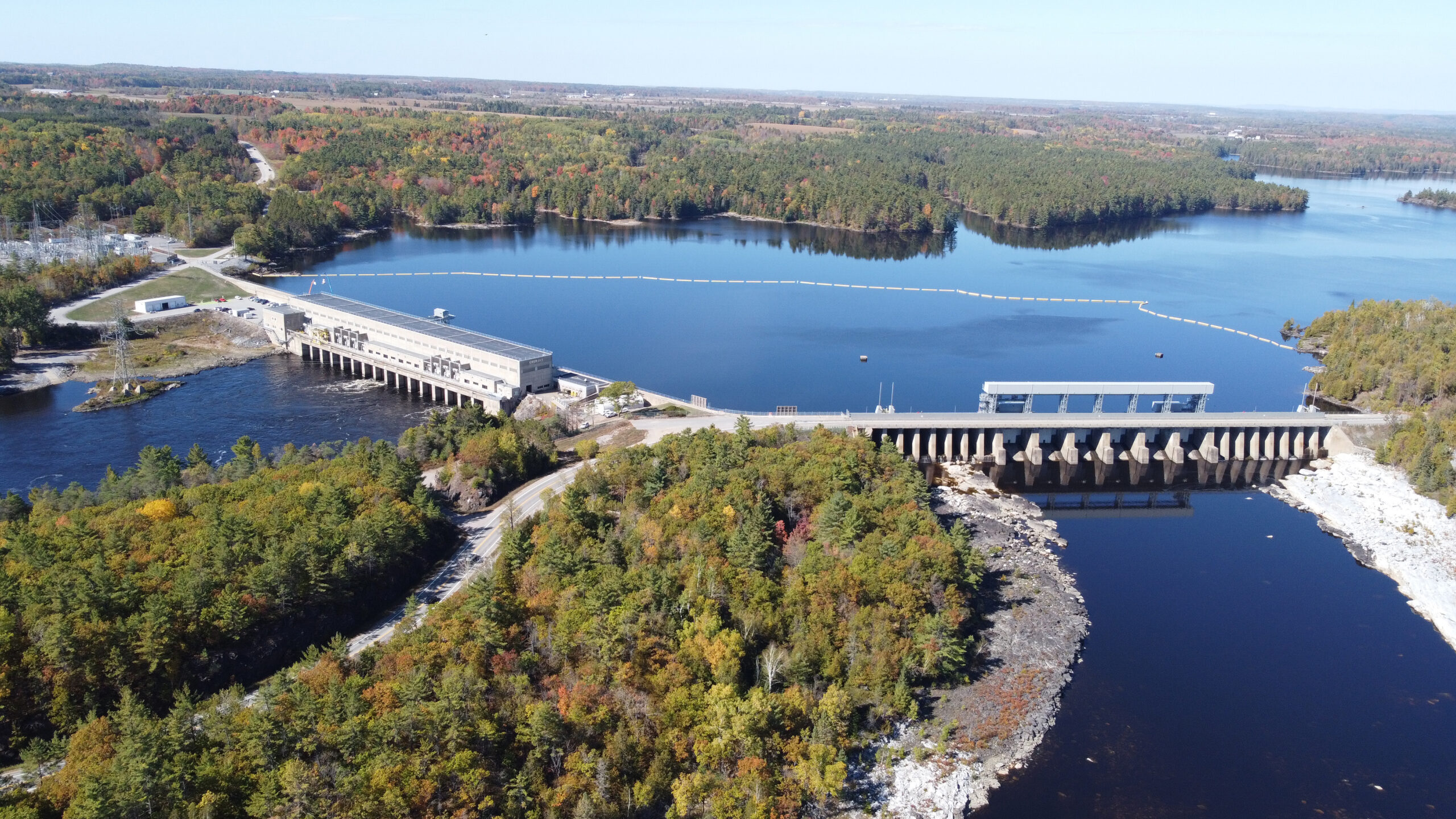



On Friday, Ontario Power Generation (OPG) held a tour of the Chenaux generating station, which sits on the Ottawa River across from Portage-du-Fort, to mark the 75th anniversary of the facility.
The tour on Friday was for media and elected officials from both Quebec and Ontario, with about 400 members of the general public expected to explore the site the following day.
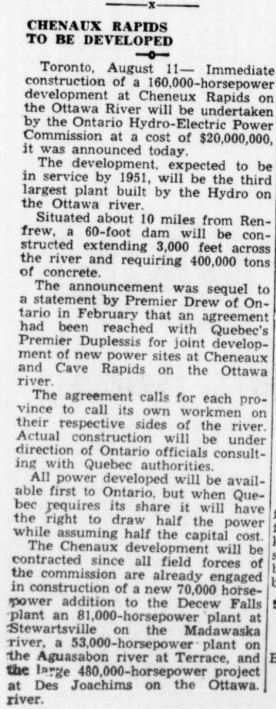
According to OPG, construction on the dam began in June 1948, with units coming online starting in 1950, and the project fully completed in December 1951.
Manager Chris Hamel, who oversees both the Chenaux and Chats Falls stations, led the tour and gave an overview of how the facility fits into Ontario’s electrical infrastructure.
“We’re the main power producer in the province of Ontario, with more than 65 hydroelectric dams,” he said. “[Chenaux] would be one of the larger ones we have in our fleet. All of our stations on the Ottawa River are similar in size.”
The station has around 20 employees, including electrical, mechanical and trades workers. Hamel explained that each of the total output of the station is 144 megawatts, or 18 megawatts per turbine unit.
“Usually we kind of use the analogy that one megawatt powers 1,000 homes so this site will power roughly 144,000 homes,” he said, adding that the main line from the station travels directly to the city of Peterborough, though they have the ability to direct power to Pembroke as well if the need arises.
“One thing to know, where does our electricity go? Basically two locations,” Hamel explained. “The main line that comes out of here, we step up the electricity to 230,000 volts and it goes straight to Peterborough. That’s the main X1P line, that’s what they call it. We can direct electricity to Pembroke as well, so there’s kind of those two options.”
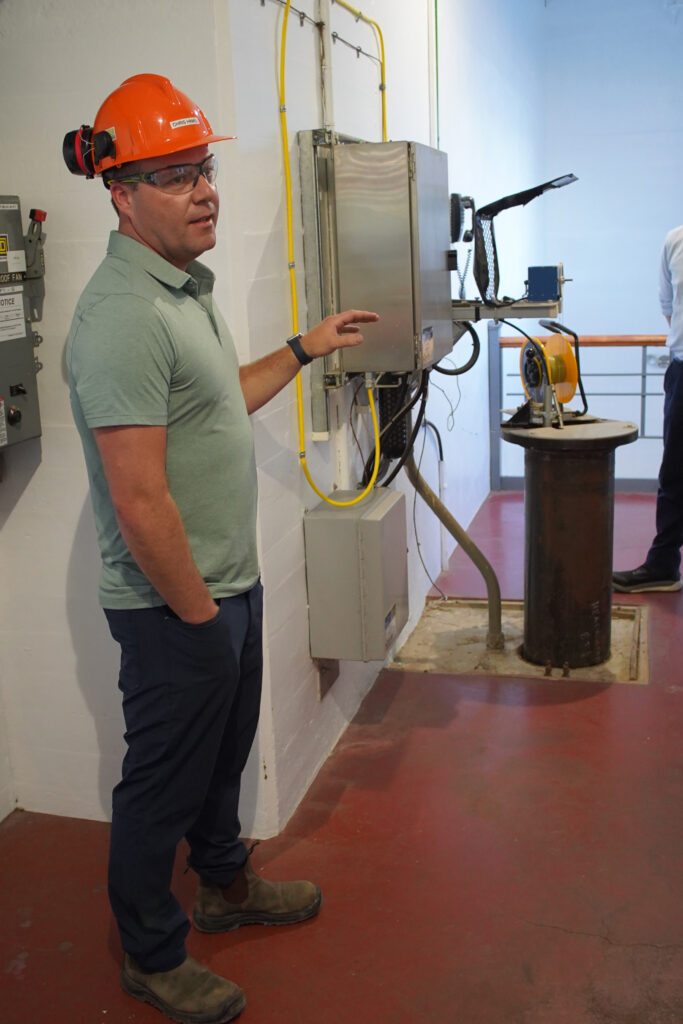
During the tour, Hamel took guests along the length of the station, up to the top of the gate winches (visible when driving along the middle span in the road), and down into the depths of the facility. Pointing out the water gauge, Hamel explained that it’s a critical piece of equipment during the high flows of the spring.
“This doesn’t look like much but this is probably some of the most important [equipment] we have on the site. So especially in times of high flows, this is very critical equipment that we rely on,” he said.
“This is read continuously in real time through our control room at [R.H. Saunders generating station in Cornwall, Ont.]. On top of that, every month our maintenance staff come up and they’ll do a physical reading. So they’re verifying that what they’re reading on site is matching what they’re seeing in our control room at Saunders. We’re doing that continuously.”
Down in the depths of the plant, Hamel showed guests a turbine shaft that was switched off. The rotors, which sit above the room, are covered in electromagnets and generate electricity by spinning within what’s called a stator, which is made up of copper. Hamel said that each of the eight rotors they have weighs around 400,000 lbs and spin at 100 rpm. The electricity they generate is stepped up by transformers on the building’s exterior from 13,800 volts to 230,000 volts for transmission.
On the platform on the upper side of the dam, Hamel showed the crane that’s used to extract flotsam that collects at the dam.
“So one of our big chores every year for about a month is river debris removal, so both taking stuff off the surface and the stuff below,” he explained, estimating that they haul out around 60 dump truck loads per year.
“It’s funny, if you come up here the May long weekend, if you stand right here and look, you’ll see all kinds of stuff floating down. Basically that’s people opening up their cottages for the year, cleaning their shorelines and rifling whatever they have on their property into the river and letting it come to us. We get all kinds of stuff, docks, kayaks, you name it.”
He added that OPG installed a boom, or safety barrier, in 2018 to prevent people from getting too close to the facility.
“You name it and somebody will try it,” he said, recalling a time someone was tubing next to the dam. “Since the boom’s been installed, it’s really deterred anyone.”
Le vendredi, Ontario Power Generation (OPG) a organisé une visite de la centrale de Chenaux, située sur la rivière des Outaouais en face de Portage-du-Fort, pour marquer le 75e anniversaire de l’installation.
La visite de vendredi était destinée aux médias et aux élus du Québec et de l’Ontario, et environ 400 membres du grand public devaient explorer le site le lendemain.
Selon l’OPG, la construction du barrage a débuté en juin 1948, les unités étant mises en service à partir de 1950, et le projet entièrement achevé en décembre 1951.
Le gestionnaire Chris Hamel, qui supervise les centrales de Chenaux et de Chats Falls, a dirigé la visite et a donné un aperçu de la façon dont l’installation s’intègre dans l’infrastructure électrique de l’Ontario.
« Nous sommes le principal producteur d’électricité de la province de l’Ontario, avec plus de 65 barrages hydroélectriques », a-t-il déclaré. « [Chenaux] serait l’un des plus grands de notre parc. Toutes nos centrales sur la rivière des Outaouais sont de taille similaire. »
La centrale compte une vingtaine d’employés, y compris des électriciens, des mécaniciens et des travailleurs spécialisés. Hamel a expliqué que la production totale de la centrale est de 144 mégawatts, soit 18 mégawatts par unité de turbine.
« Habituellement, nous utilisons l’analogie selon laquelle un mégawatt alimente 1 000 foyers, donc ce site alimentera environ 144 000 foyers », a-t-il dit, ajoutant que la ligne principale de la centrale se dirige directement vers la ville de Peterborough, bien qu’ils aient la capacité de diriger également l’électricité vers Pembroke si le besoin s’en fait sentir.
« Une chose à savoir, où va notre électricité? Essentiellement deux endroits », a expliqué Hamel. « La ligne principale qui part d’ici, nous élevons la tension de l’électricité à 230 000 volts et elle va directement à Peterborough. C’est la ligne principale X1P, c’est comme ça qu’on l’appelle. Nous pouvons également diriger l’électricité vers Pembroke, il y a donc en quelque sorte ces deux options. »
Pendant la visite, Hamel a emmené les invités le long de la centrale, jusqu’au sommet des treuils de vannage (visibles en roulant le long de la travée médiane de la route), et dans les profondeurs de l’installation. En montrant l’indicateur de niveau d’eau, Hamel a expliqué qu’il s’agit d’un équipement essentiel pendant les débits élevés du printemps.
« Cela n’a pas l’air de grand-chose, mais c’est probablement l’un des équipements les plus importants que nous ayons sur le site. Donc, surtout en période de débits élevés, c’est un équipement très critique sur lequel nous comptons », a-t-il dit.
« Ceci est lu en continu et en temps réel depuis notre salle de contrôle à [la centrale R.H. Saunders à Cornwall, Ont.]. En plus de cela, chaque mois, notre personnel d’entretien vient faire une lecture physique. Ils vérifient donc que ce qu’ils lisent sur le site correspond à ce qu’ils voient dans notre salle de contrôle à Saunders. Nous le faisons continuellement. »
Dans les profondeurs de la centrale, Hamel a montré aux invités un arbre de turbine qui était éteint. Les rotors, qui se trouvent au-dessus de la salle, sont recouverts d’électroaimants et génèrent de l’électricité en tournant à l’intérieur de ce que l’on appelle un stator, qui est fait de cuivre. Hamel a déclaré que chacun des huit rotors qu’ils possèdent pèse environ 400 000 livres et tourne à 100 tr/min. L’électricité qu’ils génèrent est augmentée par des transformateurs à l’extérieur du bâtiment de 13 800 volts à 230 000 volts pour la transmission.
Sur la plate-forme située sur le côté supérieur du barrage, Hamel a montré la grue utilisée pour extraire les objets flottants qui s’accumulent au barrage.
« Donc, l’une de nos grandes tâches chaque année, pendant environ un mois, est l’enlèvement des débris de la rivière, à la fois en surface et en dessous », a-t-il expliqué, estimant qu’ils retirent environ 60 chargements de camions à benne basculante par an.
« C’est amusant, si vous venez ici le long week-end de mai, si vous vous tenez là et regardez, vous verrez toutes sortes de choses flotter. En gros, ce sont des gens qui ouvrent leurs chalets pour l’année, nettoient leurs rives et jettent tout ce qu’ils ont sur leur propriété dans la rivière, la laissant nous parvenir. Nous recevons toutes sortes de choses : quais, kayaks, tout ce que vous voulez. »
Il a ajouté que l’OPG a installé un estacade, ou barrière de sécurité, en 2018 pour empêcher les gens de s’approcher trop près de l’installation.
« Nommez-le et quelqu’un l’essaiera », a-t-il dit, se souvenant d’une fois où quelqu’un faisait de la chambre à air à côté du barrage. « Depuis l’installation de l’estacade, cela a vraiment dissuadé tout le monde. »