


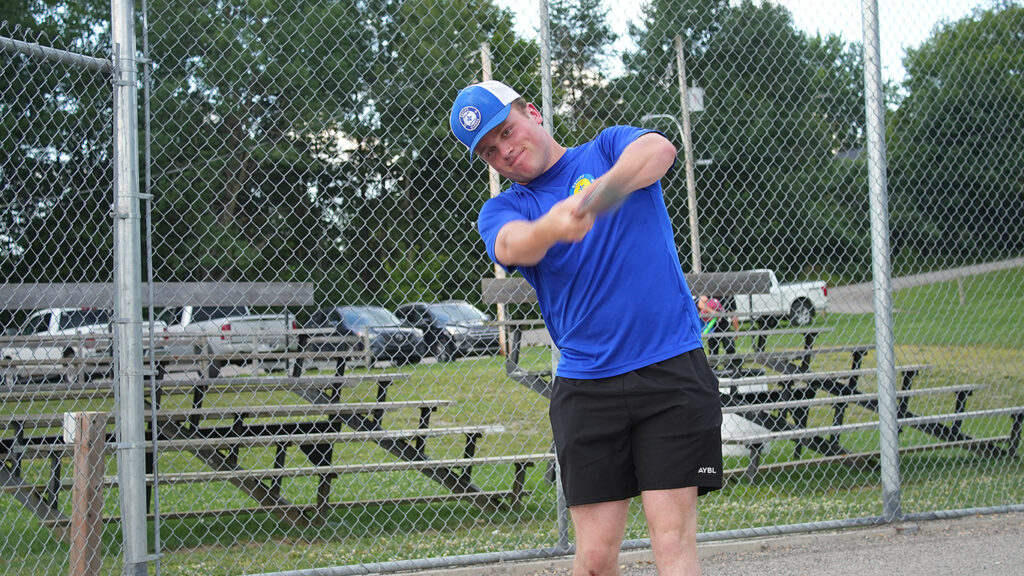
It’s a grey Thursday at Shawville’s Elwood Dale field as the Quyon Flyers take the field for their weekly men’s league game. It’s the first inning, and Hunter Beauregard steps up to the plate, just like he always does.
He struts into the batter’s box, drawing a small cross into the dirt with his bat, a routine he does to honour his late father. He sees the ball leave the pitcher’s hand, waits for it to cross centre plate, and – whack! – unloads a single to left field. Jogging into first base, he looks to the dugout, where his teammate Cade Kuehl is the first on his feet to cheer him on.
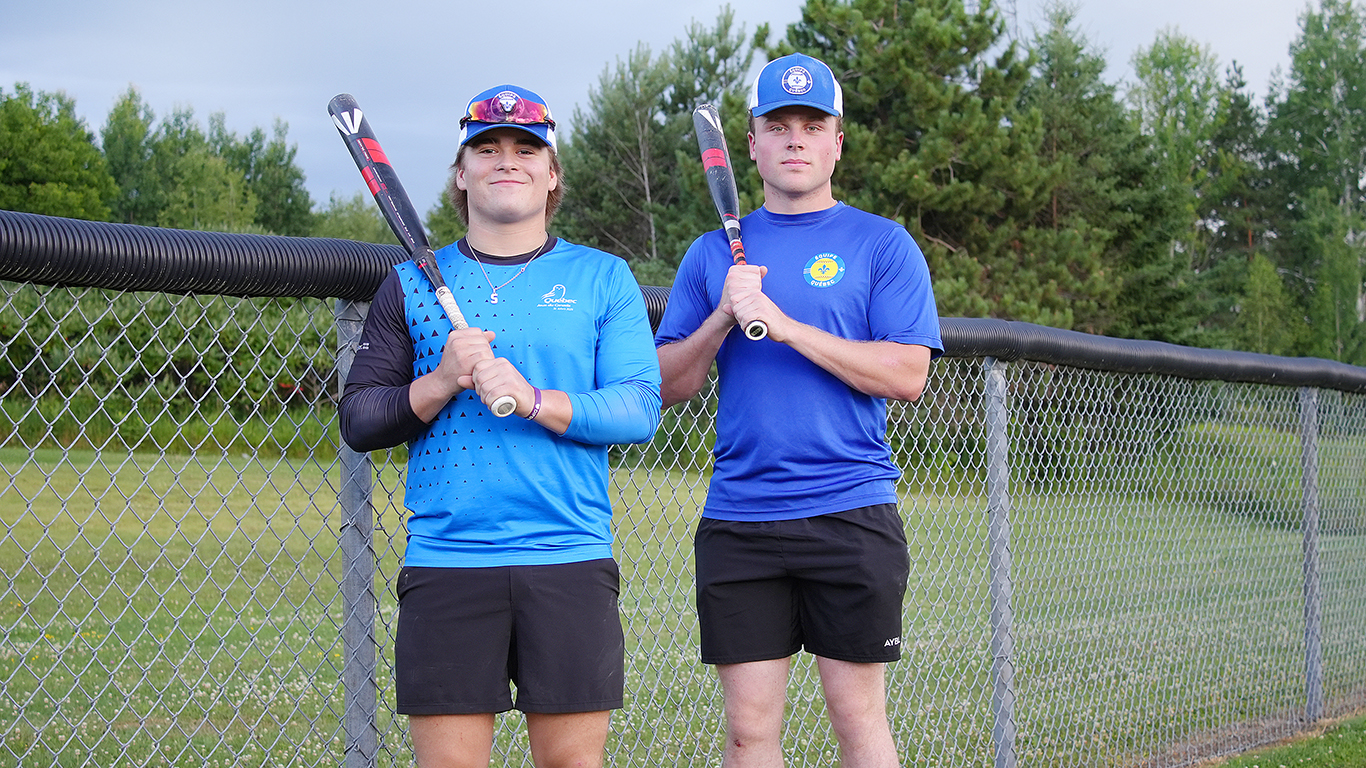
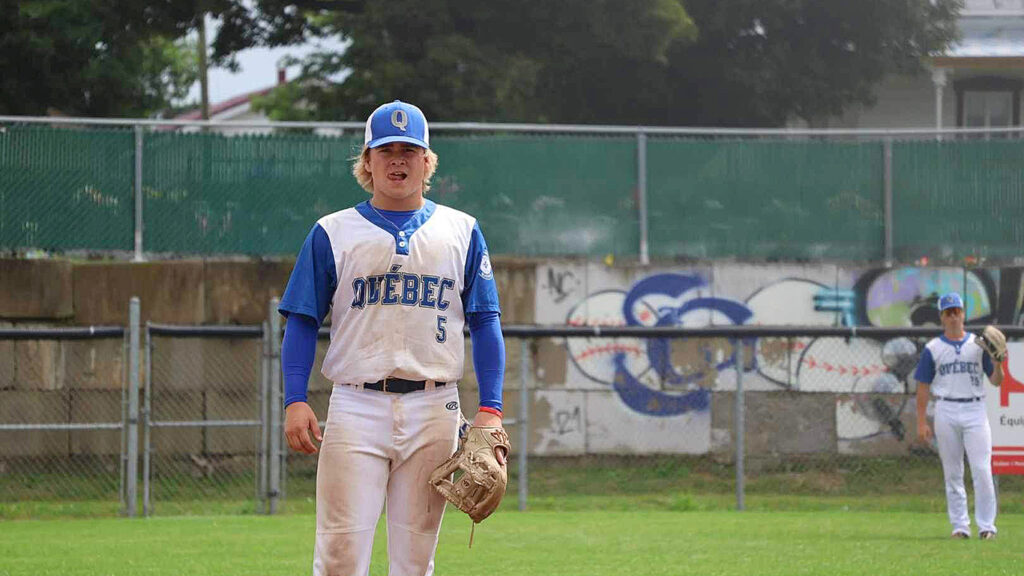
In August, these two Pontiac lads – who also happen to be best friends – will take their connection to St. John’s, Newfoundland, where they will put their softball skills to the test representing Quebec at the Canada Games.
Brothers in ball
Kuehl, a catcher from Shawville, and Beauregard, a third-baseman from Campbell’s Bay, didn’t grow up together, but you wouldn’t guess it by the way they act.
“We’re brothers,” summed up Kuehl during an interview before their Flyers game.
The pair shared the diamond for the first time together as preteens in Shawville’s fast-pitch league, both impressive young prospects testing their stuff against the older guys. Since then, they’ve practically been pinned at the hip.
“We’ve always pushed each other [ . . . ] we share the same hobbies, we’re both super into sports, we like going to the gym,” Kuehl said.
But they’re far from carbon copies. Kuehl is the more outgoing of the two. He’s loud and unafraid to talk to anyone. That personality comes with a few quirks, including a laundry list of pre-game rituals and superstitions.
One time during a winning streak, he let his uniform go unwashed for nine straight games, storing the ripe-smelling result in the hotel closet between games so his bunkmates didn’t catch a whiff.
“I had to drive in the car with him,” said Beauregard, shaking his head. “It wasn’t good.”
Beauregard, in his first year studying history at the University of Ottawa, is more introverted. Not always the first to strike up conversation, he’s more likely to be at home with his nose buried in a YouTube video.
“Sometimes I’ll walk into his room and he’ll be watching a video about World War II,” said Kuehl, who has been Beauregard’s roommate for a year.
But at the end of the day both guys share a common goal that binds them at the hip: a burning desire to be great.
“Drive [ . . . ] when everybody else is sitting at home, Cade’s out hitting off the tee,” Hunter says about which single word he would use to describe his pal.
Softball runs deep
Beauregard’s journey with softball started early. “Ball’s been in my family for as long as I can remember,” he said, recalling memories of watching his dad’s games, crane-necked on the dugout bench.
“He was like my hero. I always wanted to be on the diamond with him,” he said of father Maurice Beauregard, who served a brief term as the mayor of Campbell’s Bay. Three years ago, Mo, as he was known, passed away from cancer at the young age of 43.
This was a blow to young Hunter, who saw his dad as his first softball role model. But mom Kelly says that ball kept him going.
“He’s gone through stuff that most people don’t go through until they’re well into adulthood, and he just has that focus that was really what got him through,” she said.
Now, when Beauregard traces his trademark cross over the plate, he does it while wearing the number 27 on his back. Mo’s birthday was Feb. 27.
“I like to think that he’s always with me when I’m playing,” said Beauregard.
Kuehl’s journey with the game started a bit later in life (he was a hockey player) but he took to the new sport right away.
Beauregard said the first time he saw Kuehl play, he was blown away by his pure talent and athleticism.
“He was a lot better than I was and I was pretty raw and he kind of had it figured out,” he said.
Though the pair grew up in different towns, they they became fast friends through ball. They made Team Quebec for three straight summers, logged countless hours in the batting cage, and got each other out of bed when training was the last thing on their minds. Last year, they won gold together at the Canadian championships.
“We can thank softball for the reason that we got so close,” said Kuehl.
As their careers blossomed, so did their bond. Nine-hour round trip journeys to and from practices in central Quebec proved ample opportunity to acquaint themselves. They talked about everything from family, to handling failure, to the crappy French warm-up music their teammates were playing.
“We’ve talked about a lot of things. I don’t think there’s anything we haven’t talked about,” Beauregard said of the drives, laughing.
As of last year, the pair are also roommates. “We know the ins and outs of each other’s lives, what we had for breakfast,” laughed Kuehl.
Of course, that friendship starts and ends on the ballfield. Each one credits the other with being his biggest supporter on the field and in the duguout.
“Having him by my side the whole time has been crucial [ . . . ] if I’m sitting there with my head in the dirt, Cade’s always the first one to come pat me on the back and say, ‘Let’s go!’,” said Beauregard.
Pontiac roots
On the dusty ballfields of the Pontiac, there’s no glamour, no scouts in the crowd. You had to want it more than the other guy.
Both guys say they hold this grit as part of their identity, and that it has enabled them to get to where they are today.
But they say that hard work wouldn’t have meant anything if it weren’t for the takes-a-village mentality so common in the Pontiac, where grizzled teammates often become unofficial mentors.
Both athletes attribute their development in part to the guidance of Matt Greer, a Shawville native who once made Canada’s 40-man national softball roster and who is a fixture in the local softball community.
They say Greer has become a mentor, as unorthodox as his methods may sometimes be. Kuehl said Greer, at one time his teacher at Pontiac High School, once plopped a tome into his hands in the hallway between classes with a title something like, “How to step up your mental game.”
Kuehl, who now takes special interest in that niche, took the book in stride, soaking up the tips and tricks inside, including how to block out distractions. Now, he counts his mental fortitude as among his best assets on the field.
“He’s obviously been through it all, and he’s done so much in the game. It’s just the text he’ll send whenever he sees that something’s off,” Kuehl said of Greer’s impact.
Both players have strong support networks at home. For Kuehl, it’s his sister, mom, and dad Allen, who Kuehl said has been a fixture in his softball life ever since he can remember.
“There hasn’t been a day that’s passed for five or six years that we haven’t talked about ball [ . . . ] I could probably count on one hand the amount of ball games that he’s missed over the years. It’s just so important having him in my corner.”
For Beauregard, the support comes from his mom, who he says is there for the highs, but perhaps most importantly the lows.
“The amount of driving, the amount of time and effort that she’s put in, I don’t think I could thank her enough,” he said.
“She’s always there to listen.”
While for these two young men, the brightest opportunities for the future may not include a life in the Pontiac, they said the place and its people are still an important part of their story.
“You look around and everybody’s working really hard in the Pontiac,” said Kuehl, who said it inspired him to do the same.
Both guys took some time this spring to instill that work ethic in the next generation of Pontiac ballers, hosting a clinic in the Pontiac High gym.
“We got noticed now, but what I want to do is be able to have the spotlight put on the younger kids and tell people, ‘Hey, we do exist here,” said Beauregard.
Kuehl added onto that point, saying that they would like to be the same kind of mentor that Greer and others have been for them.
“There has been people that have helped us throughout our journey [ . . . ] and without us helping other people that are younger, they might not have the same opportunities,” he said.
The Games
Both guys have been training hard in preparation for the games, travelling as far as Quebec City to practice with the team.
For them, the anticipation of the moment is palpable.
“It’s a once-in-a-lifetime experience. I feel pretty grateful that out of every kid my age in the Pontiac that I’m the one that’s going to be able to have this experience,” Beauregard said.
The pair said they are looking forward to hitting the field with their teammates, a scrappy bunch of players who Kuehl said make up a team to be reckoned with.
“We’re scrappy. We’ll beat you whichever way you’d like. We can small-ball it, we can bunt, play really good defence or we can hit the ball over the fence,” he said.
The pair won’t be going to Newfoundland without a small contingent of Pontiac fans in tow.
Kuehl’s dad is making the trip, though his sister, who has mobility issues and can’t make the voyage, will be cheering from home.
“But when you see his love and passion for the game, it’s easily worth it,” said Kuehl’s dad.
Beauregard’s mom Kelly, as well as his younger brother and sister, will be there as well.
“We’re just so proud of him, and we know that he’s carved his own path based on the effort that he’s put into it, and we’re just [going to be] cheering loud and proud,” she said.
She said while Hunter’s hard work and dedication is clear for all to see when he steps into the batter’s box, there is a side to him that many people don’t see.
“What people take for granted is that on the field, the dads are there, and he doesn’t have that [ . . . ] so I try to be there for double duty.”
For Beauregard there will be one face that won’t be there in the flesh. But he said his dad will be with him, at least on the back of his jersey, and in his thoughts every time he steps up to the plate.
“I would have liked to imagine that if he was still here, [he would be proud],” he said.
Matt Greer will be rooting for the boys at home, and is pumped to see their hard work pay off as they rep the Pontiac on the biggest national stage. Once a young ball player with his own aspirations, he said he and other softball vets felt a need to help the teens on their journeys, just like his mentors once did for him.
“We feel as though we need to now be the guys who step up and try to help grow the game and support the kids who are trying to take this thing to the next level.”
Still here for now
Back on the diamond in Shawville, Hunter and Cade share a high-five after a game-winning home run. With the end of the season approaching and an uncertain future lying ahead, it’s unclear how many more of these moments they will have.
Both young men are in university, each with his own path ahead. Kuehl is entering his first year of sports management at the University of Ottawa and is eyeing a career in sports. Hunter’s journey looks slightly different as he follows his desire to become a teacher.
Their softball futures aren’t guaranteed, either. Kuehl attended tryouts for Canada’s U18 team, but will surely face some stiff competition throughout the selection process. Beauregard was too old to attend the tryouts, but was also too young for the next age group, U23. He hopes to try again in a future year.
“It’s every young softball player’s goal growing up in Canada to be able to wear the red and black, and I hope at some point in the future I can be given the opportunity,” he said.
The future may be uncertain, but they are going to ride this softball thing as far as it will take them. They’re leaving for the national softball championship in Saskatchewan next week, then later in the month will embark on the biggest softball moment of their lives at the Canada Games.
But right now the pair are right here, playing on the Shawville field where they honed their games and became best friends.
The game ends. Beauregard carries a case of Bud Light to the dugout. Kuehl tosses the ball around with his Flyers teammates.
A young Shawville t-ball player sits next to his mom, watching the older guys go to war. He’s preparing for the biggest moment of his own young career next Monday, his youth league finals between Quyon and Shawville.
“I can hit the ball into the grass!” he bragged.
Will he be up next?
C’est un jeudi gris au terrain Elwood Dale de Shawville, alors que les Flyers de Quyon entrent sur le terrain pour leur match hebdomadaire de la ligue masculine. C’est la première manche, et Hunter Beauregard s’avance au marbre, comme il le fait toujours.
Il s’avance d’un pas assuré dans la boîte du frappeur, traçant une petite croix dans la terre avec sa batte, une routine qu’il effectue pour honorer son défunt père. Il voit la balle quitter la main du lanceur, attend qu’elle traverse le centre du marbre et – bang ! – envoie un simple au champ gauche. En trottinant vers le premier but, il regarde vers l’abri des joueurs, où son coéquipier Cade Kuehl est le premier debout à l’encourager.
En août, ces deux jeunes du Pontiac – qui sont aussi les meilleurs amis du monde – porteront leur complicité à St. John’s, Terre-Neuve, où ils mettront leurs talents de joueurs de softball à l’épreuve en représentant le Québec aux Jeux du Canada.
Frères du softball
Kuehl, receveur de Shawville, et Beauregard, joueur de troisième but de Campbell’s Bay, n’ont pas grandi ensemble, mais on ne le devinerait jamais à la façon dont ils agissent.
« Nous sommes frères », a résumé Kuehl lors d’une entrevue avant leur match avec les Flyers.
La paire a partagé le terrain pour la première fois alors qu’ils étaient préadolescents, dans la ligue de balle rapide de Shawville, tous deux d’impressionnants jeunes espoirs se mesurant aux plus âgés. Depuis, ils sont pratiquement inséparables.
« Nous nous sommes toujours poussés mutuellement [ . . . ] nous partageons les mêmes passe-temps, nous sommes tous les deux des super fans de sport, nous aimons aller au gym », a déclaré Kuehl.
Mais ils sont loin d’être des copies conformes. Kuehl est le plus extraverti des deux. Il est bruyant et n’a pas peur de parler à qui que ce soit. Cette personnalité s’accompagne de quelques bizarreries, dont une longue liste de rituels et de superstitions d’avant-match.
Une fois, pendant une série de victoires, il a laissé son uniforme non lavé pendant neuf matchs d’affilée, rangeant le résultat à l’odeur forte dans le placard de l’hôtel entre les matchs pour que ses compagnons de chambre ne le sentent pas.
« J’ai dû faire de la route avec lui dans la voiture », a déclaré Beauregard, en secouant la tête. « Ce n’était pas bon. »
Beauregard, en première année d’histoire à l’Université d’Ottawa, est plus introverti. Pas toujours le premier à engager la conversation, il est plus susceptible d’être à la maison, le nez enfoui dans une vidéo YouTube.
« Parfois, j’entre dans sa chambre et il regarde une vidéo sur la Seconde Guerre mondiale », a déclaré Kuehl, qui est le colocataire de Beauregard depuis un an.
Mais au bout du compte, les deux jeunes partagent un objectif commun qui les lie : un désir ardent d’être excellents.
« Détermination [ . . . ] quand tout le monde est assis à la maison, Cade est dehors à frapper la balle », dit Hunter à propos du seul mot qu’il utiliserait pour décrire son ami.
Le softball, une affaire de famille
Le parcours de Beauregard avec le softball a commencé tôt. « La balle a toujours fait partie de ma famille, d’aussi loin que je me souvienne », a-t-il dit, se remémorant les souvenirs d’avoir regardé les matchs de son père, le cou tendu sur le banc de l’abri des joueurs.
« Il était comme mon héros. J’ai toujours voulu être sur le terrain avec lui », a-t-il dit de son père, Maurice Beauregard, qui a servi un court mandat en tant que maire de Campbell’s Bay. Il y a trois ans, Mo, comme on l’appelait, est décédé d’un cancer à l’âge précoce de 43 ans.
Ce fut un coup dur pour le jeune Hunter, qui voyait son père comme son premier modèle de softball. Mais sa mère, Kelly, affirme que le sport l’a aidé à tenir le coup.
« Il a traversé des épreuves que la plupart des gens ne rencontrent pas avant d’être bien avancés dans l’âge adulte, et il a simplement cette concentration qui l’a vraiment aidé à s’en sortir », a-t-elle déclaré.
Maintenant, lorsque Beauregard trace sa croix distinctive au-dessus du marbre, il le fait en portant le numéro 27 sur son dos. L’anniversaire de Mo était le 27 février.
« J’aime penser qu’il est toujours avec moi quand je joue », a déclaré Beauregard.
Le parcours de Kuehl avec ce sport a commencé un peu plus tard dans sa vie (il était joueur de hockey), mais il s’est immédiatement adapté au nouveau sport.
Beauregard a déclaré que la première fois qu’il a vu Kuehl jouer, il a été époustouflé par son talent pur et son athlétisme.
« Il était bien meilleur que moi, et j’étais assez brut, alors que lui avait déjà compris comment ça marchait », a-t-il dit.
Bien que les deux aient grandi dans des villes différentes, ils sont devenus rapidement amis grâce à la balle. Ils ont fait partie de l’équipe Québec pendant trois étés consécutifs, ont passé d’innombrables heures dans la cage de frappeur et se sont poussés mutuellement à l’entraînement, même lorsque ce n’était pas leur première pensée. L’année dernière, ils ont remporté l’or ensemble aux championnats canadiens.
« Nous pouvons remercier le softball d’être la raison pour laquelle nous sommes devenus si proches », a déclaré Kuehl.
À mesure que leurs carrières s’épanouissaient, leur lien se renforçait. Des trajets aller-retour de neuf heures vers et depuis les entraînements dans le centre du Québec ont offert de nombreuses occasions de faire connaissance. Ils ont parlé de tout, de la famille à la gestion de l’échec, en passant par la musique d’échauffement française minable que leurs coéquipiers passaient.
« Nous avons parlé de beaucoup de choses. Je ne pense pas qu’il y ait quoi que ce soit dont nous n’ayons pas parlé », a déclaré Beauregard à propos des trajets, en riant.
Depuis l’année dernière, les deux sont également colocataires. « Nous connaissons les moindres recoins de la vie de l’autre, ce que nous avons mangé au petit-déjeuner », a ri Kuehl.
Bien sûr, cette amitié commence et se termine sur le terrain de balle. Chacun attribue à l’autre le rôle d’être son plus grand supporter sur le terrain et dans l’abri des joueurs.
« L’avoir à mes côtés tout le temps a été crucial [ . . . ] si je suis là, la tête dans la terre, Cade est toujours le premier à venir me taper dans le dos et à dire : « Allons-y ! » », a déclaré Beauregard.
Les racines du Pontiac
Sur les terrains de balle poussiéreux du Pontiac, il n’y a ni glamour, ni dépisteurs dans la foule. Il fallait le vouloir plus que l’autre.
Les deux jeunes hommes affirment que cette ténacité fait partie de leur identité, et que cela leur a permis d’arriver là où ils en sont aujourd’hui.
Mais ils disent que ce travail acharné n’aurait rien signifié sans la mentalité de « il faut tout un village » si courante dans le Pontiac, où les coéquipiers aguerris deviennent souvent des mentors officieux.
Les deux athlètes attribuent leur développement en partie aux conseils de Matt Greer, un natif de Shawville qui a fait partie de la liste des 40 meilleurs joueurs de softball nationaux du Canada et qui est une figure incontournable de la communauté locale de softball.
Ils disent que Greer est devenu un mentor, aussi peu orthodoxes que ses méthodes puissent parfois être. Kuehl a raconté que Greer, à une époque son professeur à l’école secondaire Pontiac, lui a un jour glissé un tome dans les mains dans le couloir entre les cours avec un titre du genre : « Comment améliorer son jeu mental. »
Kuehl, qui s’intéresse maintenant particulièrement à ce créneau, a pris le livre avec plaisir, s’imprégnant des trucs et astuces qu’il contenait, y compris comment bloquer les distractions. Aujourd’hui, il considère sa force mentale comme l’un de ses meilleurs atouts sur le terrain.
« Il a évidemment tout vécu, et il a tellement fait dans ce sport. C’est juste le message qu’il envoie chaque fois qu’il voit que quelque chose ne va pas », a déclaré Kuehl à propos de l’impact de Greer.
Les deux joueurs ont de solides réseaux de soutien à la maison. Pour Kuehl, ce sont sa sœur, sa mère et son père Allen, qui, selon Kuehl, a été une figure constante dans sa vie de softball d’aussi loin qu’il se souvienne.
« Il ne s’est pas passé un jour depuis cinq ou six ans sans que nous parlions de balle [ . . . ] Je pourrais probablement compter sur les doigts d’une main le nombre de matchs de balle qu’il a manqués au fil des ans. C’est tellement important de l’avoir dans mon coin. »
Pour Beauregard, le soutien vient de sa mère, qui, dit-il, est là pour les hauts, mais peut-être surtout pour les bas.
« Le nombre de trajets, le temps et les efforts qu’elle a mis, je ne pense pas pouvoir la remercier assez », a-t-il dit.
« Elle est toujours là pour écouter. »
Bien que pour ces deux jeunes hommes, les plus belles opportunités d’avenir n’incluent peut-être pas une vie dans le Pontiac, ils ont déclaré que l’endroit et ses habitants sont toujours une partie importante de leur histoire.
« Vous regardez autour de vous et tout le monde travaille très fort dans le Pontiac », a déclaré Kuehl, qui a ajouté que cela l’inspirait à faire de même.
Les deux jeunes hommes ont pris le temps ce printemps d’inculquer cette éthique de travail à la prochaine génération de joueurs de balle du Pontiac, en animant une clinique dans le gymnase de l’école secondaire Pontiac.
« Nous avons été remarqués maintenant, mais ce que je veux faire, c’est pouvoir mettre en lumière les jeunes et dire aux gens : « Hé, nous existons ici » », a déclaré Beauregard.
Kuehl a ajouté à ce point, disant qu’ils aimeraient être le même genre de mentor que Greer et d’autres l’ont été pour eux.
« Il y a eu des gens qui nous ont aidés tout au long de notre parcours [ . . . ] et sans notre aide aux plus jeunes, ils n’auraient peut-être pas les mêmes opportunités », a-t-il dit.
Les Jeux
Les deux jeunes hommes se sont entraînés avec acharnement en préparation des Jeux, voyageant jusqu’à Québec pour s’entraîner avec l’équipe.
Pour eux, l’anticipation du moment est palpable.
« C’est une expérience unique. Je suis très reconnaissant que, parmi tous les jeunes de mon âge dans le Pontiac, je sois celui qui aura cette expérience », a déclaré Beauregard.
La paire a déclaré qu’ils avaient hâte de fouler le terrain avec leurs coéquipiers, une bande de joueurs combatifs qui, selon Kuehl, forment une équipe avec laquelle il faut compter.
« Nous sommes combatifs. Nous vous battrons de la manière que vous voudrez. Nous pouvons jouer en petite balle, nous pouvons amortir, jouer une très bonne défense ou nous pouvons envoyer la balle par-dessus la clôture », a-t-il dit.
La paire n’ira pas à Terre-Neuve sans un petit contingent de fans du Pontiac à la remorque.
Le père de Kuehl fera le voyage, bien que sa sœur, qui a des problèmes de mobilité et ne peut pas faire le voyage, l’encouragera de la maison.
« Mais quand on voit son amour et sa passion pour le jeu, cela en vaut largement la peine », a déclaré le père de Kuehl.
La mère de Beauregard, Kelly, ainsi que son jeune frère et sa sœur, seront également présents.
« Nous sommes tellement fiers de lui, et nous savons qu’il a tracé son propre chemin en fonction des efforts qu’il y a mis, et nous allons simplement l’encourager haut et fort », a-t-elle déclaré.
Elle a dit que si le travail acharné et le dévouement de Hunter sont clairs pour tous lorsqu’il s’avance au marbre, il y a un côté de lui que beaucoup de gens ne voient pas.
« Ce que les gens tiennent pour acquis, c’est que sur le terrain, les pères sont là, et il n’a pas ça [ . . . ] alors j’essaie d’être là pour la double tâche. »
Pour Beauregard, il y aura un visage qui ne sera pas là en chair et en os. Mais il a dit que son père sera avec lui, du moins sur le dos de son maillot, et dans ses pensées chaque fois qu’il s’avancera au marbre.
« J’aurais aimé imaginer que s’il était encore là, [il serait fier] », a-t-il dit.
Matt Greer encouragera les garçons depuis la maison et est très enthousiaste de voir leur travail acharné porter ses fruits alors qu’ils représentent le Pontiac sur la plus grande scène nationale. Ancien jeune joueur de balle avec ses propres aspirations, il a dit que lui et d’autres vétérans du softball ont ressenti le besoin d’aider les adolescents dans leur parcours, tout comme ses mentors l’avaient fait pour lui.
« Nous sentons que nous devons maintenant être ceux qui se manifestent et essaient de faire grandir le sport et de soutenir les jeunes qui essaient d’amener cela au niveau supérieur. »
Toujours là pour l’instant
De retour sur le terrain de Shawville, Hunter et Cade se tapent dans les mains après un circuit qui fait gagner le match. Alors que la fin de la saison approche et qu’un avenir incertain les attend, il est difficile de dire combien d’autres de ces moments ils auront.
Les deux jeunes hommes sont à l’université, chacun avec son propre chemin devant lui. Kuehl entame sa première année en gestion du sport à l’Université d’Ottawa et envisage une carrière dans le domaine sportif. Le parcours de Hunter semble légèrement différent puisqu’il suit son désir de devenir enseignant.
Leurs avenirs au softball ne sont pas garantis non plus. Kuehl a participé aux essais pour l’équipe canadienne des moins de 18 ans, mais fera sûrement face à une forte compétition tout au long du processus de sélection. Beauregard était trop vieux pour participer aux essais, mais aussi trop jeune pour la catégorie d’âge suivante, les moins de 23 ans. Il espère réessayer dans une année future.
« C’est l’objectif de tout jeune joueur de softball qui grandit au Canada de pouvoir porter le rouge et le noir, et j’espère qu’à un moment donné, à l’avenir, on me donnera cette opportunité », a-t-il dit.
L’avenir est peut-être incertain, mais ils vont pousser cette aventure du softball aussi loin qu’elle les mènera. Ils partiront pour le championnat national de softball en Saskatchewan la semaine prochaine, puis plus tard dans le mois, ils vivront le plus grand moment de leur vie de softball aux Jeux du Canada.
Mais pour l’instant, les deux sont ici, jouant sur le terrain de Shawville où ils ont perfectionné leur jeu et sont devenus les meilleurs amis du monde.
Le match se termine. Beauregard porte une caisse de Bud Light à l’abri des joueurs. Kuehl lance la balle avec ses coéquipiers des Flyers.
Un jeune joueur de t-ball de Shawville est assis à côté de sa mère, regardant les plus grands se « faire la guerre ». Il se prépare pour le plus grand moment de sa jeune carrière, lundi prochain : la finale de sa ligue jeunesse entre Quyon et Shawville.
« Je peux envoyer la balle dans l’herbe ! », s’est-il vanté.
Sera-t-il le prochain ?