


The Federal Liberal caucus is meeting in Edmonton this week to discuss priorities before Parliament resumes on Monday, Sept. 15.
THE EQUITY spoke with Pontiac-Kitigan Zibi MP Sophie Chatel as she gears up to return to the House of Commons, to learn about what her priorities will be during this fall session.
She said after a busy summer visiting with agricultural producers in Quebec and Ontario, she is returning to Parliament with two key priorities she believes are key to growing the agriculture and agri-food sectors.
“The first one is really reducing the regulatory burden on producers so they can innovate, grow and compete. So I think that will be one big focus of my work,” she said, noting reducing red tape across all sectors is a top priority for her government.
“And the second is really to propose strategic investments in areas with strong added value and growth potential. I found this is one key sector where the waste of one business becomes the input of another business, and so we can create opportunities there for maximizing profit.”
Outside of her role as Parliamentary Secretary to the Minister of Agriculture and Agri-Food, Chatel said she will be closely tracking the development of a new Crown corporation called Build Canada Homes – something the Liberals believe will help them meet their housing targets.
“The government has the ambition to build more than 500,000 new affordable homes a year,” Chatel said.
“Well, part of the job of an MP is to make sure that the initiative has impact in my riding. [ . . . ] One of the things I hear as an obstacle to building affordable homes is the capacity of municipalities to build sewage and water infrastructure.”
She pointed to the 24-unit affordable housing project on Allumette Island as an example of how she hopes to be able to support housing development in the riding.
“We have approval to build affordable homes, but we need the money from the federal, from the provincial, and municipal to build the water infrastructure to allow the building of those units,” she said.
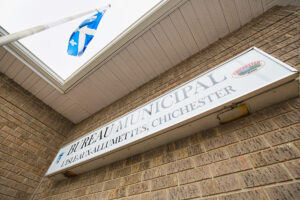
The Municipality of L’Isle-aux-Allumettes has already submitted a funding application under the federal Canada Housing Infrastructure Fund (CHIF) for financial support developing the infrastructure needed to support this housing project.
On the subject of inter-provincial trade barriers, Chatel said while her government has lifted all barriers “that are not necessary to preserve the safety and security of Canadians or an international trade commitment,” by way of its Bill C-5 passed earlier this summer, regulations in Ontario and Quebec remain a sticking point.
She said with regards to barriers imposed on meat producers when they want to sell meat processed at a Quebec-certified abattoir in Ontario, Bill C-5 does not make this any easier.
“I was wondering whether that [regulation] was necessary to keep, but [what I heard] during my tour of Quebec, and also of stakeholders from the meat sector across Canada, is that [ . . . ] if we lower the federal standard for an abattoir, then meat producers from Brazil, from other countries, can all of a sudden start importing their meat into the Canadian market at a provincial standard, and some provinces do not have very high standards.”
She said she has begun discussions with the Canadian Food Inspection Agency to see what would be needed to give the Shawville abattoir, not yet reopened, a federal certification.
“Right now, priority number one is to have the abattoir open, and ready for business,” she said. “But then there will be an assessment on what it takes, and what support we can offer to move to federal certification.”
Chatel also highlighted her work supporting the Kidjīmāninān biodiversity protection initiative led by Kitigan Zibi Anishinàbeg First Nation, as well as Bill S-229 – which seeks to enshrine the boundaries of the Gatineau Park in law – as ongoing priorities for her.
The bill was drafted in the summer of 2024, and is currently in the Senate.
“That is one of the priorities, to see that it has all the support it needs in the House of Commons,” she said, noting she hopes it will receive Royal assent by June 2026.
Le caucus libéral fédéral se réunit à Edmonton cette semaine pour discuter des priorités avant la reprise des travaux parlementaires le lundi 15 septembre.
The Equity s’est entretenu avec la députée de Pontiac-Kitigan Zibi, Sophie Chatel, alors qu’elle se prépare à retourner à la Chambre des communes, afin de connaître ses priorités pour cette session d’automne.
Elle a déclaré qu’après un été chargé à rencontrer des producteurs agricoles au Québec et en Ontario, elle retourne au Parlement avec deux priorités clés qu’elle estime essentielles à la croissance des secteurs de l’agriculture et de l’agroalimentaire.
« La première est vraiment de réduire le fardeau réglementaire des producteurs afin qu’ils puissent innover, croître et faire concurrence. Je pense que ce sera un axe majeur de mon travail », a-t-elle dit, notant que la réduction de la bureaucratie dans tous les secteurs est une priorité absolue pour son gouvernement.
« Et la deuxième est vraiment de proposer des investissements stratégiques dans des domaines à forte valeur ajoutée et à fort potentiel de croissance. J’ai constaté que c’est un secteur clé où le déchet d’une entreprise devient l’intrant d’une autre, et nous pouvons ainsi créer des opportunités pour maximiser les profits. »
En dehors de son rôle de secrétaire parlementaire de la ministre de l’Agriculture et de l’Agroalimentaire, Sophie Chatel a indiqué qu’elle suivra de près le développement d’une nouvelle société d’État appelée Build Canada Homes – ce que les libéraux croient les aidera à atteindre leurs objectifs en matière de logement.
« Le gouvernement a l’ambition de construire plus de 500 000 nouveaux logements abordables par an », a déclaré Sophie Chatel.
« Eh bien, une partie du travail d’un député est de s’assurer que l’initiative a un impact dans ma circonscription. […] L’un des obstacles que j’entends à la construction de logements abordables est la capacité des municipalités à construire des infrastructures d’égouts et d’aqueduc. »
Elle a cité le projet de 24 logements abordables sur L’Isle-aux-Allumettes comme exemple de la manière dont elle espère pouvoir soutenir le développement de logements dans la circonscription.
« Nous avons l’approbation pour construire des logements abordables, mais nous avons besoin des fonds des gouvernements fédéral, provincial et municipal pour construire les infrastructures d’aqueduc qui permettront la construction de ces unités », a-t-elle dit.
La Municipalité de L’Isle-aux-Allumettes a déjà soumis une demande de financement dans le cadre du Fonds canadien pour les infrastructures de logement (FCIL) du gouvernement fédéral, afin d’obtenir un soutien financier pour le développement des infrastructures nécessaires à la réalisation de ce projet de logement.
Au sujet des obstacles au commerce interprovincial, Sophie Chatel a déclaré que, bien que son gouvernement ait levé toutes les barrières « qui ne sont pas nécessaires pour préserver la sécurité des Canadiens ou un engagement commercial international », par l’entremise de son projet de loi C-5 adopté plus tôt cet été, les règlements en Ontario et au Québec demeurent un point de désaccord.
Elle a indiqué qu’en ce qui concerne les obstacles imposés aux producteurs de viande lorsqu’ils veulent vendre de la viande transformée dans un abattoir certifié au Québec en Ontario, le projet de loi C-5 ne facilite pas les choses.
« Je me demandais si cette [réglementation] était nécessaire à conserver, mais [ce que j’ai entendu] lors de ma tournée du Québec, et aussi des intervenants du secteur de la viande partout au Canada, est que […] si nous abaissons la norme fédérale pour un abattoir, alors les producteurs de viande du Brésil, d’autres pays, peuvent tout à coup commencer à importer leur viande sur le marché canadien selon une norme provinciale, et certaines provinces n’ont pas des normes très élevées. »
Elle a déclaré avoir entamé des discussions avec l’Agence canadienne d’inspection des aliments pour voir ce qui serait nécessaire pour que l’abattoir de Shawville, pas encore rouvert, obtienne une certification fédérale.
« Pour l’instant, la priorité numéro un est que l’abattoir soit ouvert et prêt à fonctionner, a-t-elle dit. Mais ensuite, il y aura une évaluation de ce qu’il faut, et du soutien que nous pouvons offrir pour passer à la certification fédérale. »
Sophie Chatel a également souligné son travail de soutien à l’initiative de protection de la biodiversité Kidjīmāninān, menée par la Première Nation de Kitigan Zibi Anishinàbeg, ainsi que le projet de loi S-229 – qui vise à ancrer dans la loi les limites du Parc de la Gatineau – comme des priorités continues pour elle.
Le projet de loi a été rédigé à l’été 2024 et est actuellement devant le Sénat.
« C’est l’une des priorités, de veiller à ce qu’il obtienne tout le soutien nécessaire à la Chambre des communes », a-t-elle dit, notant qu’elle espère qu’il recevra la sanction royale d’ici juin 2026.