


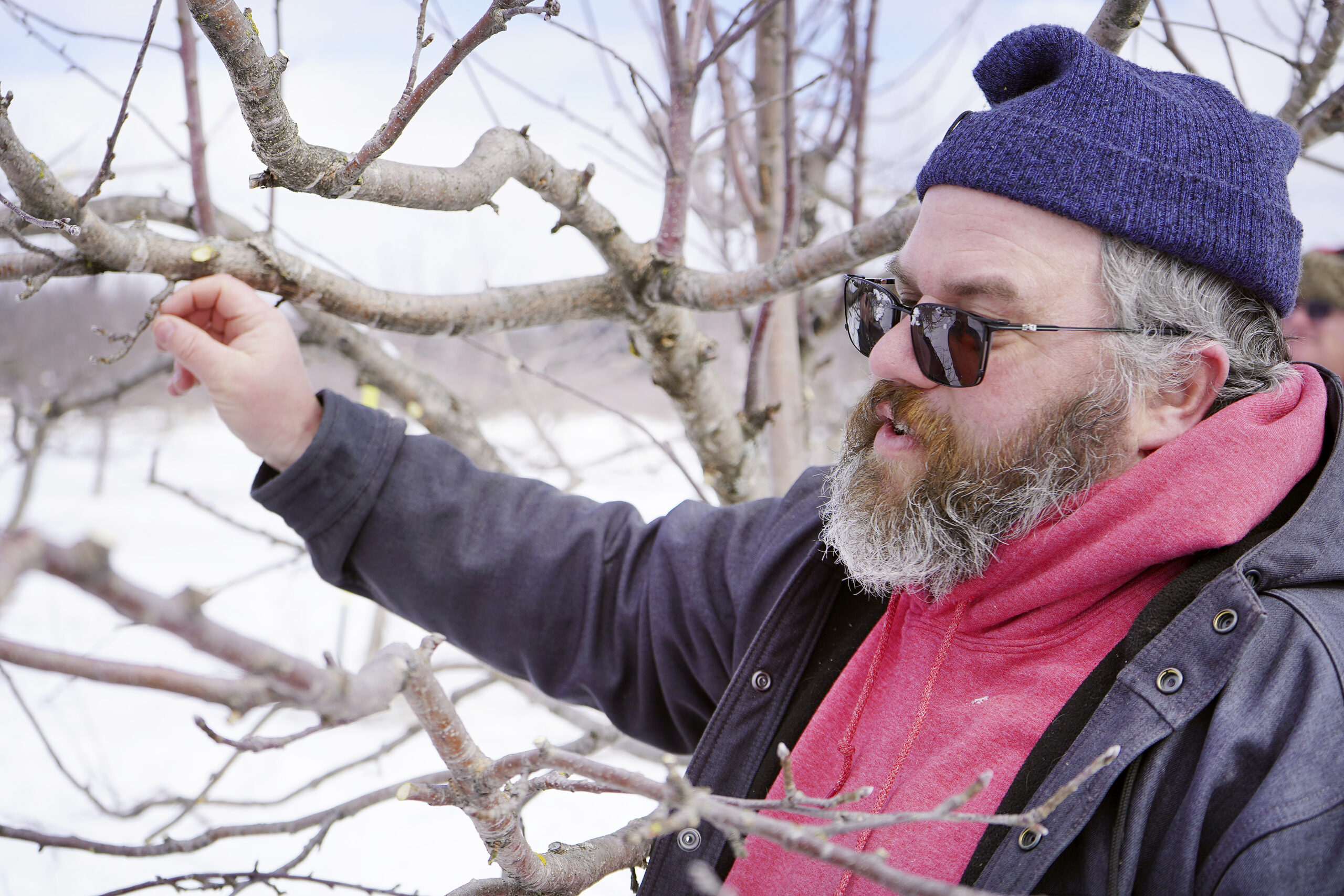



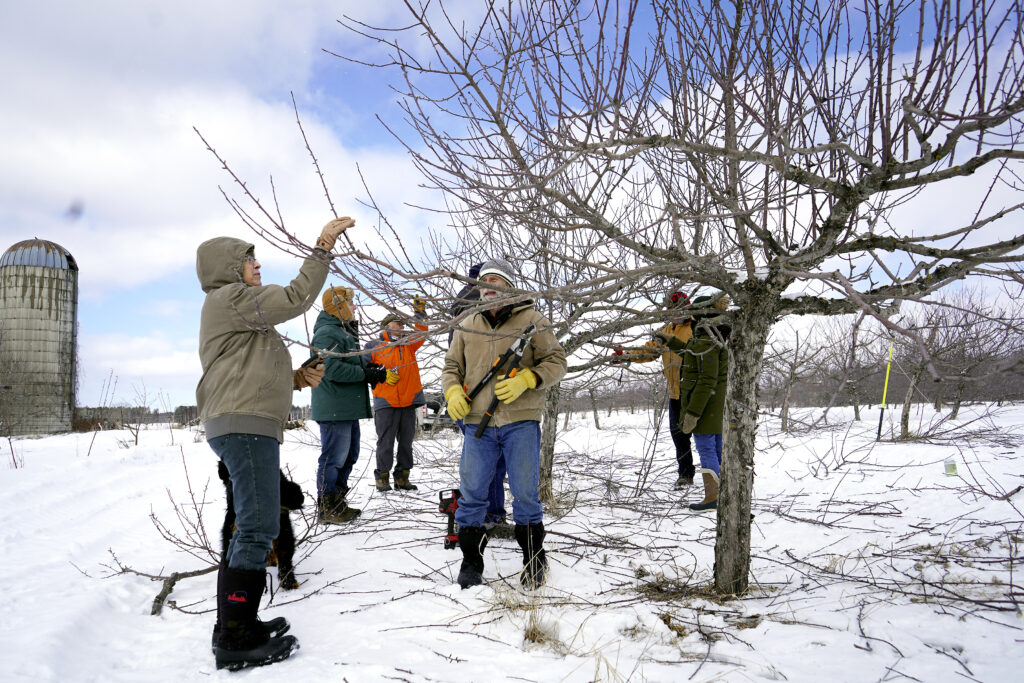
Saturday may not have brought the warmer weather typically associated with the return of the growing season, but that did not stop a small group of spring hopefuls from gathering in a windy, snow-covered Bristol field for a lesson on how to prune an apple tree.
The workshop was hosted by Greg Graham, who has been caring for his 1,100-tree apple orchard on his family farm in Bristol since it was planted in the early 2000s.
“Usually we say you can prune once the coldest part of winter is over,” he said, explaining prolonged cold winds will suck moisture out of the open wounds left behind by pruning. Graham said the long winter meant Saturday’s blitz came later in the season than he usually begins the process.
Among those gathered to pick up a few tips and tricks was Dave Schock, who showed up to learn how to care for some trees his grandfather planted on his family’s Ladysmith farm about a century ago.
“They need attention,” he said, noting while he was unsure of their variety, they made excellent pie apples. “This is learning how to do it properly.”
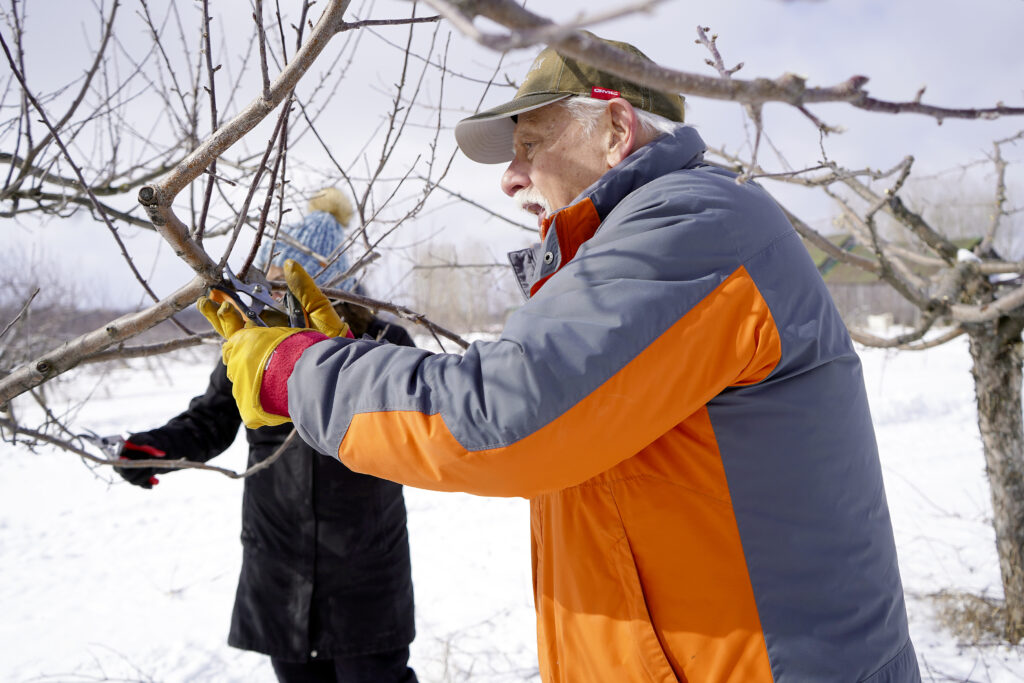
After having all participants sterilize their pruners in some bleach, Graham encouraged them to get trimming. He highlighted a few key practices for pruning, noting there will be different challenges to watch for depending on what kind of tree is being pruned.
1. Cut out the dead stuff
“If there’s any part of the tree that’s dead it’s going to provide a habitat for bacteria, it’s going to encourage insects that can transfer viruses and disease, and the dead tissue can travel back up into the branch,” Graham explained.
He said you can identify dead wood by using a thumbnail to scrape one of the trees younger branches. If it’s alive, the scrape will reveal a layer of green – the cambium that has the active cells and does the growing and the transfer of nutrients and water. If a scrape reveals a layer of brown or red, the branch is dead.
Graham said wrinkly bark is also evidence of a dead branch, an indication that it was dehydrated after a winter of cold winds and was unable to rehydrate itself.
“Figure out where it’s dead and where it’s living, and cut into the living part because you don’t want to leave any dead wood on the tree,” Graham said, emphasizing the importance of making the cut at 90 degrees to the branch to create the smallest possible wound.
Also important is using a resin, or sometimes tar, to seal up wounds, and using well-sharpened pruners.
2. Give it a haircut
Once dead wood is removed, the next step is to open up the spaces between the tree’s main fruit producing branches.
“Apple trees in particular, but most fruit trees, tend to form fruit on lateral drooping branches, they don’t form fruit on upright branches. Upright branches are all vegetal,” Graham said.
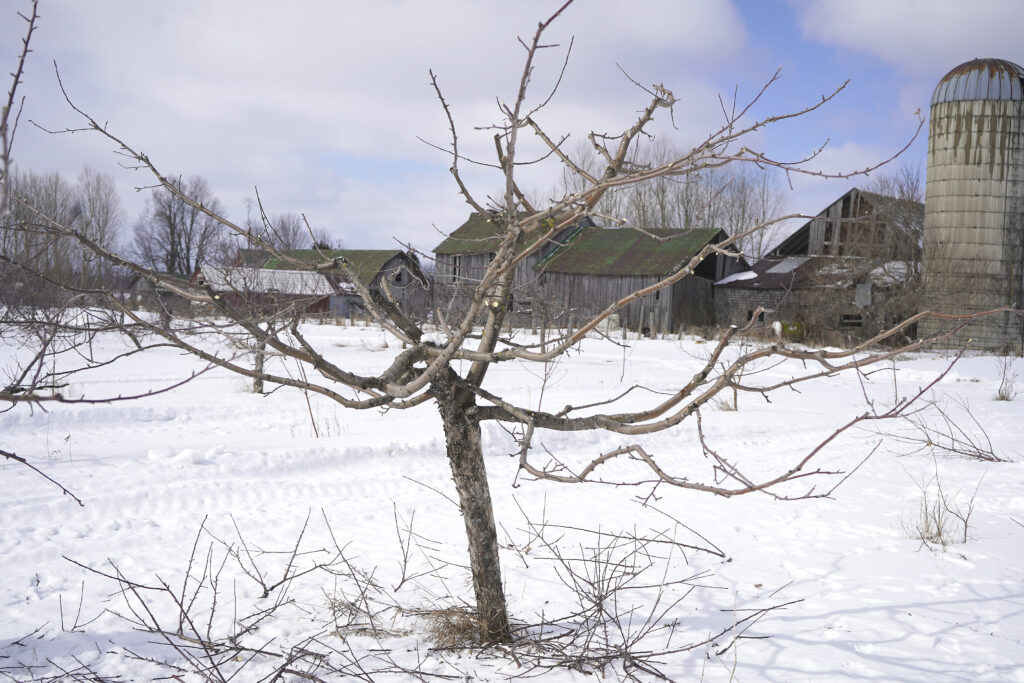
He advised pruners to trim their tree so it becomes shaped like a fountain, with strong lateral branches that droop down at their ends.
Part of this process involves cutting back all water sprout branches – the young twig-looking ones, usually lighter in colour with less developed bark, that grow out of lateral branches, heading straight up towards the sky. Graham said these rarely produce fruit, just weigh down the lateral branches and eventually cause breaks.
“You don’t want Bart Simpson hair,” he warned. Importantly, Graham noted that not all not all small branches on the older wood are bad news. The shorter, more crooked twigs that grow out from older branches in random directions – referred to by Graham as witches’ fingers – often bear fruit and should be saved.
Graham said trees can withstand being trimmed back by about a third of their size in one year.
“If you stress the tree out too much it’s going to send up a ton of water sprouts that year.”
He said big picture, the goal is to open up breathing room between the branches to allow for more sunlight to reach the tree’s inner branches and for greater air circulation to prevent disease.
Graham shared a visual once shared with him when he was first learning to care for his tries.
“If you’ve got a more mature tree, and you’re wondering how much you should thin it out, take a cat, rub it the wrong way until it’s good and angry, and then throw the cat through the tree. The cat should pass through the tree without hitting a branch,” he said.
“Now, of course, we don’t condone animal abuse, it’s just a mental exercise.”
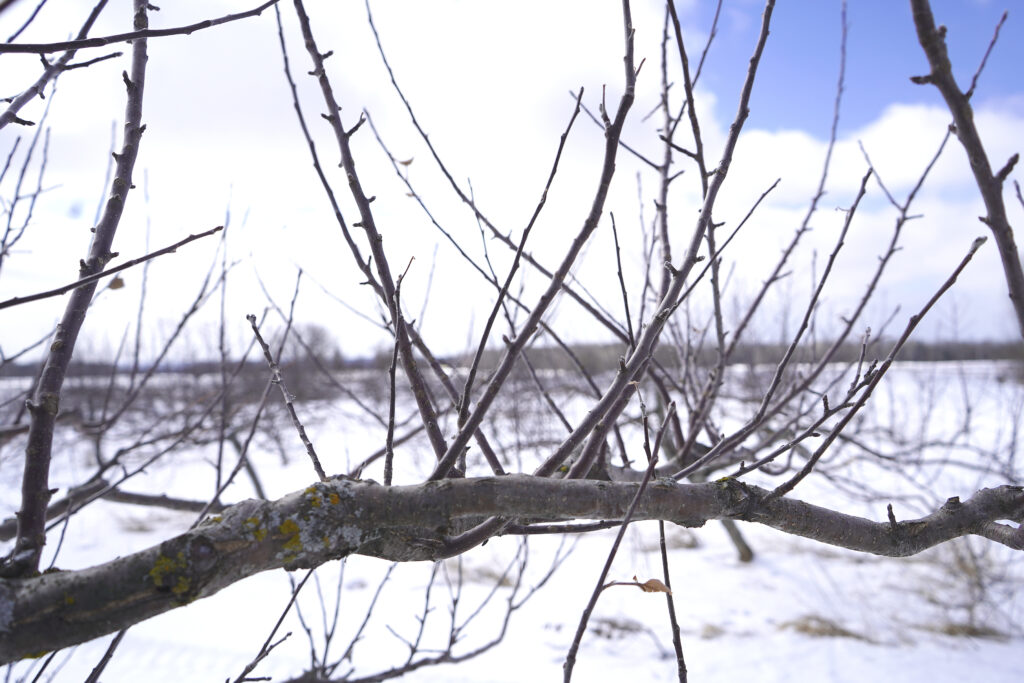
Samedi n’a peut-être pas apporté le temps plus chaud habituellement associé au retour de la saison de croissance, mais cela n’a pas empêché un petit groupe d’amateurs de printemps de se réunir dans un champ venteux et enneigé de Bristol pour une leçon sur la taille des pommiers.
L’atelier était animé par Greg Graham, qui prend soin de son verger de 1 100 pommiers sur sa ferme familiale à Bristol depuis qu’il a été planté au début des années 2000.
« Habituellement, nous disons que l’on peut tailler une fois que la partie la plus froide de l’hiver est passée », a-t-il déclaré, expliquant que les vents froids prolongés assèchent l’humidité des plaies ouvertes laissées par la taille. Graham a ajouté que le long hiver a fait en sorte que l’opération de samedi est arrivée plus tard dans la saison qu’il n’entame habituellement le processus.
Parmi les personnes réunies pour glaner quelques astuces et conseils, se trouvait Dave Schock, qui est venu apprendre à prendre soin de quelques arbres que son grand-père avait plantés sur la ferme de sa famille à Ladysmith il y a environ un siècle.
« Ils ont besoin d’attention », a-t-il déclaré, notant que, bien qu’il ne soit pas sûr de leur variété, ils faisaient d’excellentes pommes à tarte. « C’est apprendre à le faire correctement. »
Après avoir fait stériliser leurs sécateurs dans de l’eau de Javel par tous les participants, Graham les a encouragés à commencer la taille. Il a mis en évidence quelques pratiques clés pour la taille, notant qu’il y aura différents défis à surveiller en fonction du type d’arbre taillé.
1. Coupez le bois mort
« Si une partie de l’arbre est morte, elle va servir d’habitat aux bactéries, elle va encourager les insectes qui peuvent transmettre des virus et des maladies, et le tissu mort peut remonter dans la branche », a expliqué Graham.
Il a précisé que l’on peut identifier le bois mort en utilisant un ongle pour gratter l’une des jeunes branches de l’arbre. Si elle est vivante, la rayure révélera une couche verte – le cambium qui contient les cellules actives et assure la croissance ainsi que le transfert des nutriments et de l’eau. Si une rayure révèle une couche brune ou rouge, la branche est morte.
Graham a ajouté que l’écorce ridée est également un signe de branche morte, indiquant qu’elle a été déshydratée après un hiver de vents froids et n’a pas pu se réhydrater.
« Déterminez où il est mort et où il est vivant, et coupez dans la partie vivante, car vous ne voulez pas laisser de bois mort sur l’arbre », a déclaré Graham, soulignant l’importance de faire la coupe à 90 degrés par rapport à la branche pour créer la plus petite plaie possible.
Il est également important d’utiliser une résine, ou parfois du goudron, pour sceller les plaies, et d’utiliser des sécateurs bien aiguisés.
2. Faites-lui une coupe
Une fois le bois mort retiré, l’étape suivante consiste à dégager les espaces entre les principales branches fructifères de l’arbre.
« Les pommiers en particulier, mais la plupart des arbres fruitiers, ont tendance à former des fruits sur les branches latérales retombantes, ils ne forment pas de fruits sur les branches dressées. Les branches dressées sont entièrement végétatives », a déclaré Graham.
Il a conseillé aux élagueurs de former leur arbre de manière à ce qu’il prenne la forme d’une fontaine, avec de fortes branches latérales qui retombent à leurs extrémités.
Une partie de ce processus implique de couper toutes les branches gourmandes (les jeunes pousses ressemblant à des brindilles, généralement de couleur plus claire avec une écorce moins développée, qui poussent à partir des branches latérales, se dirigeant droit vers le ciel). Graham a déclaré que celles-ci produisent rarement des fruits, ne font qu’alourdir les branches latérales et finissent par provoquer des cassures.
« Vous ne voulez pas avoir les cheveux de Bart Simpson », a-t-il averti. Fait important, Graham a souligné que toutes les petites branches sur le vieux bois ne sont pas néfastes. Les brindilles plus courtes et plus tordues qui poussent à partir de branches plus anciennes dans des directions aléatoires – que Graham appelle des « doigts de sorcière » – portent souvent des fruits et devraient être conservées.
Graham a précisé que les arbres peuvent supporter d’être taillés d’environ un tiers de leur taille en un an.
« Si vous stressez trop l’arbre, il va produire une tonne de gourmands cette année-là. »
Il a précisé que, globalement, l’objectif est de dégager de l’espace entre les branches pour permettre à plus de lumière du soleil d’atteindre les branches intérieures de l’arbre et pour une meilleure circulation de l’air afin de prévenir les maladies.
Graham a partagé une image qui lui avait été présentée lorsqu’il apprenait à prendre soin de ses arbres.
« Si vous avez un arbre plus mature, et que vous vous demandez à quel point vous devriez l’éclaircir, prenez un chat, frottez-le à contresens jusqu’à ce qu’il soit bien en colère, puis lancez le chat à travers l’arbre. Le chat devrait passer à travers l’arbre sans heurter une branche », a-t-il déclaré.
« Bien sûr, nous ne cautionnons pas la maltraitance animale, ce n’est qu’un exercice mental. »