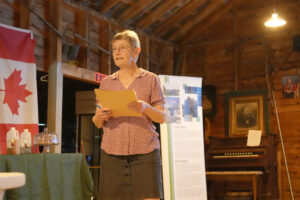



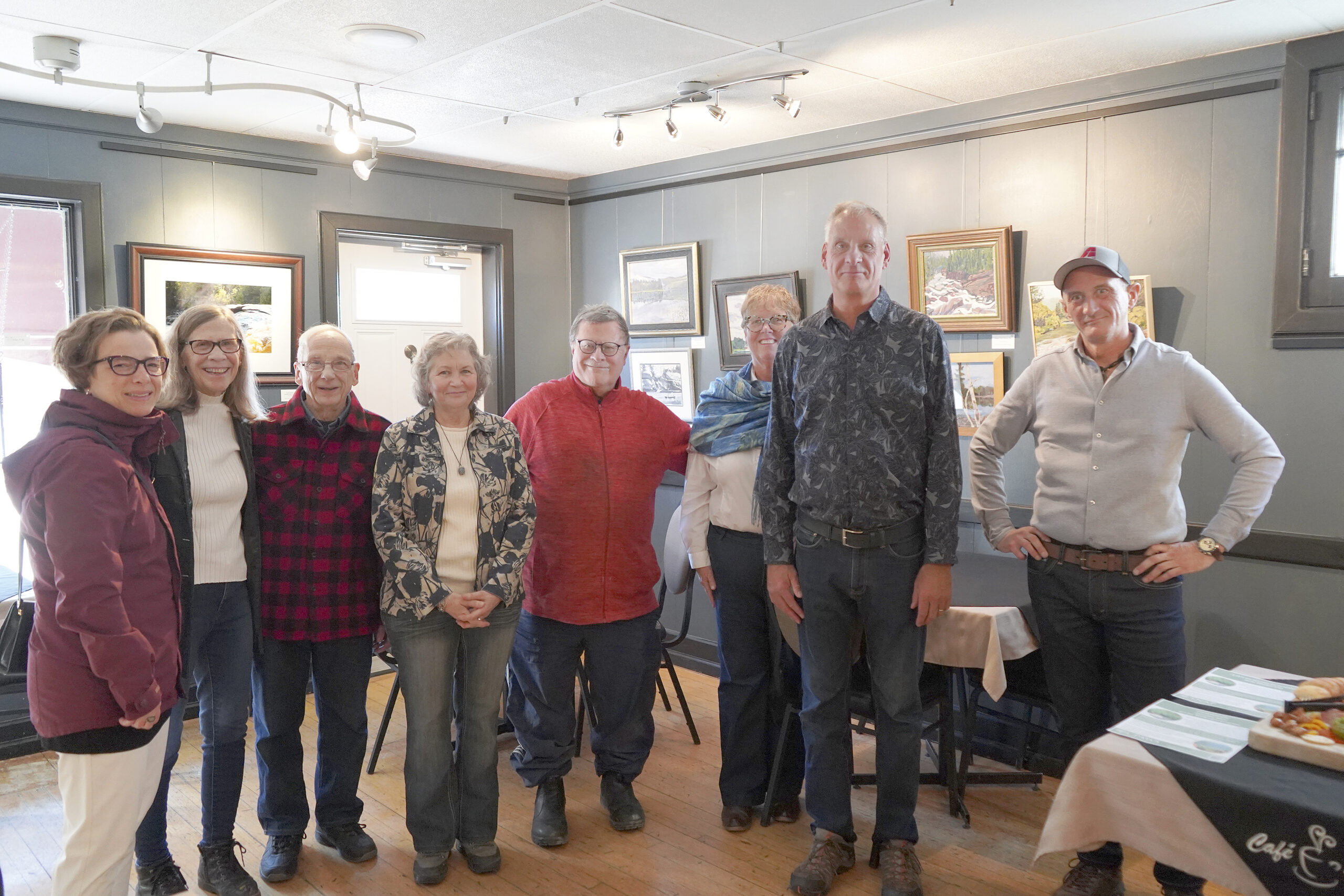



On Saturday afternoon, the Ottawa Valley chapter of the Canadian Parks and Wilderness Society (CPAWS) held a vernissage at Café 349 in Shawville featuring art that was inspired by the Pontiac wilderness along the Dumoine River.
John McDonnell, the director of CPAWS-OV explained that the works were created during the organization’s Dumoine River Art for Wilderness retreats (DRAW), which the organization hosts every summer. Each artist who attends the retreat is asked to donate a finished piece to help raise money for the organization, and there were a wide variety of paintings, drawings and photography on display. “So all this work is inspired by the Pontiac, mainly the Dumoine River but also the Noire and Coulonge,” McDonnell said. “All the work is available for sale and the proceeds will support the work of CPAWS Ottawa Valley in protecting areas in the Pontiac.”
Lyndon Johnston had his art featured in the exhibit and has been attending the retreats for several years, initially as the volunteer cook for the excursion, and later as an artist. He said he enjoyed the area’s serenity the most.
“The tranquility, the peace, the quiet, the beautiful nature, it feels untouched,” he said. “Like being dropped into pure wilderness, not just a hiking trail like other places.”
McDonnell said that CPAWS’s goal is to protect 30 per cent of the Ottawa River watershed, which includes the so-called “three sisters”: the Dumoine, Noire and Coulonge rivers, which flow into the Ottawa River from the upper Pontiac.
“Right now, about 11 per cent is protected, so there’s quite a bit of work to be done to reach that target but we have a lot of projects underway,” McDonnell said. “The Dumoine River watershed is partly protected today thanks to our work as well as the Noire and Coulonge, but we have a number of other projects, places like Lac Dumont near Otter Lake, Lac Brûlé, areas like that, where we’re hoping to see more protection.”
He added that they weren’t opposed to recreation activities in the territories, but more so protection from heavy industry.
“In terms of the level of protection we’re looking for, we’d like to see no logging, mining, or hydro-electric development in those areas,” he said. “But you know, hunting, fishing, trapping, recreational activities, cabin leases, all of those things are protected. The idea is to have a fairly flexible level of protection, to protect the values of that area but not restrict people from going there.“
The exhibit will run at the Café until May 29.
Le samedi après-midi, la section de la Vallée de l’Outaouais de la Société pour la nature et les parcs du Canada (SNAP) a tenu un vernissage au Café 349 à Shawville, présentant des œuvres d’art inspirées par la nature sauvage du Pontiac, le long de la rivière Dumoine.
John McDonnell, directeur de la SNAP-VO, a expliqué que les œuvres ont été créées lors des retraites de l’organisation « Dumoine River Art for Wilderness » (DRAW), qu’elle organise chaque été. Chaque artiste qui participe à la retraite est invité à faire don d’une œuvre achevée pour aider à recueillir des fonds pour l’organisation, et une grande variété de peintures, de dessins et de photographies étaient exposées. « Tout ce travail est inspiré par le Pontiac, principalement la rivière Dumoine, mais aussi la Noire et la Coulonge », a déclaré McDonnell. « Toutes les œuvres sont disponibles à la vente et les recettes soutiendront le travail de la SNAP Vallée de l’Outaouais pour la protection des zones du Pontiac. »
Lyndon Johnston a exposé ses œuvres et participe aux retraites depuis plusieurs années, d’abord comme cuisinier bénévole pour l’excursion, puis comme artiste. Il a déclaré que ce qu’il appréciait le plus était la sérénité de la région.
« La tranquillité, la paix, le calme, la belle nature, on a l’impression que c’est intact », a-t-il dit. « C’est comme être largué en pleine nature sauvage, pas seulement sur un sentier de randonnée comme ailleurs. »
McDonnell a déclaré que l’objectif de la SNAP est de protéger 30 % du bassin versant de la rivière des Outaouais, qui comprend les « trois sœurs » : les rivières Dumoine, Noire et Coulonge, qui se jettent dans la rivière des Outaouais depuis le haut-Pontiac.
« Actuellement, environ 11 % est protégé, il y a donc beaucoup de travail à faire pour atteindre cet objectif, mais nous avons de nombreux projets en cours », a déclaré McDonnell. « Le bassin versant de la rivière Dumoine est en partie protégé aujourd’hui grâce à notre travail, de même que la Noire et la Coulonge, mais nous avons un certain nombre d’autres projets, des endroits comme le lac Dumont près d’Otter Lake, le lac Brûlé, des zones comme celles-là, où nous espérons voir une plus grande protection. »
Il a ajouté qu’ils n’étaient pas opposés aux activités récréatives dans ces territoires, mais plutôt à la protection contre l’industrie lourde.
« En ce qui concerne le niveau de protection que nous recherchons, nous aimerions qu’il n’y ait pas d’exploitation forestière, minière ou de développement hydroélectrique dans ces zones », a-t-il déclaré. « Mais, vous savez, la chasse, la pêche, le piégeage, les activités récréatives, les baux de chalets, toutes ces choses sont protégées. L’idée est d’avoir un niveau de protection assez flexible, pour protéger les valeurs de cette zone sans empêcher les gens de s’y rendre. »
L’exposition se tiendra au Café jusqu’au 29 mai.