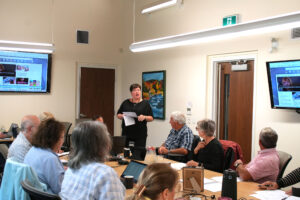







At June’s meeting of MRC Pontiac mayors, a member of the public asked a question about what local plans are in place for responding to emergency situations, specifically extreme weather events.
“The climate crisis basically says that we may be ourselves facing a calamity,” said Judith Spence, then putting her question regarding the MRC’s emergency preparedness to the table of mayors.
“So my question is, what’s happening as far as the emergency announcements? Is that rolling along?”
Various answers were thrown around by the director general and mayors. The DG pointed to the MRC’s ongoing work developing a flooding adaptation plan and a climate change plan, as well as the electronic billboard the MRC installed this year that it plans to use to share emergency notices with the population, as examples of the MRC’s efforts to prepare the population for emergencies.
Some mayors highlighted that residents in some municipalities should be able to sign up to receive emergency alerts to their cell phones or computers through a service called Telematic, which has been promised as an efficient way to get critical information out to every resident.
But as Shawville learned during last week’s power outage, these alerts can’t be sent out when your power is out, and so too your internet.
In the storms we see around here, power is usually the first thing to go. Surely our emergency communications systems can’t be entirely dependent on having electricity, which seems to disappear as reliably as the sun sets these days.
And it’s reassuring to see the MRC is taking steps to adapt its territory and the communities that live on it to be resilient to flooding in the long-term (read our story on this effort in last week’s issue). But in true bureaucratic fashion, this project will likely take years – two years to come up with the plan, and then who knows how long to implement it.
We will surely see many more extreme rain storms, wind storms, and floods and possibly forest fires closer to home in the time it takes to roll out these plans.
In the Pontiac, we have been more or less cushioned from the increase in extreme weather events that scientists are now linking to climate change. Our towns aren’t pounded with several hurricanes a year, or threatened by rising sea levels; forest fires have yet to force evacuations as they have across much of this country.
But there is no denying these sudden weather events are landing closer to home, and more frequently, it seems. Twice already this year the region has been hit with violent winds that have torn up trees and power lines, leaving many in the dark for several days.
Regardless of what we believe to be causing these events, we would be fools to not do everything we can to protect ourselves from them.
In the case of a sudden climate disaster, how will municipalities be communicating with residents? And how about when there’s a power outage? Who will be responsible for sending out the communications? Where will residents forced to leave their homes be able to go? How will they get there? Who will drive the buses? Who will run these shelter spaces? How will the people in these shelters be fed? How will these spaces be powered, or heated or cooled, depending on the season? Which municipalities will team up to support each other? Which municipalities have resources that can be leant out, and which are missing critical pieces of infrastructure needed to properly respond to emergencies?
We know some municipalities have answers to these questions. Others, we believe, are working on them. At some point, it might be wise to take stock of all the resources available beyond those the municipalities own. Our communities are rich with people who are trained in various emergency response situations. These people should be used. And at some point, it might be good to share these emergency plans with the public, so we can all better jump to action when the next storm comes knocking. It may be bigger, stronger, than the last.