





Ladysmith has hosted an Oktoberfest celebration since 1985, and with it comes the tradition of making a German culinary staple: sauerkraut.
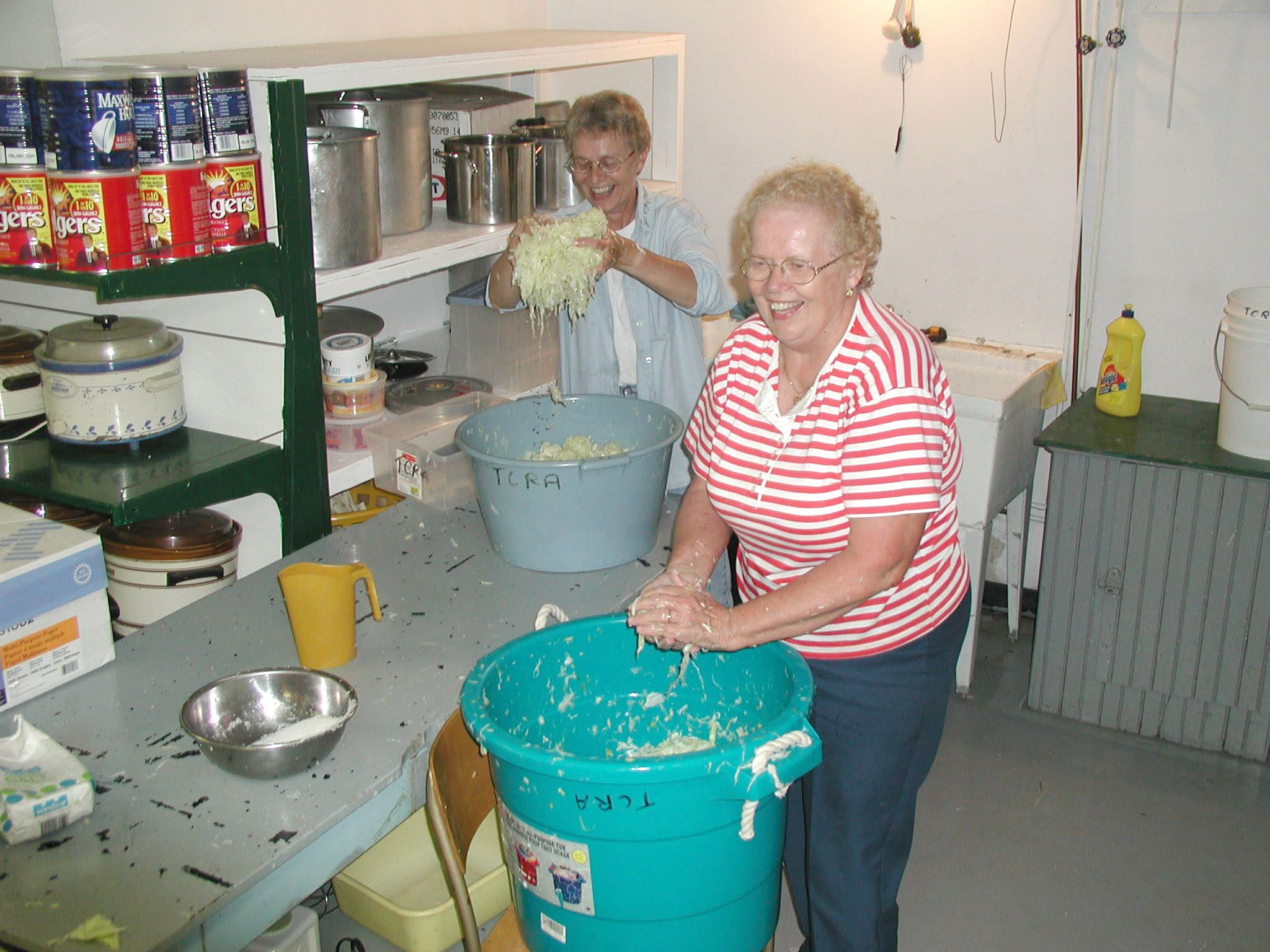
As has become somewhat of a tradition, this reporter joined the group of volunteers who spent last Wednesday (Sept. 9) elbow deep in cabbage, preparing the 90 gallons of fermented produce needed for the event, while also learning the story behind the staple.
I was delighted to discover a part of the story that had yet to be told in these pages, at least not in recent history – that of longtime Oktoberfest kitchen director Freida Krose.
Back in 1968, the Pontiac Printshop published Pontiac County Recipes. It is on page 13 where the sauerkraut recipes appear, and there printed is an introductory line that captures one’s attention.
“This recipe originally came from a dear old German lady and is really good,” the recipe promises.
“That’s probably Freida Krose,” said Marguerite Born, an Oktoberfest board member and head organizer of the day’s prep work.
Krose was an original founding director of the Ladysmith Oktoberfest, and she held the role of kitchen director from 1985 to 2006. She was given the unofficial title of “Sauerkraut Queen” upon stepping down from the director position, and in this position she oversaw production of the cabbage delicacy until 2019.
Krose would have been in her forties when Pontiac County Recipes was published. Whether she is indeed the “dear old German lady” in question is unconfirmed. Nonetheless, the recipe at hand suggests a process nearly identical to the Ladysmith operation.
The cabbages are quartered and cored then brought in bulk to the shredding area. Volunteers use mandolins for this part, gathering the cabbage fibers and sorting them in plastic tubs before escorting them to the mixing station. The workers then grab handfuls of cabbage confetti and toss it with coarse salt until it begins to sweat out its water, otherwise known as weeping. The sauerkraut is then added into 45-gallon barrels, pounded down with a large wooden tamper, covered with remaining leaves and left to ferment for 21 days. For a more detailed account of this process, read THE EQUITY’s coverage of the sauerkraut-making work party from 2024.
Krose taught Marguerite and her husband Randall the ways of the sauerkraut, instructing them to follow all details down to a T. The couple have been a part of Oktoberfest since the inaugural year, where they started out selling tickets and helping in the kitchen. The two remember their mentor fondly.
“She was quite a pillar in the community,” Marguerite said. “Very nice, very knowledgeable [ . . . ] we still use her same recipes, her meatball recipe.”
“Freida was a good boss, and a good motivator,” Randall remembered. “I called her the ‘sauerkraut wizard’ because we had some issues a couple years ago and she knew how to fix it.”
Steward Schwartz has been in charge of the Oktoberfest parade since 1988, a task handed to him by founding member Clarence Bretzlaff. He remembers Krose as a community-first person, an impact that still resonates today.
“She just liked to have things going on,” he said. “She was a wonderful person in the kitchen and she’s so good at that because her mother died when she was 12. She had three younger siblings, so she had to take over.”
Now in his eighties, Schwartz did not physically participate in this year’s prep work, but was seated, “supervising” the shredders, as he put it, while chatting with THE EQUITY.
“It’s good for the community to have a way of getting people involved, and she was really good to them, and getting them in while not being too pushy.”
Though volunteer support has been waning in recent years, a solid team still shows up every year to ensure the party goes on, with plenty of food to feed the attendees.
On Wednesday, numerous volunteers made appearances throughout the afternoon, and returned to the TCRA again that same evening to finish the job.
“It’s wonderful, if you’re a small community, to carry on that [tradition] for 40 years,” Schwartz said.
The Oktoberfest-ivities have evolved since the inaugural year, transforming from a string of tents where attendees danced in the rain, to a lively Clarence Bretzlaff Hall and a bustling kitchen where volunteers compile 90 gallons of sauerkraut and cook on electric stoves.
What remains intact is the sense of community. The impact of members such as Krose, Schwartz, and the not yet mentioned Hulda “Oma” Erfel—whose 100 year old mandolins are still used in the shredding process—and the foundation they built.
“Look after them, and they look after you,” Marguerite said, speaking of the Ladysmith community.
Oktoberfest will be held from Oct. 2-4 in Ladysmith. Weekend passes are available to buy online only.

Ladysmith accueille une célébration de l’Oktoberfest depuis 1985, et avec elle vient la tradition de préparer un aliment de base de la cuisine allemande : la choucroute.
Comme c’est un peu devenu une tradition, ce journaliste a rejoint le groupe de bénévoles qui ont passé le mercredi dernier (9 septembre) les bras plongés dans le chou, préparant les 90 gallons de produit fermenté nécessaires à l’événement, tout en apprenant l’histoire derrière cet aliment de base.
J’ai été ravi de découvrir une partie de l’histoire qui n’avait pas encore été racontée dans ces pages, du moins pas dans l’histoire récente – celle de Freida Krose, directrice de longue date de la cuisine de l’Oktoberfest.
En 1968, la Pontiac Printshop a publié Pontiac County Recipes. C’est à la page 13 que les recettes de choucroute apparaissent, et on y trouve une ligne d’introduction qui capte l’attention.
« Cette recette provient à l’origine d’une chère vieille dame allemande et est vraiment bonne », promet la recette.
« C’est probablement Freida Krose », a déclaré Marguerite Born, membre du conseil d’administration de l’Oktoberfest et organisatrice principale des préparatifs de la journée.
Krose était l’une des directrices fondatrices de l’Oktoberfest de Ladysmith, et elle a occupé le poste de directrice de la cuisine de 1985 à 2006. Elle a reçu le titre officieux de « reine de la choucroute » en quittant son poste de directrice, et à ce titre, elle a supervisé la production de cette délicatesse de chou jusqu’en 2019.
Krose aurait eu la quarantaine lorsque Pontiac County Recipes a été publié. Il n’est pas confirmé qu’elle soit effectivement la « chère vieille dame allemande » en question. Néanmoins, la recette en question suggère un processus presque identique à celui de l’opération de Ladysmith.
Les choux sont coupés en quartiers, évidés, puis apportés en vrac à la zone de déchiquetage. Les bénévoles utilisent des mandolines pour cette partie, recueillant les fibres de chou et les triant dans des bacs en plastique avant de les escorter jusqu’à la station de mélange. Les travailleurs saisissent ensuite des poignées de « confettis » de chou et les mélangent avec du gros sel jusqu’à ce qu’il commence à suer son eau, également connu sous le nom de pleurs. La choucroute est ensuite ajoutée dans des barils de 45 gallons, tassée avec un grand pilon en bois, recouverte des feuilles restantes et laissée à fermenter pendant 21 jours. Pour un compte rendu plus détaillé de ce processus, lisez la couverture de THE EQUITY sur la journée de travail de fabrication de choucroute de 2024.
Krose a enseigné à Marguerite et à son mari Randall les secrets de la choucroute, leur demandant de suivre tous les détails à la lettre. Le couple fait partie de l’Oktoberfest depuis sa première année, où ils ont commencé par vendre des billets et aider en cuisine. Tous deux se souviennent avec affection de leur mentor.
« Elle était un pilier important de la communauté », a déclaré Marguerite. « Très gentille, très bien informée [ . . . ] nous utilisons toujours ses mêmes recettes, sa recette de boulettes de viande. »
« Freida était une bonne patronne et une bonne motivatrice », s’est souvenu Randall. « Je l’appelais la “magicienne de la choucroute” parce que nous avions eu des problèmes il y a quelques années et elle savait comment les régler. »
Steward Schwartz est responsable du défilé de l’Oktoberfest depuis 1988, une tâche que lui a confiée le membre fondateur Clarence Bretzlaff. Il se souvient de Krose comme d’une personne qui mettait la communauté au premier plan, un impact qui résonne encore aujourd’hui.
« Elle aimait simplement que les choses se passent bien », a-t-il dit. « C’était une personne formidable en cuisine et elle était si douée parce que sa mère est décédée quand elle avait 12 ans. Elle avait trois jeunes frères et sœurs, alors elle a dû prendre la relève. »
Maintenant octogénaire, Schwartz n’a pas participé physiquement aux préparatifs de cette année, mais était assis, « supervisant » les déchiqueteurs, comme il l’a dit, tout en discutant avec THE EQUITY.
« C’est bon pour la communauté d’avoir un moyen d’impliquer les gens, et elle était vraiment bonne avec eux, et elle les faisait participer sans être trop insistante. »
Bien que le soutien bénévole ait diminué ces dernières années, une équipe solide se présente encore chaque année pour s’assurer que la fête continue, avec beaucoup de nourriture pour les participants.
Mercredi, de nombreux bénévoles ont fait des apparitions tout au long de l’après-midi, et sont retournés à la TCRA le même soir pour terminer le travail.
« C’est merveilleux, pour une petite communauté, de maintenir cette [tradition] pendant 40 ans », a déclaré Schwartz.
Les festivités de l’Oktoberfest ont évolué depuis leur première année, passant d’une série de tentes où les participants dansaient sous la pluie, à une salle Clarence Bretzlaff animée et une cuisine très active où les bénévoles préparent 90 gallons de choucroute et cuisinent sur des cuisinières électriques.
Ce qui reste intact, c’est le sens de la communauté. L’impact de membres tels que Krose, Schwartz, et Hulda « Oma » Erfel, pas encore mentionnée – dont les mandolines centenaires sont toujours utilisées dans le processus de déchiquetage – et les fondations qu’ils ont bâties.
« Prenez soin d’eux, et ils prendront soin de vous », a déclaré Marguerite, parlant de la communauté de Ladysmith.
L’Oktoberfest aura lieu du 2 au 4 octobre à Ladysmith. Les laissez-passer de fin de semaine sont disponibles à l’achat en ligne seulement.