


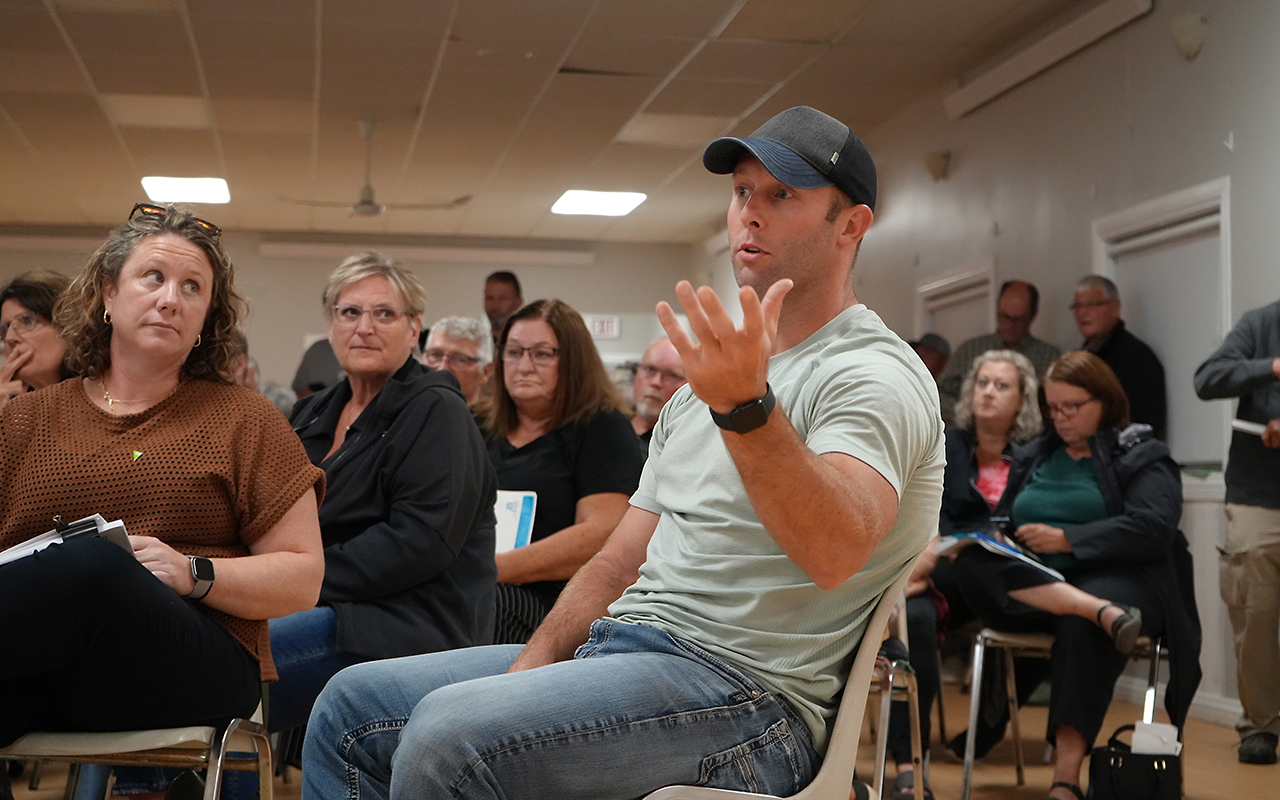



About 50 people packed the Shawville RA hall on the evening of Sept. 18 for a public information session hosted by the municipality to discuss the future of the Shawville arena.
The municipality called the meeting to share the contents of a report it received earlier this summer that detailed $17 million in repairs recommended to repair its floor, keep the ice plant alive and bring the arena up to minimum fire and building code requirements.
The hall was packed with arena users, representatives from various municipalities and community groups, and interested citizens, many of whom had questions for the council about their plans for the future of the arena.
Shawville councillor and arena committee chair Julien Gagnon shared the study’s findings, saying that a growing deficit and the study’s long list of recommended fixes make the next few years a critical decision point for the future of the arena.
Councillor Richard Armitage explained the arena’s deficit has grown in recent years because of increasing expenses related to the ice plant. Last year, the town spent $47,000 on ice plant repairs from refrigeration company Cimco, increased hydro costs as well $10,000 spent on the zamboni this spring to get it through the rest of the season. Also, the municipality’s rent contribution to the Pontiac Agricultural Society (PAS) rose from $2,100 to $25,000 this year, also contributing to the deficit.
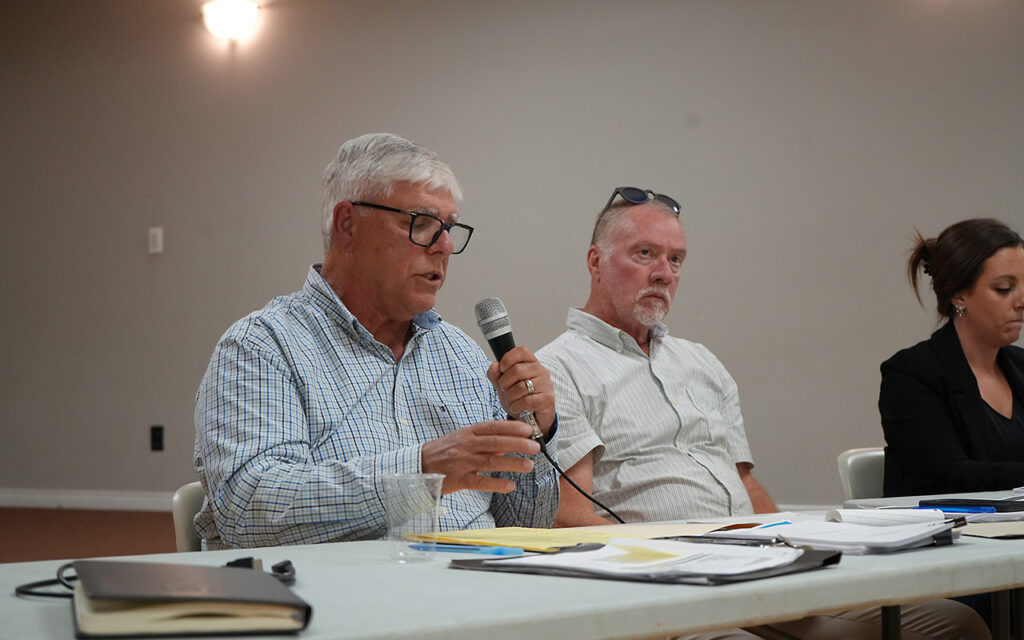
“The municipality believes we are at a major junction point in the history of the Shawville arena,” Gagnon said, adding that the municipality has not made any decisions and wants to hear from the community first on which route it wants to see the arena take.
Gagnon encouraged attendees to fill out a survey with their residence information, level of involvement with the arena, and which fixes residents want to see prioritized. In his presentation he suggested three main paths forward: address repairs as they come up, make the more expensive repairs listed in the study, or find a way to build a new arena altogether.
“Month to month we don’t know if the arena will be operating. That’s where we’re at, it’s that scary, and that’s what we’re concerned about.”
Public chimes in
Several members of the public stepped forward to ask questions about the arena’s finances, share suggestions for possible strategies to move forward, as well as their feelings about the critical role the arena plays in the community.
Arena user Greg Hayes suggested the municipality could help tackle some of the deficit by raising the rate for men’s leagues in addition to youth users.
Gagnon said the municipality is open to this, and while it has sometimes been hard to track down players to pay their fee, he said he is in talks with men’s leagues to provide a photocopy of their driver’s licence as a proof of address.
“We’re putting the onus on those leagues, but considering that we doubled the cost of a user fee last year, we have to consider that we didn’t increase accordingly the men’s league’s rentals,” said Gagnon.
Hayes, whose kids also used the arena for minor hockey, said when it comes to the arena’s future the community cannot afford a disruption of services.
“Therefore there is no chance that a major renovation can happen. There’s no alternative but to keep using it, but the only way that we can keep using it is to repair it properly while we figure out the plan,” he said.
Meagan Derouin, vice-president of the Pontiac Arena Fund, weighed in on the question of how to get support from other municipalities who use the arena.
She said while Shawville is asking other municipalities to contribute to attack its deficit, other municipalities also have financial challenges of their own and may not be able to afford to contribute.
“We can’t expect that each municipality is going to pay,” she said.
After a slight confusion over how the municipality came to the $177,000 deficit number, Derouin asked Gagnon if there could be a way where municipalities’ arena users could share a relatively equal tax burden, instead of Shawville taxpayers paying it all.
“Are you suggesting that potentially that if we are doing a [25 per cent split] for the four municipalities that use it the most, then it would be approximately $50 each on each person’s taxes instead of $215 for Shawville?”
Gagnon said yes, however it is not that simple because Shawville has been the only municipality to manage the arena throughout its 60-plus-year history, making it hard to get other municipalities to chip in.
“The main issue is when you have a municipality paying zero dollars and you are asking for money for a service that we are already offering, and we are saying ‘pretty please, would you send us $50 per tax bill,’
[ . . . ] It’s easy to say no.”
PAS president Ralph Lang said he’s found it difficult to get financial statements out of the municipality, suggesting that it will be hard to find a partner to run the facility.
“We’ve had trouble getting financial statements out of council about what the cost is to run the arena. We’ve heard about deficits for the past three or four years, they’re real hard to get. It’s hard to get a partner unless you’re transparent and honest,” he said.
“When we get numbers, we will make sure the public gets them,” said Gagnon later in the meeting. “Other than increasing taxes, we’re kind of strapped on some of the budget. We’re spending more than the average municipality in terms of recreation, and unfortunately it’s going mostly to the arena.”
Shawville looking for partners
Currently, Shawville alone manages the operations of the arena as a tenant of the PAS, but it is looking for both financial and operational support from other municipalities.
Council said it would be open to building a new arena if it could find partners to own and operate the facility. This could either be neighbouring municipalities or community organizations such as the PAS, the RA or the Pontiac Arena Fund.
Gagnon said the municipality has done some basic calculations about what it would cost to build a new arena, and how much each partner would have to pay. While a preliminary estimate received by the municipality for a new arena amounted to around $30 million, there is no official plan yet and therefore no accurate estimate.
“Assuming our net contribution is a third of $30 million and we can get $20 million in grant money, we would have to look for at least four partners [ . . . ] which gives us about $2.5 million. We could finance that over 10 or 20 years, and we’re looking at maybe $100,000 to $200,000 a year,” he said.
While the municipalities of Clarendon and Thorne have contributed financially, and discussions are being had with other municipalities including the Municipality of Pontiac, Gagnon said again it has been difficult to get more of a commitment.
“Anytime we’ve discussed that with other municipalities, they’ve been willing to sign the cheque, but not manage the operation because it’s a big headache.”
Gagnon said some sort of shared recreation budget between some major users of the arena could be a possible solution toward an equitable sharing of arena costs.
“Personally, I will 100 per cent pay for part of the [Bristol] pier because I know residents of the Municipality of Shawville love to go swimming [ . . . ] If there’s any major projects I think we should all chip in together.”
Councillor and finance committee chair Richard Armitage said he has been asking for help since 2022, and is hoping someone will step up to the plate.
“All I want right now is a reliable arena. We can’t let those programs go to pieces,” he said of the minor hockey and figure skating programs.
Gagnon said while a new arena is likely at least five years away, the municipality wanted to collect this information from the public before the election nomination period ends so it can hit the ground running when the next council is sworn in, in November.
“We just want to make sure we know you’re open to anything, that way going forward we know who’s into one aspect or nothing at all, that way we can come back to you with prices for all that stuff,” he said.
He added that the council will consider the results of the survey and use them to help orient the direction the next council will take. Shawville council will cease being able to act as a council after the Oct. 2 council meeting.
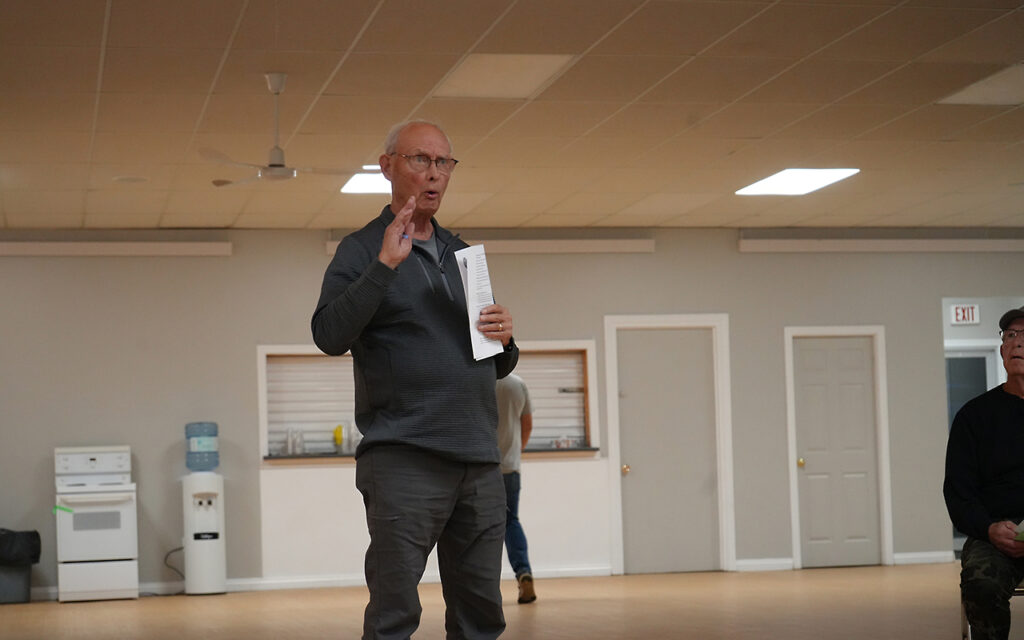
Environ 50 personnes ont rempli la salle du RA de Shawville le soir du 18 sept. pour une séance d’information publique organisée par la municipalité afin de discuter de l’avenir de l’aréna de Shawville.
La municipalité a convoqué la réunion pour partager le contenu d’un rapport reçu plus tôt cet été, détaillant 17 millions de dollars en réparations recommandées pour son plancher, maintenir l’usine de glace en fonction et mettre l’aréna aux normes minimales du code du bâtiment et de sécurité incendie.
La salle était remplie d’usagers de l’aréna, de représentants de diverses municipalités et groupes communautaires, et de citoyens intéressés, dont beaucoup avaient des questions pour le conseil concernant ses plans pour l’avenir de l’aréna.
Julien Gagnon, conseiller municipal de Shawville et président du comité de l’aréna, a partagé les conclusions de l’étude, affirmant qu’un déficit croissant et la longue liste de réparations recommandées par l’étude font des prochaines années un point de décision critique pour l’avenir de l’aréna.
Le conseiller Richard Armitage a expliqué que le déficit de l’aréna a augmenté ces dernières années en raison des dépenses croissantes liées à l’usine de glace. L’année dernière, la ville a dépensé 47 000 $ pour des réparations à l’usine de glace effectuées par la compagnie de réfrigération Cimco, a subi une augmentation des coûts d’électricité, et a dépensé 10 000 $ pour la zamboni ce printemps afin qu’elle puisse traverser le reste de la saison. De plus, la contribution locative de la municipalité à la Société agricole du Pontiac (SAP) est passée de 2 100 $ à 25 000 $ cette année, contribuant également au déficit.
« La municipalité croit que nous sommes à un carrefour important dans l’histoire de l’aréna de Shawville », a déclaré M. Gagnon, ajoutant que la municipalité n’a pris aucune décision et souhaite d’abord entendre la communauté sur la voie qu’elle veut voir l’aréna prendre.
M. Gagnon a encouragé les participants à remplir un sondage avec leurs informations de résidence, leur niveau d’implication avec l’aréna, et les réparations que les résidents souhaitent voir priorisées. Dans sa présentation, il a suggéré trois pistes principales : adresser les réparations au fur et à mesure, effectuer les réparations plus coûteuses énumérées dans l’étude, ou trouver un moyen de construire un tout nouvel aréna.
« Mois après mois, nous ne savons pas si l’aréna sera en opération. C’est là que nous en sommes, c’est si effrayant, et c’est ce qui nous inquiète. »
Le public se prononce
Plusieurs membres du public se sont avancés pour poser des questions sur les finances de l’aréna, partager des suggestions de stratégies possibles pour aller de l’avant, ainsi que leurs sentiments sur le rôle crucial que joue l’aréna dans la communauté.
Greg Hayes, un usager de l’aréna, a suggéré que la municipalité pourrait aider à combler une partie du déficit en augmentant le tarif pour les ligues masculines en plus des jeunes utilisateurs.
M. Gagnon a dit que la municipalité était ouverte à cette idée, et bien qu’il ait parfois été difficile de retrouver les joueurs pour qu’ils paient leurs frais, il a déclaré être en pourparlers avec les ligues masculines pour qu’elles fournissent une photocopie de leur permis de conduire comme preuve de résidence.
« Nous mettons la responsabilité sur ces ligues, mais étant donné que nous avons doublé le coût des frais d’utilisation l’année dernière, nous devons considérer que nous n’avons pas augmenté en conséquence les frais de location des ligues masculines », a déclaré M. Gagnon.
M. Hayes, dont les enfants ont également utilisé l’aréna pour le hockey mineur, a déclaré qu’en ce qui concerne l’avenir de l’aréna, la communauté ne peut pas se permettre une interruption des services.
« Par conséquent, il n’y a aucune chance qu’une rénovation majeure puisse avoir lieu. Il n’y a pas d’autre solution que de continuer à l’utiliser, mais la seule façon de continuer à l’utiliser est de le réparer correctement pendant que nous élaborons le plan », a-t-il dit.
Meagan Derouin, vice-présidente du Fonds de l’aréna de Pontiac, est intervenue sur la question de savoir comment obtenir le soutien des autres municipalités qui utilisent l’aréna.
Elle a dit que bien que Shawville demande à d’autres municipalités de contribuer à la réduction de son déficit, ces dernières ont aussi leurs propres défis financiers et pourraient ne pas être en mesure de contribuer.
« On ne peut pas s’attendre à ce que chaque municipalité paie », a-t-elle dit.
Après une légère confusion sur la manière dont la municipalité est arrivée au chiffre du déficit de 177 000 $, Mme Derouin a demandé à M. Gagnon s’il y avait un moyen pour que les usagers de l’aréna des municipalités puissent partager un fardeau fiscal relativement égal, au lieu que les contribuables de Shawville paient tout.
« Suggérez-vous que si nous faisons un [partage de 25 pour cent] pour les quatre municipalités qui l’utilisent le plus, alors ce serait environ 50 $ chacun sur les taxes de chaque personne au lieu de 215 $ pour Shawville ? »
M. Gagnon a répondu oui, mais ce n’est pas si simple parce que Shawville a été la seule municipalité à gérer l’aréna tout au long de ses plus de 60 ans d’histoire, ce qui rend difficile d’obtenir que d’autres municipalités y contribuent.
« Le problème principal est quand vous avez une municipalité qui paie zéro dollar et que vous demandez de l’argent pour un service que nous offrons déjà, et que nous disons « s’il vous plaît, seriez-vous si gentils de nous envoyer 50 $ par facture de taxes »,
[ . . . ] Il est facile de dire non. »
Ralph Lang, président de la SAP, a dit qu’il a trouvé difficile d’obtenir des états financiers de la municipalité, suggérant qu’il sera difficile de trouver un partenaire pour gérer l’installation.
« Nous avons eu du mal à obtenir des états financiers du conseil concernant le coût d’exploitation de l’aréna. Nous entendons parler de déficits depuis trois ou quatre ans, ils sont très difficiles à obtenir. Il est difficile de trouver un partenaire à moins d’être transparent et honnête », a-t-il dit.
« Quand nous aurons les chiffres, nous nous assurerons que le public les obtienne », a déclaré M. Gagnon plus tard dans la réunion. « À part l’augmentation des taxes, nous sommes un peu à court de budget. Nous dépensons plus que la municipalité moyenne en termes de loisirs, et malheureusement, cela va principalement à l’aréna. »
Shawville cherche des partenaires
Actuellement, Shawville gère seule les opérations de l’aréna en tant que locataire de la SAP, mais elle recherche un soutien financier et opérationnel d’autres municipalités.
Le conseil a dit qu’il serait ouvert à la construction d’un nouvel aréna s’il pouvait trouver des partenaires pour posséder et exploiter l’installation. Il pourrait s’agir de municipalités voisines ou d’organisations communautaires telles que la SAP, le RA ou le Fonds de l’aréna de Pontiac.
M. Gagnon a dit que la municipalité a fait quelques calculs de base sur ce qu’il en coûterait pour construire un nouvel aréna, et combien chaque partenaire devrait payer. Bien qu’une estimation préliminaire reçue par la municipalité pour un nouvel aréna s’élevait à environ 30 millions de dollars, il n’y a pas encore de plan officiel et donc pas d’estimation précise.
« En supposant que notre contribution nette représente un tiers de 30 millions de dollars et que nous puissions obtenir 20 millions de dollars en subventions, nous devrions chercher au moins quatre partenaires [ . . . ] ce qui nous donnerait environ 2,5 millions de dollars. Nous pourrions financer cela sur 10 ou 20 ans, et nous envisagerions peut-être 100 000 $ à 200 000 $ par an », a-t-il dit.
Bien que les municipalités de Clarendon et de Thorne aient contribué financièrement, et que des discussions soient en cours avec d’autres municipalités, y compris la Municipalité de Pontiac, M. Gagnon a répété qu’il avait été difficile d’obtenir un engagement plus ferme.
« Chaque fois que nous en avons discuté avec d’autres municipalités, elles étaient prêtes à signer le chèque, mais pas à gérer l’opération parce que c’est un gros casse-tête. »
M. Gagnon a dit qu’une sorte de budget récréatif partagé entre certains grands utilisateurs de l’aréna pourrait être une solution possible pour un partage équitable des coûts de l’aréna.
« Personnellement, je paierai à 100 % une partie du quai [de Bristol] parce que je sais que les résidents de la Municipalité de Shawville adorent aller nager [ . . . ] S’il y a des projets majeurs, je pense que nous devrions tous y contribuer ensemble. »
Le conseiller et président du comité des finances, Richard Armitage, a dit qu’il demandait de l’aide depuis 2022, et espère que quelqu’un se manifestera.
« Tout ce que je veux en ce moment, c’est un aréna fiable. Nous ne pouvons pas laisser ces programmes s’écrouler », a-t-il dit en parlant des programmes de hockey mineur et de patinage artistique.
M. Gagnon a dit que même si un nouvel aréna est probablement dans au moins cinq ans, la municipalité voulait recueillir ces informations auprès du public avant la fin de la période de mise en candidature aux élections afin qu’elle puisse démarrer en force lorsque le prochain conseil sera assermenté, en novembre.
« Nous voulons simplement nous assurer de savoir que vous êtes ouverts à tout, de cette façon, à l’avenir, nous saurons qui est intéressé par un aspect ou rien du tout, ainsi nous pourrons revenir vers vous avec des prix pour tout cela », a-t-il dit.
Il a ajouté que le conseil examinera les résultats du sondage et les utilisera pour aider à orienter la direction que prendra le prochain conseil. Le conseil de Shawville cessera d’être en mesure d’agir en tant que conseil après la réunion du conseil du 2 oct.