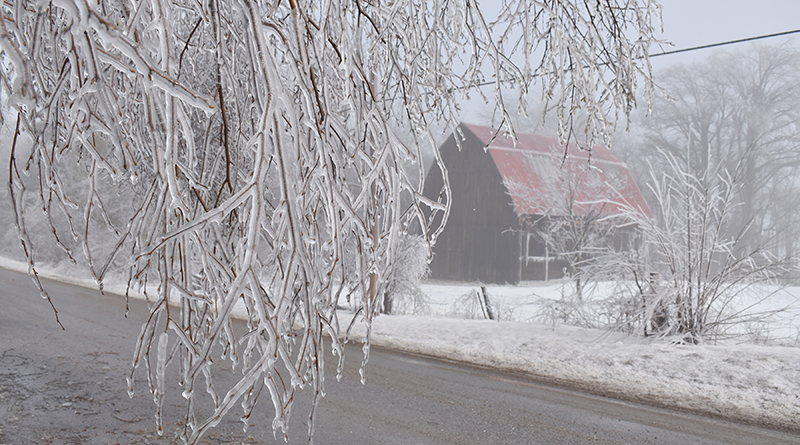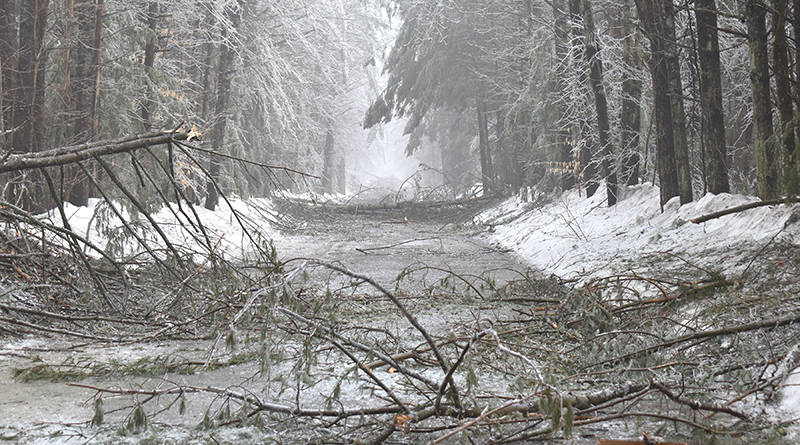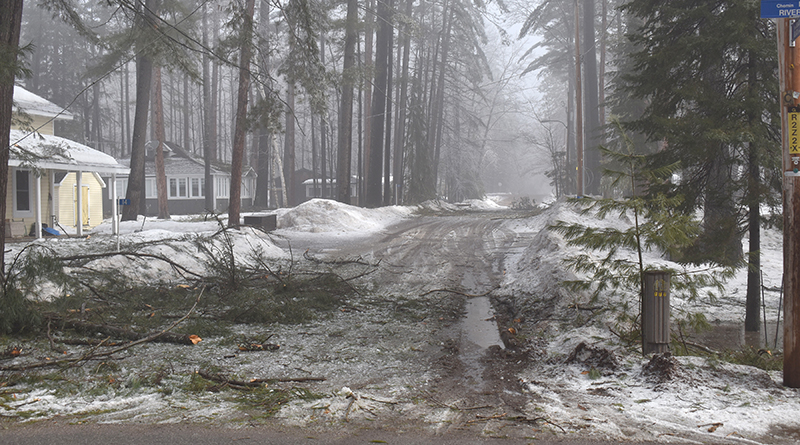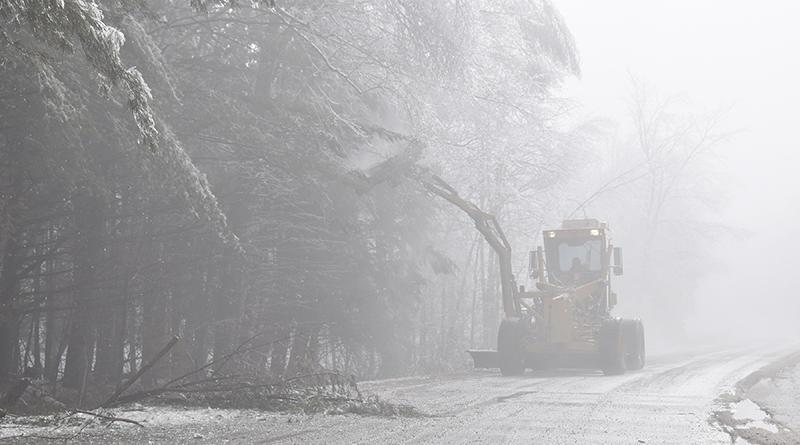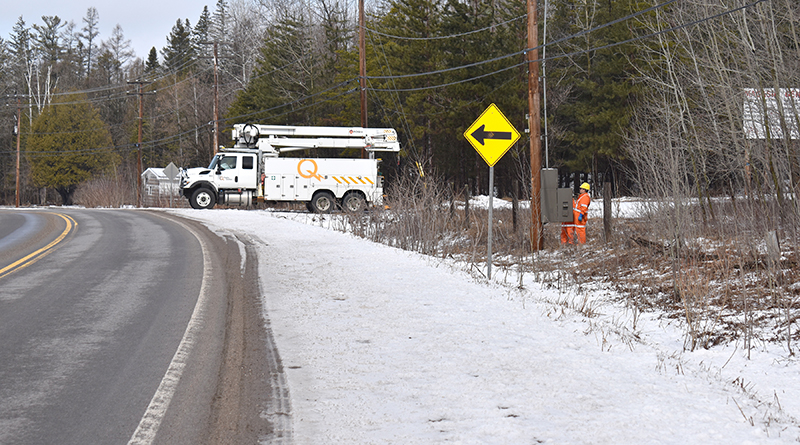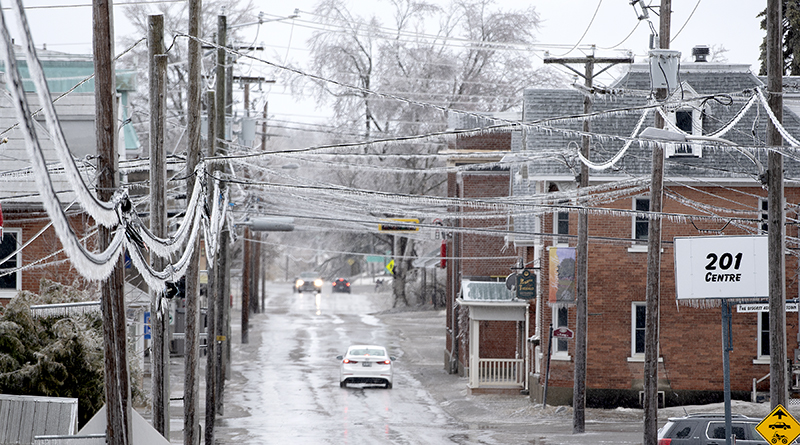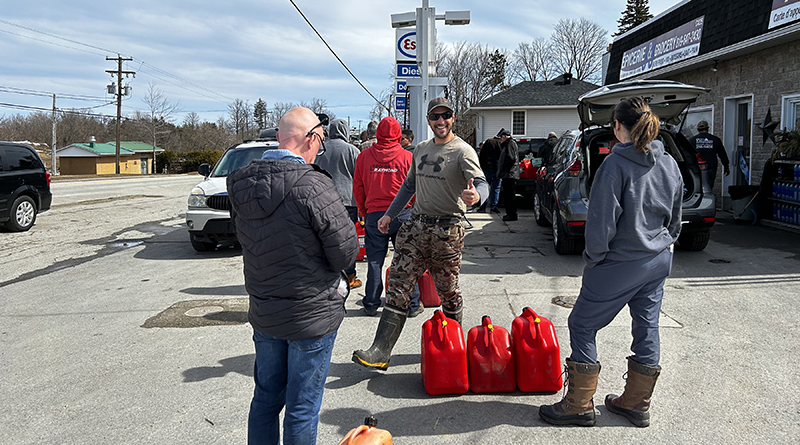







The biggest ice storm to hit the region since 1998 left thousands of homes and businesses across the Pontiac and beyond without electricity this Easter long weekend. The ice storm, which occurred most of the day last Wednesday, brought high winds that disabled much the province’s energy infrastructure.
As of Monday, over 2000 Hydro Quebec (HQ) customers in the Pontiac were still without power. At the outage’s peak on Thursday, 117,821 out of 226,921 HQ customers in the Outaouais were without power. In the MRC Pontiac there were about 10,000 out of the over 12,600 HQ customers with no power.
While towns like Chapeau, Fort-Coulonge, and most of Shawville saw their power restored by the end of Thursday night, places like Bristol, Otter Lake, most of Clarendon, Quyon, Portage-du-Fort and more went more than five days straight without power.
Along with the widespread power outages, the storm also caused the cellular network to shut down in much of the area during the first two days of the crisis, causing communication difficulties.
According to HQ, the hydro outages were primarily caused by Wednesday’s ice storm bringing trees down on power lines. Network outages were caused by a lack of power to the cellular towers, according to MRC Pontiac officials.
During the weekend, HQ crews were put under pressure to restore power to the entire province, and Pontiac was no exception.
In a presentation to Quebec municipalities held on Thursday, HQ representatives outlined how they prioritized their restoration efforts.
According to the presentation, the first priority of HQ is to restore service to critical infrastructure like hospitals. The second priority is to reestablish communication services to allow authorities to communicate to the population about public safety and restoration work. The third priority is to reestablish service to CHSLDs, CLSCs, public services, and critical industries. After those three priorities are met crews then work on restoring everyone else.
When restoring services to residential areas, HQ explained lines that have a higher density of users on them are prioritized, meaning a line that serves 100 customers would be prioritized before a line that serves 10.
During the last outage, various municipal halls and other buildings were open to the public for residents to come in to charge their phones, use the internet, have a coffee, take a shower and more.
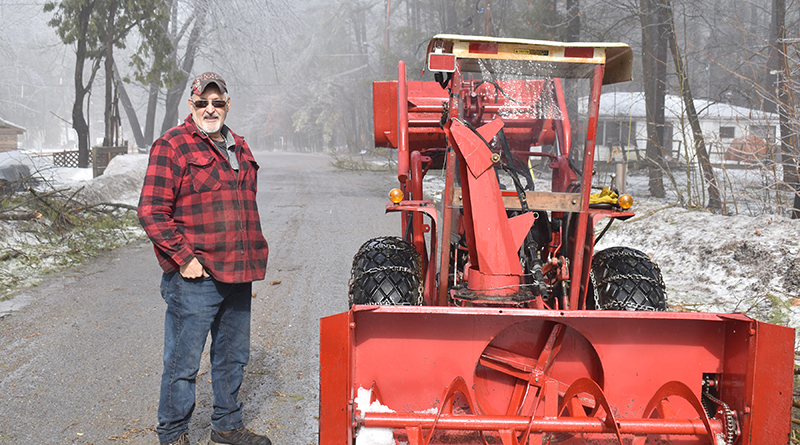
THE EQUITY also heard various reports of neighbours helping each other clean up debris and the sharing of generators.
“As usual, the Pontiac comes together when there’s a crisis, and we all work together,” said Kim Lesage, Director General of the MRC Pontiac.
MRC Pontiac officials, Pontiac MNA André Fortin, and the mayors of the various municipalities coordinated their efforts with HQ during the event.
While local leaders have generally been sympathetic to the scale of the challenge of restoring power to affected areas of the province, as the outages continued more criticisms of HQ’s response were voiced.
“It’s now been five and a half days since the start of this and the fact that there are too few hydro crews out there directly leads to an inadequate response time,” Fortin said.
“This has really taught us that we need a lot of change in terms of the way priority is given,” Warden Jane Toller said. For example, Toller stressed that farms and grocery stores need to be given a higher priority during restoration efforts.
“Our farmers need far more attention. This is 32 per cent of the employment of the Pontiac and when it comes to running farm equipment you need hydro.”
Toller said she has had to contact HQ to intervene in a few cases where it was critical for service to be restored.
Another area of concern for both Fortin and Toller was that HQ failed to take advantage of hydro workers from Ontario and private contractors to restore power.
“HQ made it clear in their press conferences that they refused the help of other jurisdictions for what they claim to be different technology and too much training and coordination required. But having too few crews means that people missed out on power for extended periods of time. Hydro Quebec workers go in to assist in other provinces and in the US all the time so this seems like a point that definitely needs to be looked into,” Fortin said.
“Hydro One (Ontario’s power utility) workers should have been not only allowed to come across but summoned, we should have had the ability to call in help right at the beginning and tackle this so that after two or three days we would have the power restored for everyone,” Toller said.
Fortin and Toller also pointed out the breakdown in communication between various segments of society as a critical failure.
“The lack of communication is the real issue here. Hydro Quebec puts forward its priorities, but it’s hard for citizens to see whether they actually follow it or not. And so that needs to be addressed in future outages,” Fortin said.
“This is the first experience that we haven’t had landlines and cell phones and internet working on a large scale. So what could we do to communicate? I think CHIP radio did a good job but even they didn’t have power for a while,” Toller said.
Toller also added that direct communication from HQ to customers could be improved.
“One of the things that has bothered residents the most is not being given a range of roughly how long it’s going to take them to restore power to certain areas,” Toller said.
On that point Fortin added that as restoration occured for the bulk of the population, those left behind should have been given more specific details and timelines on their circumstances, however that did not happen.
In terms of going forward Fortin and Toller have offered a few solutions.
“We need to look at a better forestry management or tree management system around our hydro lines,” Fortin said. “It seems that most of the damage was caused by trees that maybe could have been could have been cut or trimmed.”
“I think that we need to learn from this experience. Hydro Quebec have told us that they’re looking forward to follow-up meetings, and that we need to have good constructive ideas. One thing that’s not constructive is burying all the lines. That will never happen. It’s way too expensive, especially in Pontiac. We need better planning and more cooperation,” said Toller.
Fortin also said that the province should be looking at compensating customers who have experienced damages as a result of the outage.
“This has had a massive cost not only to municipalities but to businesses and to citizens. I’d like to get a clearer picture so we can make appropriate representations in that regard. The government has said that municipalities would receive some form of compensaation without going into too many details. That’s great, but a lot of what a lot of the costs that were incurred were by private citizens themselves and that can’t be that can’t be simply dismissed.”
Fortin, Toller, and others also emphasized their gratefulness for the work performed by HQ employees, municipal leaders and volunteers who had to give up their Easter long weekend to try to get a handle on the situation.
The full extent of the damage of the storm is not yet known.
photos and story by Brett Thoms