By Ole Hendrickson
The Canadian Nuclear Safety Commission (CNSC) has scheduled hearings on a controversial 60-foot-high mound for one million cubic metres of radioactive and hazardous wastes, called the “Near Surface Disposal Facility”, or NSDF.
The mound – similar to a municipal landfill – would be built on a hillside next to a lake and wetlands, one kilometer from the Ottawa River, directly across from the Municipality of Sheenboro, on the Chalk River Laboratories property of Atomic Energy of Canada Limited (AECL). The mound would leak for thousands of years into the Ottawa River and pose . . .
serious risks to present and future Ottawa Valley residents.
Canadian Nuclear Laboratories (CNL) is the NSDF proponent. In 2015, ownership of CNL was transferred from AECL to SNC-Lavalin and Texas-based Fluor and Jacobs through a 10-year, multi-billion-dollar contract issued by the Harper government that calls for reducing AECL’s $16-billion nuclear liability as quickly and cheaply as possible.
The CNSC has never refused to grant a licence for a new nuclear facility. A draft licence and an environmental assessment (EA) report for the NSDF were scheduled for release on January 24.
Judging from past experience, CNSC will probably claim that the NSDF project “is not likely to cause significant adverse environmental effects”, or that the significant adverse environmental effects it is likely to cause are “justified in the circumstances.”
The CNSC initially promised a public hearing and a public comment period on its EA report, but later eliminated them.
Even though the International Atomic Energy Agency (IAEA) says siting is a “fundamentally important activity in the disposal of radioactive waste”, the mound location was chosen to be as close as possible to the dozens of old, radioactively contaminated structures awaiting demolition at Chalk River Laboratories.
The IAEA says landfills are suitable only for very low level waste with “very limited” concentrations of long-lived radionuclides. The waste inventory in CNL’s environmental impact statement (EIS) shows 23 of 31 radionuclides with half-lives exceeding 1,600 years, including the man-made elements americium, neptunium and plutonium.
The EIS says the mound would experience degradation as a result of “normal evolution”. This means that mixed radioactive and hazardous industrial wastes (arsenic, beryllium, mercury, benzene, dioxins, PCBs, etc.) would leak into the Ottawa River, essentially forever.
Future generations might be tempted to scavenge for scrap metal in the mound—an estimated 33 tonnes of aluminum, 178 tonnes of lead, 3,520 tonnes of copper, and 10,442 tonnes of iron.
The EIS contains minimal information on the sources of the wastes that would go into the mound. It does not mention that commercial industry wastes – such as highly radioactive cobalt-60 devices used to sterilize medical equipment – would go in the mound. It does not describe the wastes being sent to Chalk River from shut-down AECL reactor locations in Quebec, southern Ontario and Manitoba. It merely refers to disposal of waste “packages” that range in size up to intermodal shipping containers.
Because the mound’s contents would be exposed to wind, rain, and snow during a 50-year operating phase, the project includes a water treatment plant to remove leachate contaminants. Some packages would supposedly be designed so their contents would not leak out, but no evidence is provided that they would withstand the heavy equipment (bulldozers, rollers) used to compact the mound.
The treatment plant would not remove tritium, the radioactive form of hydrogen. A pipeline would discharge partly treated leachate into Perch Lake, which drains through Perch Creek into the Ottawa River, one kilometre away.
A former AECL staff member says CNL lacks adequate waste characterization and waste segregation procedures. This raises concerns about whether CNL would be able to track the wastes going into the mound and not exceed its “licensed inventory.”
The $750-million cost estimate in the EIS lacks credibility. Canada has no experience with permanent radioactive waste disposal. Why build such an expensive facility that would do little to reduce the federal nuclear liability, would not conform to international safety standards, and would pollute the Ottawa River?
A 2019 IAEA mission to Canada found virtually “no evidence of a governmental policy or strategy related to radioactive waste management.” In response, Natural Resources Canada (NRCan) launched an “engagement process to modernize Canada’s Radioactive Waste Policy” in November 2020. Seven environmental petitions related to the NSDF have been filed with Canada’s Auditor General, who anticipates publication of a nuclear waste management audit this year.
The Auditor General’s nuclear waste management audit and NRCan’s policy process should be allowed to conclude before the CNSC considers approving the NSDF. Their results may help prevent the NSDF from becoming a financial and environmental disaster that would permanently contaminate one of Canada’s most treasured heritage rivers.
Ole Hendrickson is a researcher with Concerned Citizensof Renfrew County and Area.
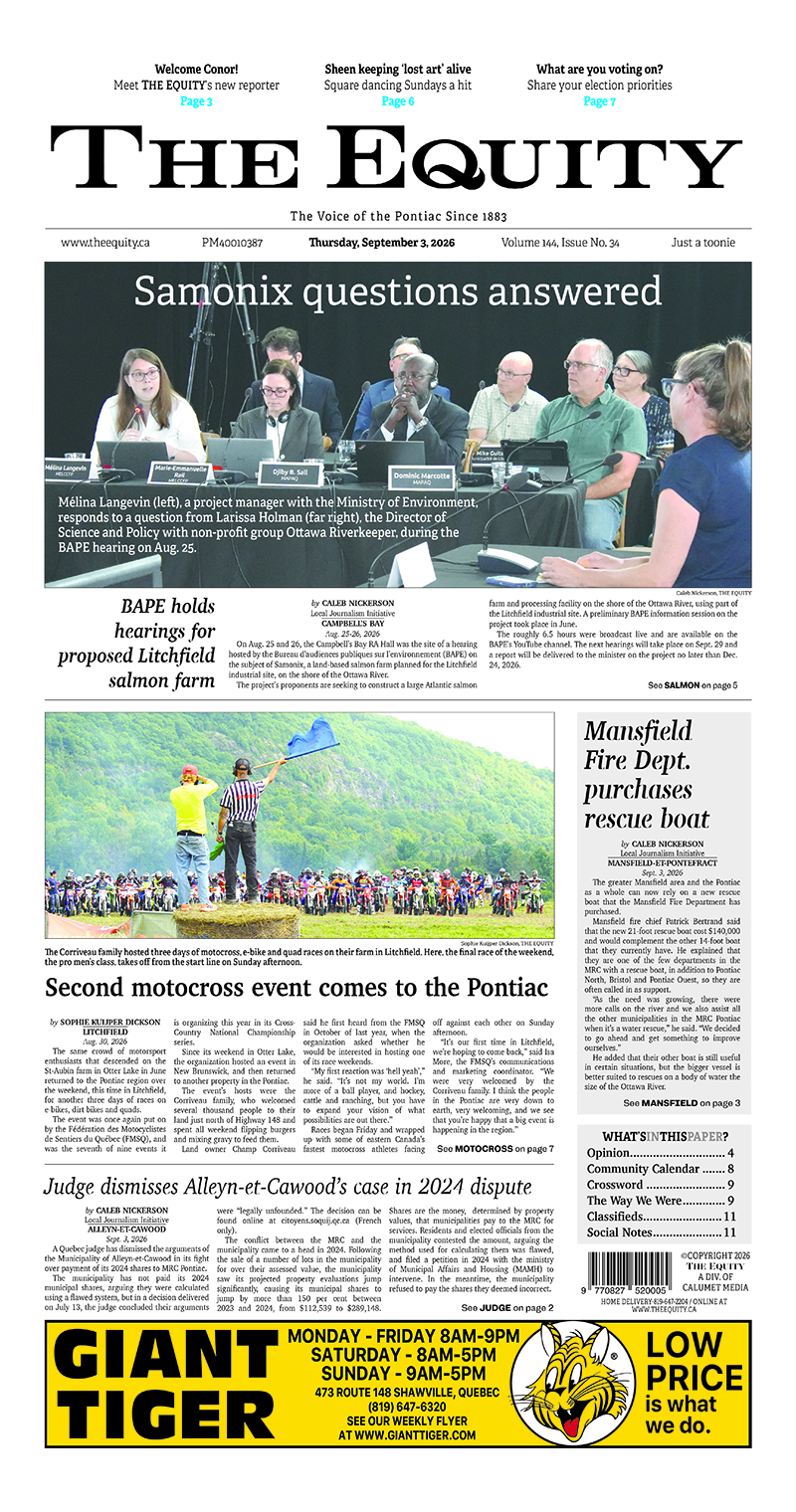



Near Surface Disposal Facility creates unacceptable risks to Ottawa River communities
Near Surface Disposal Facility creates unacceptable risks to Ottawa River communities
Council of mayors holds special meeting to approve financial statements
Meet THE EQUITY’s new reporter
Mansfield Fire Dept. purchases rescue boat
Judge dismisses Alleyn-et-Cawood’s case in 2024 dispute
Thrift art sale
Sheen square dancers put their steps to the test
Second motocross event comes to the Pontiac
Shawville Fair highlights from over the years
Salmon farm proposal gets grilled
In Photos: Shawville Fairs Past (1977 – 2001)
Lions fire up the grill for St. Paul’s chicken dinner
Parti Québécois announces Pontiac candidate
By Ole Hendrickson
The Canadian Nuclear Safety Commission (CNSC) has scheduled hearings on a controversial 60-foot-high mound for one million cubic metres of radioactive and hazardous wastes, called the “Near Surface Disposal Facility”, or NSDF.
The mound – similar to a municipal landfill – would be built on a hillside next to a lake and wetlands, one kilometer from the Ottawa River, directly across from the Municipality of Sheenboro, on the Chalk River Laboratories property of Atomic Energy of Canada Limited (AECL). The mound would leak for thousands of years into the Ottawa River and pose . . .
serious risks to present and future Ottawa Valley residents.
Canadian Nuclear Laboratories (CNL) is the NSDF proponent. In 2015, ownership of CNL was transferred from AECL to SNC-Lavalin and Texas-based Fluor and Jacobs through a 10-year, multi-billion-dollar contract issued by the Harper government that calls for reducing AECL’s $16-billion nuclear liability as quickly and cheaply as possible.
The CNSC has never refused to grant a licence for a new nuclear facility. A draft licence and an environmental assessment (EA) report for the NSDF were scheduled for release on January 24.
Judging from past experience, CNSC will probably claim that the NSDF project “is not likely to cause significant adverse environmental effects”, or that the significant adverse environmental effects it is likely to cause are “justified in the circumstances.”
The CNSC initially promised a public hearing and a public comment period on its EA report, but later eliminated them.
Even though the International Atomic Energy Agency (IAEA) says siting is a “fundamentally important activity in the disposal of radioactive waste”, the mound location was chosen to be as close as possible to the dozens of old, radioactively contaminated structures awaiting demolition at Chalk River Laboratories.
The IAEA says landfills are suitable only for very low level waste with “very limited” concentrations of long-lived radionuclides. The waste inventory in CNL’s environmental impact statement (EIS) shows 23 of 31 radionuclides with half-lives exceeding 1,600 years, including the man-made elements americium, neptunium and plutonium.
The EIS says the mound would experience degradation as a result of “normal evolution”. This means that mixed radioactive and hazardous industrial wastes (arsenic, beryllium, mercury, benzene, dioxins, PCBs, etc.) would leak into the Ottawa River, essentially forever.
Future generations might be tempted to scavenge for scrap metal in the mound—an estimated 33 tonnes of aluminum, 178 tonnes of lead, 3,520 tonnes of copper, and 10,442 tonnes of iron.
The EIS contains minimal information on the sources of the wastes that would go into the mound. It does not mention that commercial industry wastes – such as highly radioactive cobalt-60 devices used to sterilize medical equipment – would go in the mound. It does not describe the wastes being sent to Chalk River from shut-down AECL reactor locations in Quebec, southern Ontario and Manitoba. It merely refers to disposal of waste “packages” that range in size up to intermodal shipping containers.
Because the mound’s contents would be exposed to wind, rain, and snow during a 50-year operating phase, the project includes a water treatment plant to remove leachate contaminants. Some packages would supposedly be designed so their contents would not leak out, but no evidence is provided that they would withstand the heavy equipment (bulldozers, rollers) used to compact the mound.
The treatment plant would not remove tritium, the radioactive form of hydrogen. A pipeline would discharge partly treated leachate into Perch Lake, which drains through Perch Creek into the Ottawa River, one kilometre away.
A former AECL staff member says CNL lacks adequate waste characterization and waste segregation procedures. This raises concerns about whether CNL would be able to track the wastes going into the mound and not exceed its “licensed inventory.”
The $750-million cost estimate in the EIS lacks credibility. Canada has no experience with permanent radioactive waste disposal. Why build such an expensive facility that would do little to reduce the federal nuclear liability, would not conform to international safety standards, and would pollute the Ottawa River?
A 2019 IAEA mission to Canada found virtually “no evidence of a governmental policy or strategy related to radioactive waste management.” In response, Natural Resources Canada (NRCan) launched an “engagement process to modernize Canada’s Radioactive Waste Policy” in November 2020. Seven environmental petitions related to the NSDF have been filed with Canada’s Auditor General, who anticipates publication of a nuclear waste management audit this year.
The Auditor General’s nuclear waste management audit and NRCan’s policy process should be allowed to conclude before the CNSC considers approving the NSDF. Their results may help prevent the NSDF from becoming a financial and environmental disaster that would permanently contaminate one of Canada’s most treasured heritage rivers.
Ole Hendrickson is a researcher with Concerned Citizensof Renfrew County and Area.
More Local News
Council of mayors holds special meeting to approve financial statements
Meet THE EQUITY’s new reporter
Mansfield Fire Dept. purchases rescue boat
Judge dismisses Alleyn-et-Cawood’s case in 2024 dispute
Thrift art sale
Sheen square dancers put their steps to the test
Second motocross event comes to the Pontiac
Shawville Fair highlights from over the years
Salmon farm proposal gets grilled
In Photos: Shawville Fairs Past (1977 – 2001)
Lions fire up the grill for St. Paul’s chicken dinner
Parti Québécois announces Pontiac candidate
Council of mayors holds special meeting to approve financial statements
Meet THE EQUITY’s new reporter
Mansfield Fire Dept. purchases rescue boat
Judge dismisses Alleyn-et-Cawood’s case in 2024 dispute
Thrift art sale
Sheen square dancers put their steps to the test
Second motocross event comes to the Pontiac
Shawville Fair highlights from over the years
Salmon farm proposal gets grilled
In Photos: Shawville Fairs Past (1977 – 2001)
Lions fire up the grill for St. Paul’s chicken dinner
Parti Québécois announces Pontiac candidate
Near Surface Disposal Facility creates unacceptable risks to Ottawa River communities