


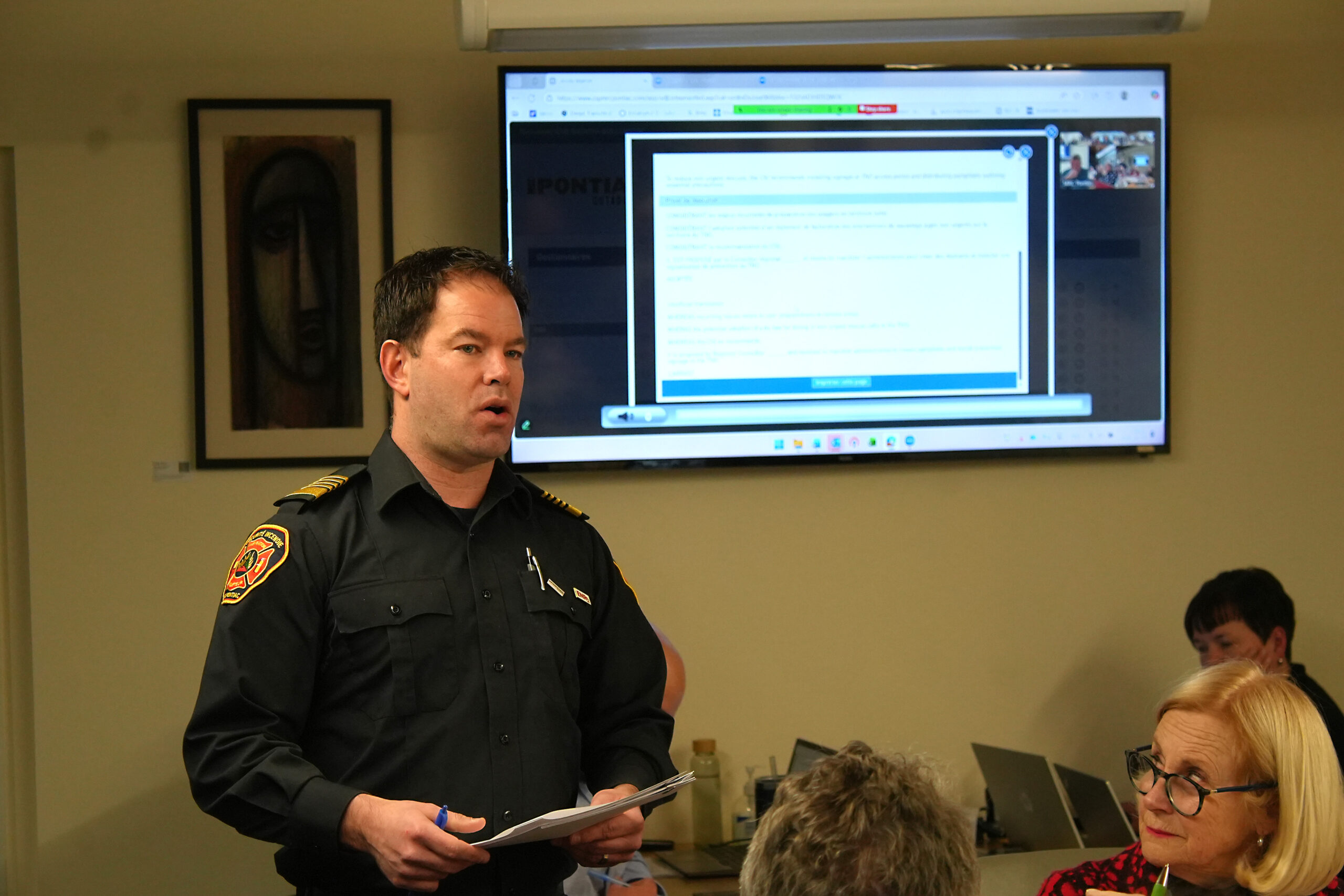



At the MRC Pontiac council of mayors public meeting on Jan. 29, there were two big grants awarded through the FRR component four funding envelope, which is distributed by the provincial ministry of municipal affairs and administered by MRC Pontiac.
The MRC awarded $23,000 to the Shawville Curling Club to deal with issues with its ice plant.
Another $100,000 was awarded to the Shawville Arena for emergency ice-related work, and an additional $10,000 was earmarked for a literacy action plan for the MRC.
Council also approved $75,515.31 for a MRC territorial marketing strategy for 2026, with 80 per cent of the funding ($60,531.73) coming from FRR component two with the remainder ($14,983.58) covered by the MRC.
In an email, MRC economic development officer for tourism Stéphanie Hébert-Potter wrote that the marketing budget was slightly smaller than previous years and “supports a range of initiatives, including print publications, partnerships with Tourisme Outaouais for media campaigns, media tours, trade show participation, the production of marketing materials, and various signage projects.”
THE EQUITY has requested an interview with Hébert-Potter for a more thorough breakdown of the marketing budget.
Thorne mayor advocates for increased mayor salaries
Also at the Jan. 29 meeting, the mayors voted to approve salaries for elected officials including a pay bump for the warden, notice of which had been given at the previous monthly meeting (see our Jan. 7 edition). The vote was a unanimous 17-0, as there was no representative from the Municipality of Waltham present at the meeting.
The salary paid to mayors for attending 2026 MRC proceedings was set at $4,635, two thirds of which ($3,105.76) is for attendance at 11 monthly plenary meetings, while the final third ($1,529) is for attendance at 11 public meetings. The plenary meetings last the whole day, while the public meetings typically last around two to three hours. The mayors can also sit on a variety of committees, and while they have their mileage reimbursed for travel to these meetings, they are not paid for attendance like the regular meetings.
Thorne Mayor Terry Murdock said that since he is paid three times as much as the councillors in his municipality, then the mayors at the table should be paid a third of the warden’s salary (which would be $22,214).
“What I do in my municipality is, I take three times the salary of the councillors, and if we did that at this council and made that policy, I think that would work out just fine,” he said.
Toller said that while they were only approving the current salaries noted earlier, she said they would research salaries of similarly sized MRCs to ensure their salaries were competitive, and discuss the issue at their next budget meeting, which would be in February.
“Thanks again Mayor Murdock for having the courage to raise this and talk about it because everyone deserves to be compensated for the hard work they’re doing,” she said
“People, they get to a council like this, and they’re afraid to get a raise because they’re afraid what the public will think of them,” Murdock added. “Well, the public will think they’re dummies if they don’t, you know?”
“I think we’re doing a good job of it, and we should be paid accordingly,” he concluded.
Looking into ice rescue, standardizing fire aid contracts
Council approved a resolution allowing public safety coordinator Julien Gagnon to come up with an estimate for establishing an ice rescue team for the region.
Gagnon said that the issue was raised at the fire safety committee by the Mansfield Fire Department, which is already equipped to handle off-road and water rescues.
“The resolution is just to assess the [equipment] costs and logistics of who would be willing to take the course and what the training costs,” he said.
He estimated the cost would be in the low tens of thousands, and said the goal would be to have one team trained and responsible for the equipment, with additional firefighters in each department trained in ice rescue as well.
He said that if all gets approved, the equipment would be ready to go in time for next winter.
Another resolution was passed to work towards standardizing mutual aid agreements for fire services. Inter-municipal agreements set out the terms for when a fire service responds to a fire in a neighbouring municipality, from the payment of firefighters to the fees charged per truck.
Gagnon said that some departments have numerous agreements, not always at the same rate, and standardizing the pay structures would make things easier.
“The actual inter-municipal agreement they have, the wording in it hasn’t been changing over the years,” he said. “There was a slew of inter-municipal agreements adopted in 2011, with our very first fire safety cover plan, and at the time, it was 15 bucks an hour for a man and so much for the truck, then we’ve moved up to 25 an hour . . . each municipality is responsible to go to its neighbours and change those parameters.”
He said that the new standardized agreements would be sent to the municipalities for assessment and discussion, which he expected would take some time.
Lors de la séance publique du conseil des maires de la MRC de Pontiac, le 29 janvier, deux importantes subventions ont été octroyées par l’entremise de l’enveloppe de financement du volet quatre du FRR, qui est distribuée par le ministère provincial des Affaires municipales et administrée par la MRC de Pontiac.
La MRC a octroyé 23 000 $ au Club de curling de Shawville pour résoudre des problèmes liés à son installation de production de glace.
Un autre montant de 100 000 $ a été accordé à l’Aréna de Shawville pour des travaux d’urgence liés à la glace, et 10 000 $ supplémentaires ont été réservés pour un plan d’action en littératie pour la MRC.
Le conseil a également approuvé 75 515,31 $ pour une stratégie de marketing territorial de la MRC pour 2026, dont 80 % du financement (60 531,73 $) proviendra du volet deux du FRR, le solde (14 983,58 $) étant couvert par la MRC.
Dans un courriel, l’agente de développement économique – tourisme de la MRC, Stéphanie Hébert-Potter, a écrit que le budget de marketing était légèrement inférieur à celui des années précédentes et « appuie un éventail d’initiatives, y compris les publications imprimées, les partenariats avec Tourisme Outaouais pour les campagnes médiatiques, les tournées de presse, la participation à des salons professionnels, la production de matériel de marketing et divers projets de signalisation ».
The Equity a demandé une entrevue avec Mme Hébert-Potter pour une analyse plus approfondie du budget de marketing.
Le maire de Thorne préconise l’augmentation des salaires des maires
Également lors de la séance du 29 janvier, les maires ont voté pour approuver les salaires des élus, y compris une augmentation de salaire pour la préfète, dont l’avis avait été donné lors de la réunion mensuelle précédente (voir notre édition du 7 janvier). Le vote a été unanime, 17-0, car aucun représentant de la Municipalité de Waltham n’était présent à la séance.
Le salaire versé aux maires pour leur participation aux délibérations de la MRC en 2026 a été fixé à 4 635 $, dont les deux tiers (3 105,76 $) sont pour la participation à 11 réunions plénières mensuelles, tandis que le dernier tiers (1 529 $) est pour la participation à 11 séances publiques. Les réunions plénières durent toute la journée, tandis que les séances publiques durent généralement environ deux ou trois heures. Les maires peuvent également siéger à divers comités, et bien que leurs frais de déplacement soient remboursés pour ces réunions, ils ne sont pas rémunérés pour leur présence comme pour les réunions régulières.
Le maire de Thorne, Terry Murdock, a déclaré que puisqu’il est rémunéré trois fois plus que les conseillers de sa municipalité, les maires présents à la table devraient être rémunérés un tiers du salaire de la préfète (ce qui correspondrait à 22 214 $).
« Ce que je fais dans ma municipalité, c’est que je prends trois fois le salaire des conseillers, et si nous faisions cela au sein de ce conseil et adoptions cette politique, je pense que cela fonctionnerait très bien », a-t-il dit.
Mme Toller a déclaré que, bien qu’ils n’approuvaient que les salaires actuels mentionnés précédemment, ils étudieraient les salaires des MRC de taille similaire pour s’assurer que leurs salaires étaient compétitifs, et discuteraient de la question lors de leur prochaine réunion budgétaire, qui aurait lieu en février.
« Merci encore, maire Murdock, d’avoir eu le courage de soulever ce point et d’en parler, car tout le monde mérite d’être rémunéré pour le travail acharné qu’il accomplit », a-t-elle dit.
« Les gens, ils arrivent à un conseil comme celui-ci, et ils ont peur d’obtenir une augmentation parce qu’ils craignent ce que le public pensera d’eux », a ajouté M. Murdock. « Eh bien, le public pensera qu’ils sont des idiots s’ils ne le font pas, vous savez ? »
« Je pense que nous faisons du bon travail, et nous devrions être rémunérés en conséquence », a-t-il conclu.
Étude du sauvetage sur glace et standardisation des ententes d’aide incendie
Le conseil a approuvé une résolution permettant au coordonnateur de la sécurité civile, Julien Gagnon, d’établir une estimation pour la mise en place d’une équipe de sauvetage sur glace pour la région.
M. Gagnon a déclaré que la question avait été soulevée au comité de sécurité incendie par le Service des incendies de Mansfield, qui est déjà équipé pour gérer les sauvetages hors route et nautiques.
« La résolution vise uniquement à évaluer les coûts [d’équipement] et la logistique de qui serait prêt à suivre le cours et quels seraient les coûts de formation », a-t-il dit.
Il a estimé que le coût s’élèverait à quelques dizaines de milliers de dollars, et a déclaré que l’objectif serait d’avoir une équipe formée et responsable de l’équipement, avec des pompiers supplémentaires dans chaque service également formés au sauvetage sur glace.
Il a déclaré que si tout est approuvé, l’équipement serait prêt à être utilisé à temps pour l’hiver prochain.
Une autre résolution a été adoptée pour travailler à la standardisation des ententes d’entraide pour les services incendie. Les ententes intermunicipales définissent les modalités d’intervention d’un service incendie lors d’un incendie dans une municipalité voisine, depuis la rémunération des pompiers jusqu’aux frais facturés par camion.
M. Gagnon a déclaré que certains services ont de nombreuses ententes, pas toujours au même tarif, et que la standardisation des structures de rémunération faciliterait les choses.
« L’entente intermunicipale qu’ils ont, la formulation n’a pas changé au fil des ans », a-t-il dit. « Il y a eu une foule d’ententes intermunicipales adoptées en 2011, avec notre tout premier schéma de couverture de risques en sécurité incendie, et à l’époque, c’était 15 $ de l’heure pour un homme et tant pour le camion, puis nous sommes passés à 25 $ de l’heure . . . chaque municipalité est responsable d’aller voir ses voisins et de modifier ces paramètres. »
Il a déclaré que les nouvelles ententes standardisées seraient envoyées aux municipalités pour évaluation et discussion, ce qui, selon lui, prendrait un certain temps.