





Donald Teuma-Castelletti
LUSKVILLE Oct. 15, 2017
Municipality of Pontiac residents had the chance to meet their councillor and mayoral candidates Sunday afternoon, before being allowed the opportunity to sling their pressing questions straight to the contenders.
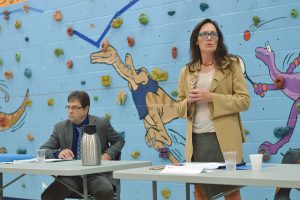
Taking over the gym in Notre-Dame-de-la-Joie School in Luskville, the three-hour meeting saw more people than chairs, as residents had plenty to ask both divisions.
Councillor candidates were up first, with candidates separated and sitting at a table designated to their ward. Ward three was won by acclamation, so that table was not represented at the discussion. The only other candidate not present was Jean Paquin, who’s running in ward six.
The first question posed to the candidates was their biggest concern if elected, garnering a variety of answers. Ward one contestants looked to roads as the main issue, while Susan McKay, candidate for ward two, sought harmony between council members and rate payers. Her opponent, Garry Dagenais, said that he sees improving the day-to-day services in the municipality as important.
Ward four saw all three candidates present a different concern. Josée Graveline-Davis plans to assess the concerns of local residents and develop an open dialogue on their regards. Susan Lamont looked towards developing tourism and senior living of great importance and Scott McDonald said that road infrastructure, especially that of chemin Tremblay and chemin des Pères Dominicains, is a crucial concern.
Ricky Knox and Isabelle Patry are duking it out for ward five, with each party taking different issues to heart. Knox said that he is most concerned with being present at council meetings and developing a cooperative council, while Patry seeks greater engagement with the community and more communal events. Leslie-Anne Barber and William Twolan held down the fort at the ward six table, with the former seeking safer streets, in the form of more street lights, and the latter highlighting tax equality and access to the Ottawa River as his main concern.
Economic growth was the next issue discussed, regarding how these potential councillors would encourage and support it. Working from ward six backwards, Barber was the first to speak on this one, saying she supports offering tax credits and improved infrastructure to encourage businesses entering the area. Twolan looks to improving the tax structure and developing greater infrastructure in these concerns.
Patry said she’d like to promote tourism, but also get more residents involved with events and event organization, while Knox believes success lies in creating more zoning for commercial activity.
McDonald said he envisions an urban-country scenario for the area, with more urban activities but maintaining the rural feeling. Lamont pointed towards tourism as her focus and Graveline-Davis said she’d like to develop an action plan for greater recreation and commercial activities, but hold onto the country aspect, as the rural feeling is a big draw for visitors and locals.
Dagenais said he’d like to stimulate and protect local business, but at the same time clearly define zoning laws. McKay said she would dive into current, unfinished projects to familiarize herself with where to go. Nancy Draper-Maxson, of ward one, said she would encourage new development, while Jean Côté, of the same ward, wants transparent, open development.
From here, the questions were opened to the audience, and started off with concerns on the aging demographics in the municipality, as to why new business would come into an older population. Answers generally defaulted to support for senior housing and the jobs that building and care would accommodate them. Barber, the youngest of the candidates, said that she sees a growing demographic of people like her in the area, especially educated and wealthy young families. She pointed out that many businesses geared towards elderly populations can also appeal to these crowds, or be repurposed in the future.
Another interesting question posed to the group was the issue of cooperating as a council and how the candidates envisioned a council they’re a part of.
“We’re going to have to talk to each other,” said Graveline-Davis. “Once a decision is made, we have to move forward.”
Knox highlighted a need to be present for everything, from meetings to phone calls. Patry said that all issues have to be addressed fairly, with solutions that move the group forward.
Twolan, as a current councillor, admitted there has been mistakes, but isn’t afraid to change his problem-solving skills.
“Yes, I can work with the council but I do need to polish my negotiating skills,” he said.
Further questions for the group ranged from priorities for young families to protecting the environment and the concerns regarding tolerance roads.
After a quick break, the mayoral candidates took their seats to deliver a quick introduction, before moving onto predetermined questions and some from the audience.
Joanne Labadie shared that her number one priority is developing the public service sector so that roads and infrastructure work can be conducted more smoothly.
“Then and only then can we focus on the issues of infrastructure,” said Labadie.
Larose retorted that the permits distributed by the current council have been done carefully and after proper research, to develop work that will last longer, highlighting his commitment to long-term, safe infrastructure.
“Every permit that we’ve got out has been good,” said Larose. “We get teams of professional people, who know what they’re doing.”
Another interesting look into their platforms came through answering the question of supporting economic growth.
Larose said that it is imperative that Hwy. 148 be made safer and more attractive for businesses and the individual. He said that in order to bring money to the municipality, they needed to bring more people there.
Labadie said that they already have a lot of talent in the area, but they needed to harness it. Proposing the creation of a high-tech incubator, she hopes to foster local talent while attracting new people.
Later, Labadie explained that a high-tech incubator is an organization that allows for the mentoring and fostering of new ideas across a variety of sectors. She suggested that with such a development, new ideas could be brought forward and upon approval, linked with local businesses that suited it.
The concept of this still had some in the audience confused, but Labadie offered to further clarify her vision for anyone after the meeting.
Each candidate was pressed on personal issues, with questions directed towards them.
Labadie had to defend her time management skills, juggling her dedication to her personal businesses and raising teenagers, while also justifying her decision to run for mayor. She told the audience that she decided to run for mayor, rather than start off as a councillor, because a lack of trust had developed between citizens and their council. She came to this conclusion after much thought and discussion with fellow citizens, including Larose.
Larose answered questions regarding treatment of council, more specifically on how he plans to work with a new council. He said that the audience had to know the group that he was working with, but looks towards more peaceful bargaining.
He was also pressed on how many grants he applied for through the MNA’s office, to which he explained that grants needed thorough research and surveying to be passed through successfully.
“To apply for grants, you need to know what you need,” he said.
Larose gave examples of grants that were not successful and also offered to show the individual all of the grants his office put forward after the meeting.
Knox asked, given that he is running for council, how both candidates would handle unruly councils.
Labadie said that the municipal code is clear and that every organization must learn how to work together. Once they learn how to disagree appropriately, she said, the group will be able to work closely without argumentative theatrics.
“At the end, my job was to work,” said Larose. “Council never stopped working.”
He also said that his council has to want to work and he cannot be physically forcing them to show up.
The candidates were also grilled on their positions regarding the Near Surface Disposal Facility for nuclear waste at Chalk River (both are against it), commercial zoning and the number of council meetings that each had attended.
The meeting was moderated by Daniel Huard and organized by the Pontiac Journal. Candidates were allowed a two-minute opening, introducing themselves to the crowd, before questions from the moderator began. Questions and answers could be delivered in either language, at the speaker’s comfort.