





Outaouais doctors and healthcare advocates are concerned a provincial bill tabled in May, if adopted as law, will decrease the already low number of available family doctors in this region.
Bill 106 states its purpose is to improve access to medical services for all Quebec residents, and attempts to do so by using financial incentives and social pressure to encourage doctors to take on heavier workloads.
Under this law, about 25 per cent of a doctor’s pay would be dependent on their performance – including the number of patients they see – in an effort to get them to increase case loads. Additionally, the bill links compensation to some form of collective performance of family doctors and specialists, but how exactly the province defines “collective” is not entirely clear.
Some local doctors are joining those across the province in warning the bill will likely not work to its intended effect, and may lead to some doctors leaving the province or practice altogether, especially in the Outaouais, which because of its proximity to Ontario, is particularly vulnerable to pressures like these.
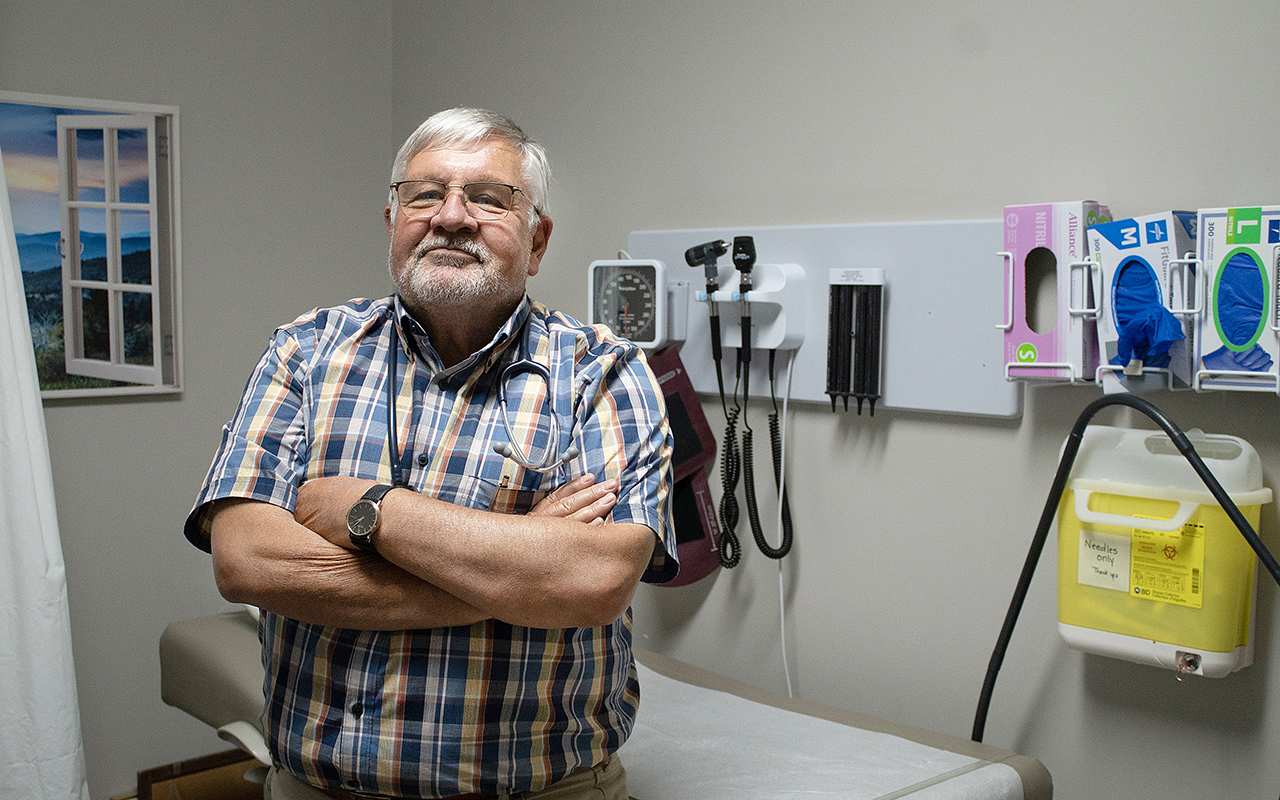
“What they’re trying to do is to squeeze more out of people who are already overstretched,” said Dr. Thomas O’Neill, a family physician at the Lotus Clinic in Shawville who has spent many decades working at the Pontiac Hospital.
“You’re already significantly short with doctors. You’re now going to push them to do more and see patients they don’t even know, which will take longer. You’re going to ask them to work longer,” O’Neill said.
Twenty-two per cent of family doctors in Quebec are over the age of 60. Many in this cohort may be working a reduced schedule, two or three days a week, because they are working towards retirement while still continuing to offer care to patients.
O’Neill believes Bill 106 will push many of these doctors in the Pontiac to leave the practice entirely.
He said the pressure to take on more patients, combined with the possibility that pay will be connected to some form of collective responsibility to meet targets, will ultimately incentivise doctors with a reduced schedule to simply retire so as to not cause a burden on their colleagues.
“What it’s basically doing is it’s linking doctors’ pay with provincial objectives – not with their individual objectives, but objectives that are completely out of their hands,” he said, explaining his interpretation of the bill.
“For example, doctors in the Pontiac will have their pay reduced if doctors in Trois-Rivières, Quebec City, or Gaspé Bay don’t meet a certain set of government objectives, but they’ve got no control over that.”
Dr. Guillaume Charbonneau, president of l’Association des médecins omnipraticiens de l’ouest du Québec, the association that represents doctors at the provincial level, said while retirement is an issue across the province, the Pontiac has an additional hurdle when it comes to retention and recruitment.
“We share a border with another province that doesn’t decide to fight with their doctors, but to work with their doctors,” he said. “We are in a situation where the competition makes it very attractive to go to the other place. [ . . . ] The feeling is that the environment here is not favourable. We would like our partner, the government, to help us recruit doctors, not make them afraid to come here.”
He added that paying doctors based on a volume based approach risks compromising the quality of care patients receive, which in turn, he believes will put added stress on the healthcare system.
A negotiating tactic, says Fortin
This bill was introduced amidst ongoing negotiations of the framework agreement between the Quebec government and the Fédération des médecins omnipraticiens du Québec (FMOQ), representing family doctors, as well as the Fédération des médecins spécialistes du Québec (FMSQ), who represent doctor specialists.
“It’s basically a signal from the government that they want to pick a fight with healthcare professionals,” said Pontiac MNA André Fortin, who served as health critic for the official opposition from 2022 until 2025. He said he believes the bill is a part of greater negotiation tactics.
“This bill is basically taking the government’s own responsibility of providing conditions in which doctors can do their work properly and effectively, and putting that onus on the shoulders of doctors,” Fortin said.
THE EQUITY reached out to the Ministry of Health to better understand its intentions with this bill, but did not hear back before publication deadline.
O’Neill said Bill 106 is an administrator’s solution to the doctor shortage that goes back decades.
Around 25 years ago, the government cut back on medical school enrolment, and now, combined with the aging population’s increased demand for care, there are not enough doctors for each resident of Quebec to have appropriate access to a family doctor, he explained.
“And now you find that people don’t have the ability to get a doctor, and you’re going to fix it by compelling [doctors] to see more patients? You’ve got a problem there. You’ve got a problem with planning,” he said.
“What they should be doing, and should have done, is increase the number of doctors. The problem now is it’s going to take time for that to happen.”
Fortin noted Quebec has increased admissions into medical programs across the province in recent years, but when simultaneously putting forward bills, such as 106, it risks driving people away from the profession.
Charbonneau echoed this point.
“[The bill] caused a lot of anxiety and it also sends a bad message to family doctors who already work very hard to provide care in a system where they don’t necessarily have the tools to provide the service,” he said.
“So the feeling is that this bill puts all the responsibility of access on the shoulders of family doctors without giving them the tools to succeed.”
Des médecins et des défenseurs des soins de santé de l’Outaouais craignent qu’un projet de loi provincial déposé en mai, s’il est adopté, ne diminue le nombre déjà faible de médecins de famille disponibles dans cette région.
Le projet de loi 106 énonce qu’il vise à améliorer l’accès aux services médicaux pour tous les résidents du Québec et tente d’y parvenir en utilisant des incitatifs financiers et la pression sociale pour encourager les médecins à prendre en charge des charges de travail plus lourdes.
En vertu de cette loi, environ 25 % du salaire d’un médecin dépendrait de son rendement – y compris le nombre de patients qu’il voit – dans le but de l’inciter à augmenter sa charge de travail. De plus, le projet de loi lie la rémunération à une forme de rendement collectif des médecins de famille et des spécialistes, mais la façon dont la province définit exactement le terme « collectif » n’est pas entièrement claire.
Certains médecins de la région se joignent à ceux de l’ensemble de la province pour avertir que le projet de loi n’aura probablement pas l’effet escompté et pourrait inciter certains médecins à quitter la province ou la pratique tout court, surtout en Outaouais, région qui, en raison de sa proximité avec l’Ontario, est particulièrement vulnérable à ce genre de pressions.
« Ce qu’ils essaient de faire, c’est de soutirer davantage de personnes qui sont déjà débordées », a déclaré le Dr Thomas O’Neill, un médecin de famille à la Clinique Lotus de Shawville qui a passé de nombreuses décennies à travailler à l’Hôpital de Pontiac.
« Vous manquez déjà considérablement de médecins. Vous allez maintenant les pousser à en faire plus et à voir des patients qu’ils ne connaissent même pas, ce qui prendra plus de temps. Vous allez leur demander de travailler plus longtemps », a affirmé le Dr O’Neill.
Vingt-deux pour cent des médecins de famille au Québec ont plus de 60 ans. Beaucoup de cette cohorte travaillent peut-être à horaire réduit, deux ou trois jours par semaine, parce qu’ils se dirigent vers la retraite tout en continuant à offrir des soins aux patients.
Le Dr O’Neill croit que le projet de loi 106 poussera de nombreux médecins du Pontiac à quitter entièrement la pratique. Il a dit que la pression pour prendre en charge plus de patients, combinée à la possibilité que la rémunération soit liée à une forme de responsabilité collective pour atteindre des objectifs, incitera finalement les médecins à horaire réduit à simplement prendre leur retraite afin de ne pas causer un fardeau à leurs collègues.
« Ce que cela fait, c’est lier la rémunération des médecins à des objectifs provinciaux – pas à leurs objectifs individuels, mais à des objectifs qui sont complètement hors de leur contrôle », a-t-il dit, expliquant son interprétation du projet de loi.
« Par exemple, les médecins du Pontiac verront leur rémunération réduite si les médecins de Trois-Rivières, de Québec ou de la Baie de Gaspé n’atteignent pas un certain ensemble d’objectifs gouvernementaux, mais ils n’ont aucun contrôle là-dessus. »
Le Dr Guillaume Charbonneau, président de l’Association des médecins omnipraticiens de l’Ouest du Québec, l’association qui représente les médecins au niveau provincial, a déclaré que bien que la retraite soit un problème à l’échelle de la province, le Pontiac fait face à un obstacle supplémentaire en matière de rétention et de recrutement.
« Nous partageons une frontière avec une autre province qui ne décide pas de se battre avec ses médecins, mais de travailler avec eux », a-t-il dit. « Nous sommes dans une situation où la concurrence rend très attrayant le fait d’aller ailleurs. [ . . . ] Le sentiment est que l’environnement ici n’est pas favorable. Nous aimerions que notre partenaire, le gouvernement, nous aide à recruter des médecins, et non pas qu’il leur fasse peur de venir ici. »
Il a ajouté que rémunérer les médecins selon une approche basée sur le volume risque de compromettre la qualité des soins que les patients reçoivent, ce qui, selon lui, exercera une pression supplémentaire sur le système de santé.
Une tactique de négociation, selon Fortin
Ce projet de loi a été présenté au milieu des négociations en cours de l’entente-cadre entre le gouvernement du Québec et la Fédération des médecins omnipraticiens du Québec (FMOQ), représentant les médecins de famille, ainsi que la Fédération des médecins spécialistes du Québec (FMSQ), qui représente les médecins spécialistes.
« C’est essentiellement un signal du gouvernement qu’il veut s’attaquer aux professionnels de la santé », a déclaré André Fortin, député de Pontiac, qui a été critique en matière de santé pour l’opposition officielle de 2022 à 2025. Il a affirmé croire que le projet de loi fait partie de tactiques de négociation plus vastes.
« Ce projet de loi transfère essentiellement la responsabilité du gouvernement de fournir les conditions dans lesquelles les médecins peuvent faire leur travail correctement et efficacement, et la place sur les épaules des médecins », a dit Fortin.
Le journal *The Equity* a contacté le ministère de la Santé pour mieux comprendre ses intentions concernant ce projet de loi, mais n’a pas eu de réponse avant la date limite de publication.
Le Dr O’Neill a dit que le projet de loi 106 est une solution d’administrateur à la pénurie de médecins qui remonte à des décennies.
Il y a environ 25 ans, le gouvernement a réduit le nombre d’inscriptions dans les facultés de médecine et maintenant, combiné à la demande croissante de soins de la part d’une population vieillissante, il n’y a pas assez de médecins pour que chaque résident du Québec ait un accès approprié à un médecin de famille, a-t-il expliqué.
« Et maintenant vous constatez que les gens n’ont pas la possibilité d’avoir un médecin, et vous allez régler ça en obligeant les [médecins] à voir plus de patients ? Vous avez un problème là. Vous avez un problème de planification », a-t-il dit.
« Ce qu’ils devraient faire, et auraient dû faire, c’est augmenter le nombre de médecins. Le problème maintenant est que cela prendra du temps avant que cela ne se produise. »
Fortin a souligné que le Québec a augmenté les admissions dans les programmes de médecine à travers la province ces dernières années, mais qu’en présentant simultanément des projets de loi, comme le 106, cela risque d’éloigner les gens de la profession. Le Dr Charbonneau a fait écho à ce point.
« [Le projet de loi] a causé beaucoup d’anxiété et il envoie également un mauvais message aux médecins de famille qui travaillent déjà très fort pour fournir des soins dans un système où ils n’ont pas nécessairement les outils pour offrir le service », a-t-il dit.
« Donc, le sentiment est que ce projet de loi met toute la responsabilité de l’accès sur les épaules des médecins de famille sans leur donner les outils pour réussir. »