“The school is the single most important institution for the survival of the official language community, which itself is a true beneficiary under section 23 of the Charter” (Arsenault-Cameron vs PEI, 2000)
By Gillian Patenaude and concerned teachers of McDowell
Clearly, access to high quality minority language education is a right, not merely a freedom, and as such it is intended to “counterbalance” the influence of the majority language within a province.
This right is entrenched in Section 23 of the Official Language Act. Our current local educational reality demands remediation and purposeful action from the guarantors of our Charter rights; the federal government. It seems providential that in the June 5 issue of THE EQUITY, our Pontiac MP, Mme Sophie Chatel, stated that Bill C-13 “invests in the minority language community in the province” and further specifies “There will be investment of $137 million in excess of existing funding to promote minority language education in the Pontiac and across Quebec.” Now, we need her to lean in and understand our urgent need.
We are facing a crisis in education that is beyond our resources and has seeped well outside of our professional capabilities.
Over the course of the last five to 10 years we have repeatedly capitalized on every available community, social and health service available to adequately meet the needs of our students.
In recent years, the results of these outreach efforts have been futile at best and overall deeply disheartening. The reason is simple, the problem is not an inherently educational issue that we can address or mitigate. The source of the problem is multi-faceted and entrenched over time. It is tied to a declining rural economy, widening learning gaps, rising social-emotional needs following a world pandemic, a language divide and until recently, a bus strike. If that isn’t enough, during the last half decade, we have watched in dismay as we were barren to halt exacerbation of these factors by the predominance of social media.
Our journey to meet the needs of our students as an English sector local school community has been fraught with adversity since 2012, yet time and time again we stood shoulder to shoulder, dedicated to the education of our students and our children.
Teachers, educational aides, administrators, students, families and local businesses have endeavoured to meet every economic, health and social-emotional threat with vigour and creativity. From implementing a dual-track immersion language learning program, to a world health pandemic, the impending fallout of interruptions to cumulative learning stemming from both school closures and secondary pandemic health effects, we would not be defeated.
Since 2012, the cascading river of challenges we have had, and continue to face, include mounting space, spending, material and skill deficits are inexorable. All have arisen out of collective efforts to ameliorate the inevitable streaming effects on either side of the language track, not the least of which was the acquisition and retention of qualified staff.
But it doesn’t end there, we now grapple with a prodigious gap in learning, detrimental to foundational “elementary” education across all cycles, and an insurmountable wall of socio-emotional deregulation within most of the English, and today trickling down into many of our French, classrooms.
Unsurprisingly, today in 2023 we are exhausted and desperate for a meaningful plan of action. Currently, our instructional reality is that we spend most of our teaching time attempting to resolve the unresolveable; the emotional readiness of students. In short, we cannot “get to the teaching.”
We know students must first feel well, before they can begin to learn and do well, but our communications of needs, our tailored interventions, and now our cries for help are not being heard. We have reached a place where we recognize that we simply do not possess the expertise and the funding to resolve this crisis without outside help. The cumulative effect of this means we can no longer protect the integrity of the learning environments with which we are charged. Students are not able to acclimatize to large social groupings with peers. Consequently, the peer to peer harm is happening within our classroom walls and hallways. Given the default to social media, and the encroachment of technology without clear safeguards, we have enabled more wounding of those in our care during the school day.
Where do we go from here? The sheer number of students in dire need, and the level of need presented, demand an injection of funds great enough to implement and track a coordinated action plan in order to generate alternative learning environments. The goal of such a structured plan would be to provide a range of targeted and individualized support from a network of health and educational professionals including social workers, nurses and therapists.
Last but not least, we must include qualified specialist teachers to deliver the array of arts our students need to support their recovery at school and at home. We need the arts. Music, visual arts, drama and dance are key to the well being of students. Once our students feel safe at school, and are emotionally ready to learn, we can reclaim our role in delivering curriculum beyond the arts.
Mme. Chatel, there is hope, surely it is our constitutional right as minority official language residents to be heard.
Gillian Patenaude lives in Aylmer (and formerly Shawville and Bristol.)
She is a Preschool Teacher at Dr. S. E McDowell Elementary.
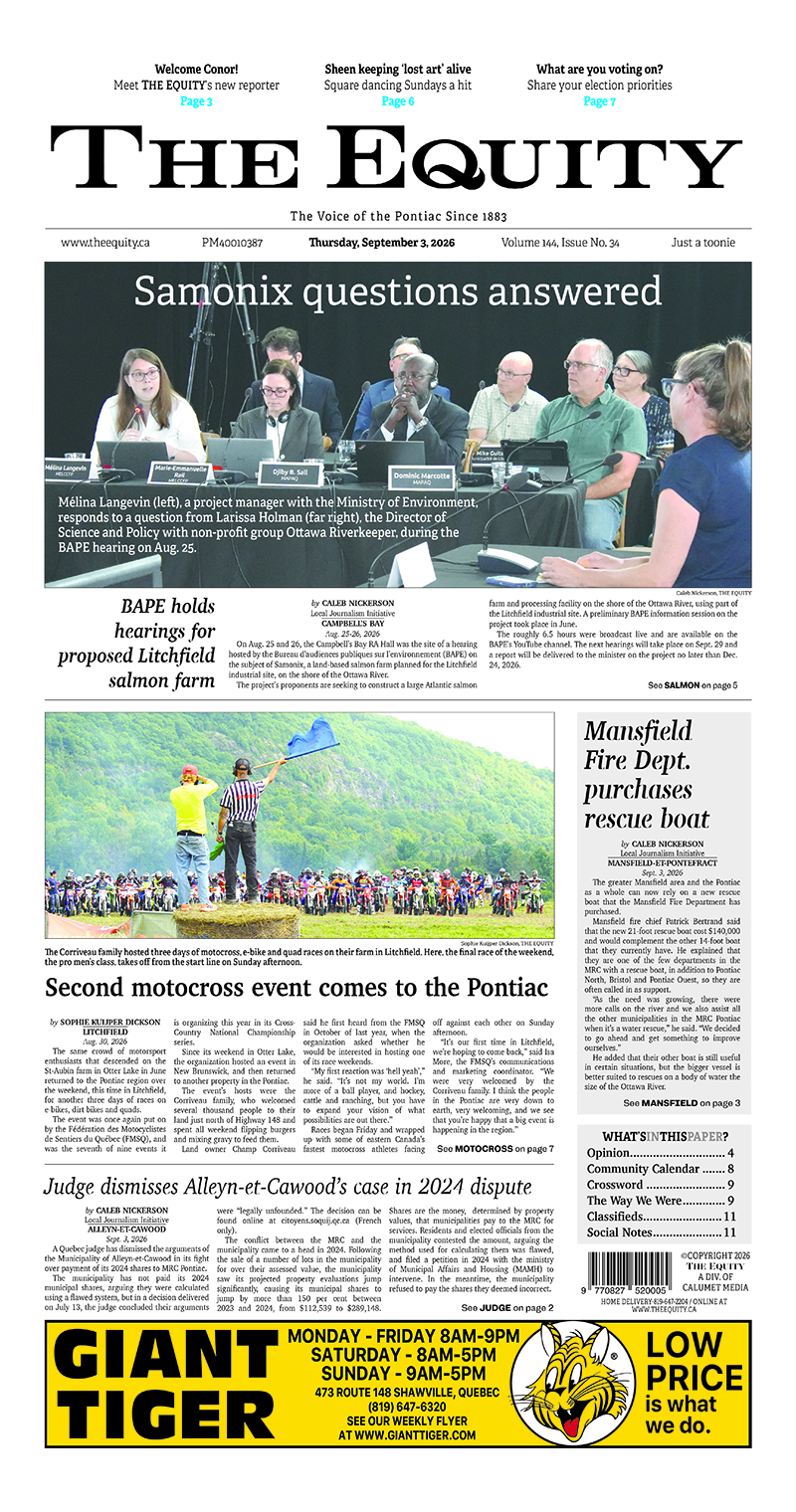



Investing in minority language education
Investing in minority language education
Council of mayors holds special meeting to approve financial statements
Meet THE EQUITY’s new reporter
Mansfield Fire Dept. purchases rescue boat
Judge dismisses Alleyn-et-Cawood’s case in 2024 dispute
Thrift art sale
Sheen square dancers put their steps to the test
Second motocross event comes to the Pontiac
Shawville Fair highlights from over the years
Salmon farm proposal gets grilled
In Photos: Shawville Fairs Past (1977 – 2001)
Lions fire up the grill for St. Paul’s chicken dinner
Parti Québécois announces Pontiac candidate
“The school is the single most important institution for the survival of the official language community, which itself is a true beneficiary under section 23 of the Charter” (Arsenault-Cameron vs PEI, 2000)
By Gillian Patenaude and concerned teachers of McDowell
Clearly, access to high quality minority language education is a right, not merely a freedom, and as such it is intended to “counterbalance” the influence of the majority language within a province.
This right is entrenched in Section 23 of the Official Language Act. Our current local educational reality demands remediation and purposeful action from the guarantors of our Charter rights; the federal government. It seems providential that in the June 5 issue of THE EQUITY, our Pontiac MP, Mme Sophie Chatel, stated that Bill C-13 “invests in the minority language community in the province” and further specifies “There will be investment of $137 million in excess of existing funding to promote minority language education in the Pontiac and across Quebec.” Now, we need her to lean in and understand our urgent need.
We are facing a crisis in education that is beyond our resources and has seeped well outside of our professional capabilities.
Over the course of the last five to 10 years we have repeatedly capitalized on every available community, social and health service available to adequately meet the needs of our students.
In recent years, the results of these outreach efforts have been futile at best and overall deeply disheartening. The reason is simple, the problem is not an inherently educational issue that we can address or mitigate. The source of the problem is multi-faceted and entrenched over time. It is tied to a declining rural economy, widening learning gaps, rising social-emotional needs following a world pandemic, a language divide and until recently, a bus strike. If that isn’t enough, during the last half decade, we have watched in dismay as we were barren to halt exacerbation of these factors by the predominance of social media.
Our journey to meet the needs of our students as an English sector local school community has been fraught with adversity since 2012, yet time and time again we stood shoulder to shoulder, dedicated to the education of our students and our children.
Teachers, educational aides, administrators, students, families and local businesses have endeavoured to meet every economic, health and social-emotional threat with vigour and creativity. From implementing a dual-track immersion language learning program, to a world health pandemic, the impending fallout of interruptions to cumulative learning stemming from both school closures and secondary pandemic health effects, we would not be defeated.
Since 2012, the cascading river of challenges we have had, and continue to face, include mounting space, spending, material and skill deficits are inexorable. All have arisen out of collective efforts to ameliorate the inevitable streaming effects on either side of the language track, not the least of which was the acquisition and retention of qualified staff.
But it doesn’t end there, we now grapple with a prodigious gap in learning, detrimental to foundational “elementary” education across all cycles, and an insurmountable wall of socio-emotional deregulation within most of the English, and today trickling down into many of our French, classrooms.
Unsurprisingly, today in 2023 we are exhausted and desperate for a meaningful plan of action. Currently, our instructional reality is that we spend most of our teaching time attempting to resolve the unresolveable; the emotional readiness of students. In short, we cannot “get to the teaching.”
We know students must first feel well, before they can begin to learn and do well, but our communications of needs, our tailored interventions, and now our cries for help are not being heard. We have reached a place where we recognize that we simply do not possess the expertise and the funding to resolve this crisis without outside help. The cumulative effect of this means we can no longer protect the integrity of the learning environments with which we are charged. Students are not able to acclimatize to large social groupings with peers. Consequently, the peer to peer harm is happening within our classroom walls and hallways. Given the default to social media, and the encroachment of technology without clear safeguards, we have enabled more wounding of those in our care during the school day.
Where do we go from here? The sheer number of students in dire need, and the level of need presented, demand an injection of funds great enough to implement and track a coordinated action plan in order to generate alternative learning environments. The goal of such a structured plan would be to provide a range of targeted and individualized support from a network of health and educational professionals including social workers, nurses and therapists.
Last but not least, we must include qualified specialist teachers to deliver the array of arts our students need to support their recovery at school and at home. We need the arts. Music, visual arts, drama and dance are key to the well being of students. Once our students feel safe at school, and are emotionally ready to learn, we can reclaim our role in delivering curriculum beyond the arts.
Mme. Chatel, there is hope, surely it is our constitutional right as minority official language residents to be heard.
Gillian Patenaude lives in Aylmer (and formerly Shawville and Bristol.)
She is a Preschool Teacher at Dr. S. E McDowell Elementary.
More Local News
Council of mayors holds special meeting to approve financial statements
Meet THE EQUITY’s new reporter
Mansfield Fire Dept. purchases rescue boat
Judge dismisses Alleyn-et-Cawood’s case in 2024 dispute
Thrift art sale
Sheen square dancers put their steps to the test
Second motocross event comes to the Pontiac
Shawville Fair highlights from over the years
Salmon farm proposal gets grilled
In Photos: Shawville Fairs Past (1977 – 2001)
Lions fire up the grill for St. Paul’s chicken dinner
Parti Québécois announces Pontiac candidate
Council of mayors holds special meeting to approve financial statements
Meet THE EQUITY’s new reporter
Mansfield Fire Dept. purchases rescue boat
Judge dismisses Alleyn-et-Cawood’s case in 2024 dispute
Thrift art sale
Sheen square dancers put their steps to the test
Second motocross event comes to the Pontiac
Shawville Fair highlights from over the years
Salmon farm proposal gets grilled
In Photos: Shawville Fairs Past (1977 – 2001)
Lions fire up the grill for St. Paul’s chicken dinner
Parti Québécois announces Pontiac candidate
Investing in minority language education