


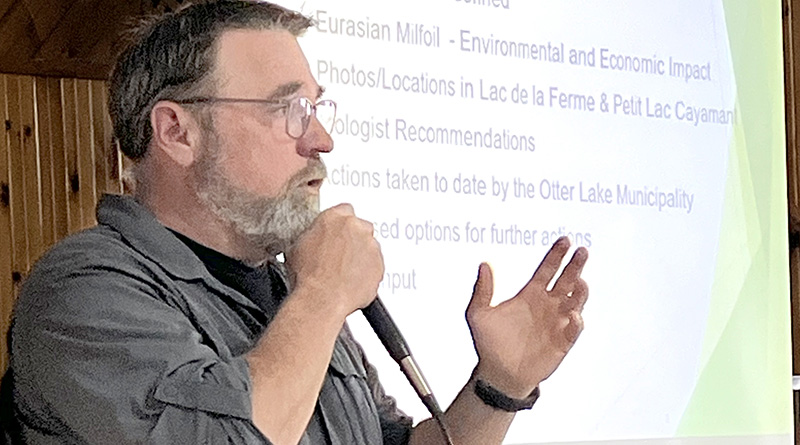



Community briefed on presence of Eurasian milfoil in Farm Lake and Petit Lac Cayamant
by Charles Dickson
Otter Lake
May 4, 2024
Sixty-five people attended a public forum in Otter Lake on Saturday morning to hear from the municipal council about Eurasian water milfoil, an invasive plant species that has been found in Farm Lake and Petit Lac Cayamant.
The meeting, held at the RA Centre, was opened by Otter Lake mayor Terry Lafleur who then turned it over for presentations by councillors Jennifer Quaile and Robin Zacharias.
As described in the presentations, milfoil is a perennial plant that grows profusely in summer and dies in the fall, using up oxygen as it decomposes, choking the lake and killing native plant species and fish.
Councillor Quaile described how anything that disturbs the plants such as boats, waves and people raking them can easily cause fragments to break off and move to another location where the leaves become roots that latch onto the bottom of the lake and produce new plants.
Dense mats of the plant can make swimming unpleasant and can wrap around propellors and paddles making boating difficult, if not impossible.
Economic consequences include reductions in waterfront property values, lost tourism causing local businesses to suffer, and high costs of controlling the problem which can lead to higher taxes.
Councillor Zacharias outlined a range of strategies to eradicate milfoil including laying large burlap tarps on top of the plants to suffocate them, hiring divers to pull the plants out by the root, and using a Health Canada-approved herbicide to kill the invasive species.
Methods of preventing the spread of the plant within a lake include marking milfoil patches with buoys to help boaters avoid driving through them, as well as limiting boat traffic around launch areas where the problem is at its worst, especially in July and August when the plant has grown up to the surface of the water.
“The most common way it propagates, it gets chopped up in a prop, and then it just goes and floats through until it clings somewhere and starts growing again,” Mayor Lafleur told THE EQUITY.
“We really want to try to get a handle on it, especially at the boat launch because, if you’re just docking your boat and you’re going in and you’re taking off, well you’re chopping up a whole bunch of it.”
Boat washing is a key means of preventing the spread of milfoil from one lake to another. Otter Lake set up a boat washing program in 2020.
Public education, citizens reporting sightings of milfoil patches, and shoreline management to keep nutrients that promote the plant’s growth from flowing from the land into the water all feature in the municipality’s proposed plans.
Late last year, after finding Petit Lac Cayamant and Farm Lake listed on a Ministry of Environment website as possibly containing Eurasian water milfoil, the municipality hired a biologist to inspect the lakes who confirmed the presence of the invasive species.
One of the municipality’s next steps will be to inspect six more lakes in the area: Clarke, Leslie, Otter, Hughes, Little Hughes and McCuaig.
“Doing nothing is not an option. We’ve got to do something,” Councillor Zacharias said. “The question is what do we do?”
In the lively question and answer period that followed the presentation, members of the audience brought forward many ideas that promise to help answer Councillor Zacharias’ excellent questions. Originating in Europe and Asia, Eurasian Water Milfoil was carried to North Americas in the ballast of large ships.