





Dear Editor,
Canadians in Eastern Canada are waking up this week to the specter of a gargantuan mound of radioactive waste beside the Ottawa River that could threaten their drinking water.
On March 25, the Radio Canada TV science program “Découverte” featured a one-hour long, in-depth look at the proposed giant radioactive waste dump which would be located on the side of a hill, next to a swamp, less than one kilometre from the Ottawa River at Chalk River, Ontario.
According to the program:
The Canadian Nuclear Laboratories, operated since 2015 by SNC-Lavalin and four Anglo-American multinationals, is the project proponent.
Up to one million cubic metres of radioactive waste would be placed on the slopes of a hill in an 18-metre-high, 16-hectare facility, less than one kilometre from the Ottawa River, drinking water source for millions of Canadians downstream in Ottawa, Gatineau, Laval and Montreal.
The mound would contain radioactive toxins including strontium, cesium and tritium.
Some very long lived radioactive materials such as plutonium would be included in the mound.
A French nuclear physicist, David Boilley, interviewed for the Découverte program, expressed surprise that the site is surrounded by water. He notes that water is the enemy of radioactive waste and that the worst thing that can happen to radioactive waste is for it to “bathe” in water since water migrates everywhere. He also expressed surprise that the proposed facility would not be covered by a roof as is done in France and noted that lessons learned through mistakes made in France had unfortunately not been transmitted across the Atlantic to Canada.
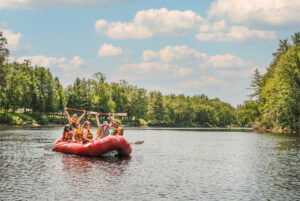
The proposed giant nuclear waste dump has been largely flying under the radar in terms of public awareness since the proposal was announced in June of 2016, according to Johanna Echlin, whose family has owned a cottage on an island just downstream of Chalk River for several generations.
“We have been doing our best to get the word out for over a year now. Everyone who swims in, fishes from or drinks water from the Ottawa River needs to know about this and should be very concerned,” Echlin said.
There is currently an environmental assessment underway for the project, under the authority of the Canadian Nuclear Safety Commission (CNSC). Critics point out that the CNSC is perceived to be a “captured agency” as noted by the recent report of the Expert Panel on Reform of Environmental Assessment, and should therefore not be in charge of the assessment.
Critics are also concerned about CNSC’s failure to protect the public from radioactive releases from nuclear facilities. According to Dr. Ole Hendrickson, environmental scientist and researcher for the group Concerned Citizens of Renfrew County and Area, the CNSC’s release limits for radioactive substances are very permissive and are not designed to protect health.
“The giant mound, if it were approved, would be permitted to release radioactive and toxic substances into the Ottawa River, and release limits would likely be very permissive, based on what we know about the release limits for other nuclear facilities in Canada,” Hendrickson said.
Johanna Echlin
Old Fort William Cottagers’ Association-