



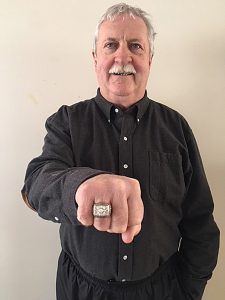

Nearly a half century after playing his first and only game with the National Hockey League’s Boston Bruins, Chapeau native Chris Hayes was finally given what was owed to him: his Stanley Cup Ring.
Hayes was playing in the Bruins’ farm system during the 1972 playoffs when he got the call to suit up for the big club against the St. Louis Blues in the semi-finals of the Stanley Cup Playoffs.
As he recalls, he only played “spot duty” on an otherwise stacked lineup that included NHL greats like Bobby Orr, Phil Esposito and Wayne Cashman.
Despite the limited ice time, he played. Hayes suited up and his name was on the game sheet.
According to NHL rules, a player has to play in at least 41 regular season games or at least one Stanley Cup Final game in order to get their name engraved on the Stanley Cup.
That’s how Jiri Slegr of the Detroit Red Wings got his name on the 2002 Stanley Cup. His teammate, Jiri Fischer, was suspended for one game after he delivered an especially mean crosscheck.
In came Slegr for one game and now he gets to go down in history with his name on the Cup – something that can never be taken away from him.
There are no such rules for Stanley Cup rings, on the other hand.
The rings are usually used as a way to include those who couldn’t get their name on the cup. Many teams will issue championship rings to trainers and other staff.
Which is why it was so peculiar that Hayes didn’t have one. Even more perplexing was the fact that he never really raised a stink about it, especially when he returned to the Bruins for the 1972-73 season’s training camp.
“I don’t think I even thought about the ring,” Hayes said of the training camp. “I had a taste of what it was like up there [in the NHL] and was focused on playing hockey.”
Not only did he not say anything about the ring, but Hayes said he can’t remember seeing any of the other players with their rings either.
“People weren’t that way back then,” Hayes said. “They weren’t flashy, it was just a different environment.”
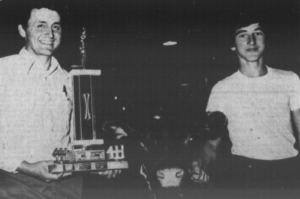
Flashy is not the first word that comes to mind when looking at a picture of Hayes from his playing days.
He looked like a character from the movie Slap Shot.
Atop his head sat the quintessential 70’s hockey hair, not to mention a stylish set of sideburns to go with it.
Not only did the hockey hair come naturally to Hayes, so did the talent.
He didn’t play organized hockey growing up. Like many people in Chapeau, Hayes spent most of his time honing his skills on the outdoor rink.
“That was the community centre,” he said. “That’s where you spent all your time.”
His first taste of organized hockey came when he tried out for the Pembroke Lumber Kings junior hockey team as a 16-year-old.
He made the team, and the next year he was with the Oshawa Generals of the Ontario Hockey Association playing alongside a young Bobby Orr.
While he was with Oshawa – and since there was no amateur draft – the Bruins signed him to a contract.
After three years in Oshawa, Hayes attended Loyola University where he continued playing hockey.
After he finished at Loyola, he reported to the Bruins’ farm team in Oklahoma City since the team still owned his rights.
Hayes himself admits that while he had some skill, he never shied away from the physical aspect of the game.
That lunch pail nature is one of the reasons Hayes didn’t push too hard for his missing ring.
Enter Hec Clouthier, the former MP for Renfrew-Nipissing-Pembroke.
Clouthier’s father used to buy supplies for his lumber camp from Hayes’ father when they were young.
“We go back a long ways,” Clouthier said.
So, when he heard about Hayes’ bare finger, Clouthier sprung into action.
He sent a letter to Bruins owner Jeremy Jacobs explaining Hayes’ situation.
Within a couple of weeks, Clouthier got a call from Bruins great and current team President Cam Neely.
Neely told Clouthier that there wasn’t much documentation to go on but he would look into it.
Neely said he’d speak with Bruins senior advisor and another NHL great, Johnny Bucyk, about Hayes’ situation.
Within a week, Clouthier got a call from Neely, who told him he had spoken to Bucyk.
“He said, ‘Yep, you’re absolutely right,’” Clouthier said. “[Neely] said, ‘I spoke with Johnny Bucyk and he remembers Chris Hayes very well.’”
The next step was finding out who the jeweller was that made the ring 46 years ago.
Clouthier suggested using Bucyk’s ring has as the template for Hayes’ ring.
“If we’re going to do this thing, let’s do it right,” Clouthier said.
The whole time that Clouthier was in contact with the Bruins and the preparations were being made, Hayes had no idea.
His first inkling that something was afoot was when Clouthier called to get his ring size, at which point Clouthier had to spill the beans.
“I think at first he thought I was kidding,” Clouthier said. “Then when he realized I was serious he went, ‘Wow, okay.’”
After a few weeks, Clouthier got a call from Neely and the excitement in Neely’s voice was palpable.
“He said, ‘Tell Chris Hayes that this Thursday the ring will be in Chapeau, Quebec!’” Clouthier said.
When the knock on the door came, Hayes said he knew what was waiting for him on the other side.
As he brought the package into his home, he looked at a picture of his late wife and took a seat.
“Okay honey,” Hayes recalls saying. “We’re going to do this together.”
As he peeled back the protective layers of cardboard and bubble wrap, Hayes came face to face with something he’d been due for 46 years: a massive ring with 18 diamonds, the words “World Champions” engraved on it along with his name.
Despite the fact that the Bruins were stacked on the left wing (which was Hayes’ position), the following season presented him with an opportunity to make the big squad thanks to the amount of players who were playing in the epic Canada-Russia Summit Series.
Even though he was on a one-way contract in the 1972-73 season, Hayes was asked if he would be willing to go down to the AHL to help the Bruins’ farm team on a road trip.
“The American Hockey League was a good hockey league,” Hayes said. “That’s where you were groomed.”
But one night in Rochester, Hayes was injured when he took a hit, which ended his season.
The following year, he was offered an opportunity to serve as captain of the farm team for the expansion Kansas City Scouts in Albuquerque, New Mexico.
So he decided to leave the Bruins organization for a chance to play an important role in an expansion franchise.
However, the owner of the Scouts at the time decided to push back the team’s entrance into the NHL for a year.
Once Hayes learned of the delay, he contemplated his future and whether now was the time to leave.
“I thought if I wanted to get into the corporate world I’d be better to do it in my late twenties,” Hayes said. “So I walked away. I know now I made the right decision.”
It was nerve wracking for a lifelong hockey player to suddenly be faced with the prospect of finding a regular nine-to-five job.
“My resumé didn’t look too good,” Hayes said with a laugh. “It just said professional hockey player. Of course, I thought everyone wanted to hire a professional hockey player but unbeknownst to me, that’s not the way things happen.”
Hayes spent the next 28 years working in the financial sector. He’s now retired and spends much of his time at his family homestead in Chapeau.
He credits Clouthier for getting the ball rolling on his shiny new piece of jewellery.
“He was the bloodhound on this,” Hayes said.
He also credits the Bruins’ staff for being so responsive.
“The Bruins are a tight-knit organization,” he said.
But Hayes also knows that luck had something to do with Clouthier actually getting in touch with the team owner and having the organization respond in kind.
“You know, the Bruins are having a good year. If they were in the cellar or something like that I could just see the board meetings where they’re saying, ‘We’ve got to cut back on things,’” said Hayes. “And they say, ‘$25,000 for a ring, are you crazy? What’s the next topic?’”