





Every night, more and more layers are being bundled on. Reds and yellows are starting to dot the forests, and I’ve even seen some trees along Hwy. 148 sitting half-naked at the side of the road.
Fall seems to have jumped the gun a bit this year, and I am upset. Traditionally, I’m a huge fan of summer – I love the heat and the beach.
However, I have decided to try and be a bit more open this year to the changing of the seasons. It’s hard to accept the end of summertime temperatures, but I do love everything pumpkin-flavoured. And yes, I have indulged already in the millennial’s obsession with overpriced pumpkin-spiced lattes from Starbucks.
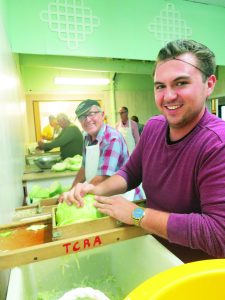
Before all of that, however, I began my easing into the season by trying something entirely new. I would join a group of volunteers at the TCRA building in order to help prepare for the upcoming Ladysmith Oktoberfest.
Our task for Sept. 6, a chilly, dark-by-eight evening? We were preparing all the sauerkraut for the upcoming festivities.
Now, going into this, I don’t believe I’ve ever even tried sauerkraut. I cannot recall anytime that I’ve grabbed some and plopped it onto my meal. There was a brief half hour period that I thought I’d tried it, but then I realized that it was only coleslaw. So, my naivety shone bright walking down the steps of the TCRA to join the group.
I was met warmly and welcomed in, first by Marguerite Born as she fought with a blender, shredding cabbage.
Greetings shot out from all over the room, and I immediately felt confused – there seemed to be a lot of people here, so where would I fit into this buzzing beehive? Lucky for me, Born’s husband, Randall, came out of nowhere, just as I finished mentioning that I wasn’t here to just cover the sauerkraut making, but to help out too. As it turned out, the Borns are both food directors for the festival, so they quickly became my go-to sources for what’s happening next.
“You’re going to need a hairnet then,” he said.
Randall turned and disappeared, or maybe I just got distracted by another volunteer introducing themselves. Either way, when he returned, I donned my gear, was handed a knife and cutting board, then set to task.
The first step in preparations was the quartering of the cabbages. Lined up with seven others, we first stripped the outer layers off and tossed those aside, along with any rotten layers, until we had fresh, clean cabbage all around. Then we simply sliced the cabbage in half, and those halves in half.
Easy enough, it was a return to my days as a produce clerk at a FreshCo in Ottawa. Our team moved so fast, the runners couldn’t keep up with us – they’d return with an empty bin and we’d have piled over half a bin’s worth of cabbage on the table. Needless to say, these volunteers weren’t about wasting time.
Suddenly 1,000 lbs. of cabbage were quartered, and well underway to being shredded. Cleaning up my station, I stood bewildered. Really, I wasn’t sure what to start doing next, but again, Randall turned the corner and got me set up with the next job.
Until this point, I wasn’t even sure what other tasks were necessary for the process, being fairly secluded within the kitchen area. Suddenly I was wheeled through a doorway to the next step in the process, the shredding.
Now I was handed a washboard-like tool – although I’m fairly sure that you’d go through a lot of clothes if you were using this on your shirts. [Ed. note: it’s called a mandoline, Don.] With sharpened blades fixed squarely in the middle, and two edges to hold the slider in place, you’d fill the sliding square with a few quarters of cabbage, apply some pressure and shred away.
It’s much tougher than it sounds and takes a bit of getting used to, as well as some precautions too. I was reminded kindly to keep my fingers out of the square, in fear of losing the tips.
My joking about red cabbage being natural seemed to go unnoticed.
“Put your fingers through those blades and you’ll never do it again,” laughed Randall.
“If I put them through, I won’t have much to do it with again,” I quipped back.
And so I worked away, and it was a busy stretch. Just as I thought I’d be nearing the end of the cabbage, another bin seemed to appear. It was trickier than I anticipated, often I’d have trouble keeping the board balanced neatly and comfortably between the wall and my gut, losing my rhythm with an absentminded distribution of my weight.
I’ll admit it, I broke a sweat here. Just endlessly grinding cabbage down to manageable, centimetre-wide slices while doing so efficiently took its toll. But we did eventually wrap up this job as well.
Again, I looked around, trying to figure out where to help next, but by now, things were starting to wrap up. Jobs were becoming hard to come by and the cleanup process started in two of the three food prep rooms. But I decided I better check out what was happening in the third room to see where all the shredded cabbage ended up.
“What happens next is they mix it with salt,” said Randall. “The reason why you add the salt is to bring out the moisture in the cabbage. You need to add just enough salt to make the cabbage weep.”
He said that by mixing the combination, the water is drawn out of the shredded cabbage. When the water comes out, you’ll know it’s ready to enter the fermentation stage.
From there, the cabbage is all dumped into 45-gallon containers, where it’s pounded down and stored. That’s right, 1,000 lbs. of cabbage and over two hours of chopping, shredding and mixing boiled down to around 90 gallons of sauerkraut. That is, before the fermentation takes hold.
“Tomorrow you’ll come in and it’ll be moldy,” said Randall, laughing. “You’ll never want to eat sauerkraut again.”
Pretty much for the volunteers, the majority of the work was done. Almost 25 volunteers came out and the work went by much quicker than expected, with just a bit of cleaning left to do an hour before the anticipated wrap up time.
“Some say anybody can make a small personal-sized batch of Sauerkraut, but it takes a community working together to create such a quantity as we made [that] night,” said Randall, in an email the next day. “Three weeks of fermenting and some TLC every other day or so should see us with an awesome batch of sauerkraut this year.”
To me, some TLC seemed just a bit of an exaggeration once Randall explained the work that goes in.
“Every day or so we check the sauerkraut. Any foam and mold is removed [from] each of the containers of sauerkraut and the pressing plate, stone weight and other coverings are changed and/or sterilized for another day or so of fermenting,” said Randall, of the following work.
But the work for the Borns isn’t just a scrape and clean up job. To prepare the sauerkraut to just the right taste, a bit of adjustments may have to be made.
“The warmth [of] the room, typically at room temperature, is adequate for the three-week fermenting period to make the sauerkraut but if later on we see and taste that the sauerkraut is behind schedule we can always raise the room temperature or wrap the barrels in blankets or towels to increase the internal heat in the barrel,” he continued.
And there you have it – a tradition explored. Sauerkraut is a staple for the upcoming Oktoberfest fun, complimenting crisp beer and salted meat with its thrilling, tangy crunch, or so I’ve been told.
For those that enjoy the topping, it’s a simple enough recipe, one that’s been provided by Freida Krose, Randall’s “sauerkraut doctor.” A recipe that may have been experimented on in the past, but will stay tried and true in years to come.
But just because the sauerkraut is ready, these directors are far from finished.
“The real work starts the day or so before Oktoberfest (kitchen setup) then the event itself,” said Randall via email, a few days later. “It’s said if you can’t stand the heat then you have no business in the kitchen. We are blessed with usually an adequate number of volunteers to man the kitchen but it can and does get overly busy at times.”