






In the 1980s, American sociologist Ray Oldenburg gave language to an idea that will likely be pretty familiar to anybody who grew up going to kitchen parties, cipaille suppers, or who’s spent some time sitting on the bench outside J & J gas bar in Shawville on any given weekday morning.
Oldenborg defined a “third place” as the place that is neither the home (the first place) or work (the second place) but a space for community life, where people can gather and exist outside the demands of their daily grinds.
Third places are multigenerational, a point of entry for visitors or newcomers, and they help break isolation felt by seniors, offering regular, casual connection to the outside world. They are places where people come together for no other reason than to be together.
“Most needed are those ‘third places’ which lend a public balance to the increased privatization of home life. Third places are nothing more than informal public gathering places,” he wrote in a journal article published in the late ‘90s.
At the time, he argued third places were disappearing.
“Most residential areas built since World War II have been designed to protect people from community rather than connect them to it,” he said. “Virtually all means of meeting and getting to know one’s neighbors have been eliminated. An electronically-operated garage door out front and a privacy fence out back afford near-total protection from those who, in former days, would have been neighbors.”
He was speaking mostly of life in the city, which was changing as post-war suburbs were sprawling like wildfire, restructuring how people lived together, how neighbours interacted, or rather didn’t.
But rural communities weren’t immune to these changes.
Longtime dairy farmer Chris Judd, also a columnist for this paper (look right), often speaks of how the introduction of large, mechanized farming equipment led to the erosion of social ties between farmers. He has pointed out how, while farmers once stopped along their fence line to chat with their neighbours on break from ploughing their fields by horse, they now drive by each other, each insulated from the other inside their large glass domes.
The growing commuter culture forced by the loss of local jobs only further eroded our local third places. People get in their cars early in the morning, travel the long journey to work where they spend most of their day and then travel home again, only to repeat the pattern the next day, and the next. Not to mention the steadily climbing cost of living which compels us to dedicate greater chunks of our precious time to raking in those dollars.
And then there was the COVID-19 pandemic, which drastically interrupted the intuitive ways in which communities still spent time together, and seemingly restructured these habits. Speak with the members of any Lions, Rotary, Knights of Columbus or other service club across the Pontiac and they will attest to the challenges of finding volunteers willing or able to dedicate time outside of their regular hustles to contribute to building these third places.
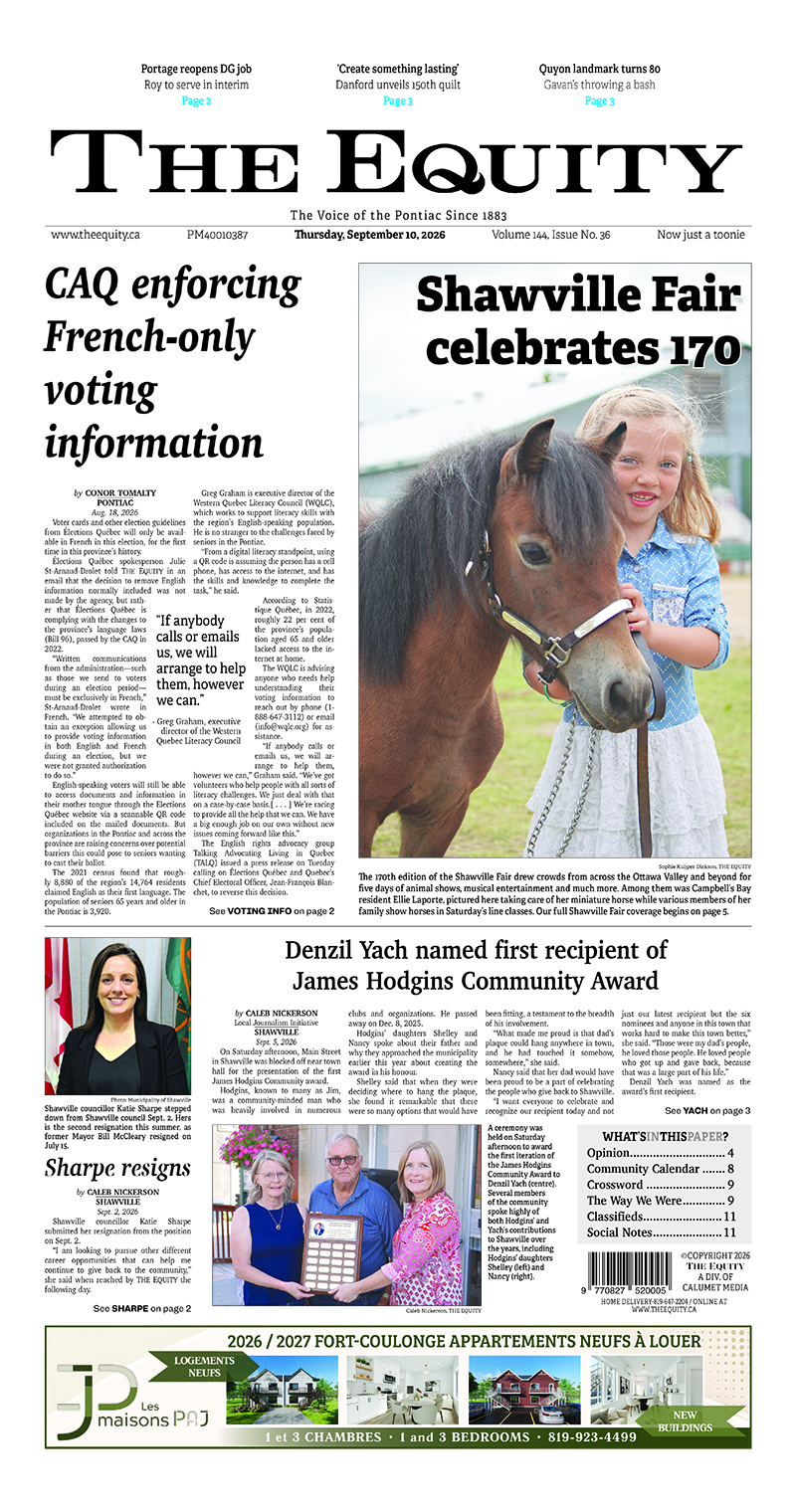
In this context, the Shawville Fair stands out as a shining example of all that a third place can offer a community. It checks all of Oldenburg’s boxes.
A swarm of volunteers gave a weekend if not months of time to ensure the many moving parts of this annual ordeal rolled out as smoothly as possible. Shawville Lions and 4-H Club volunteers flipped burgers and steamed hot dogs to feed the masses, the profits from which go right back into funding the clubs’ respective community support efforts.
Other 4-H members spent their summers raising various animals to be auctioned off to the community at Sunday evening’s market, these proceeds likely going to a cause of their choice, to the club, or to supporting their own efforts to become farmers.
Sure, large amounts of money are circulated at the fair every year. A cow isn’t cheap. But much of it, in some way or another, seems to go back to the community. And beyond this, the greater good, it seems, is the creation of this third place. Kids roam free from their parents. Parents roam free from their kids. Neighbours catch up in line for a beer, or the washroom, or sitting next to each other watching the truck pull.
A lot of effort goes into creating a space in which casual togetherness is possible. Once all the prizes have been awarded, and the photographs captured, what’s left is the memory of what it feels like to wander the fairgrounds and bump into a neighbour you’ve been missing.
I’m by no means suggesting we’ve lost our third places in the Pontiac, but like most communities, we will need to work to protect them, and give them new life.
Sophie Kuijper Dickson