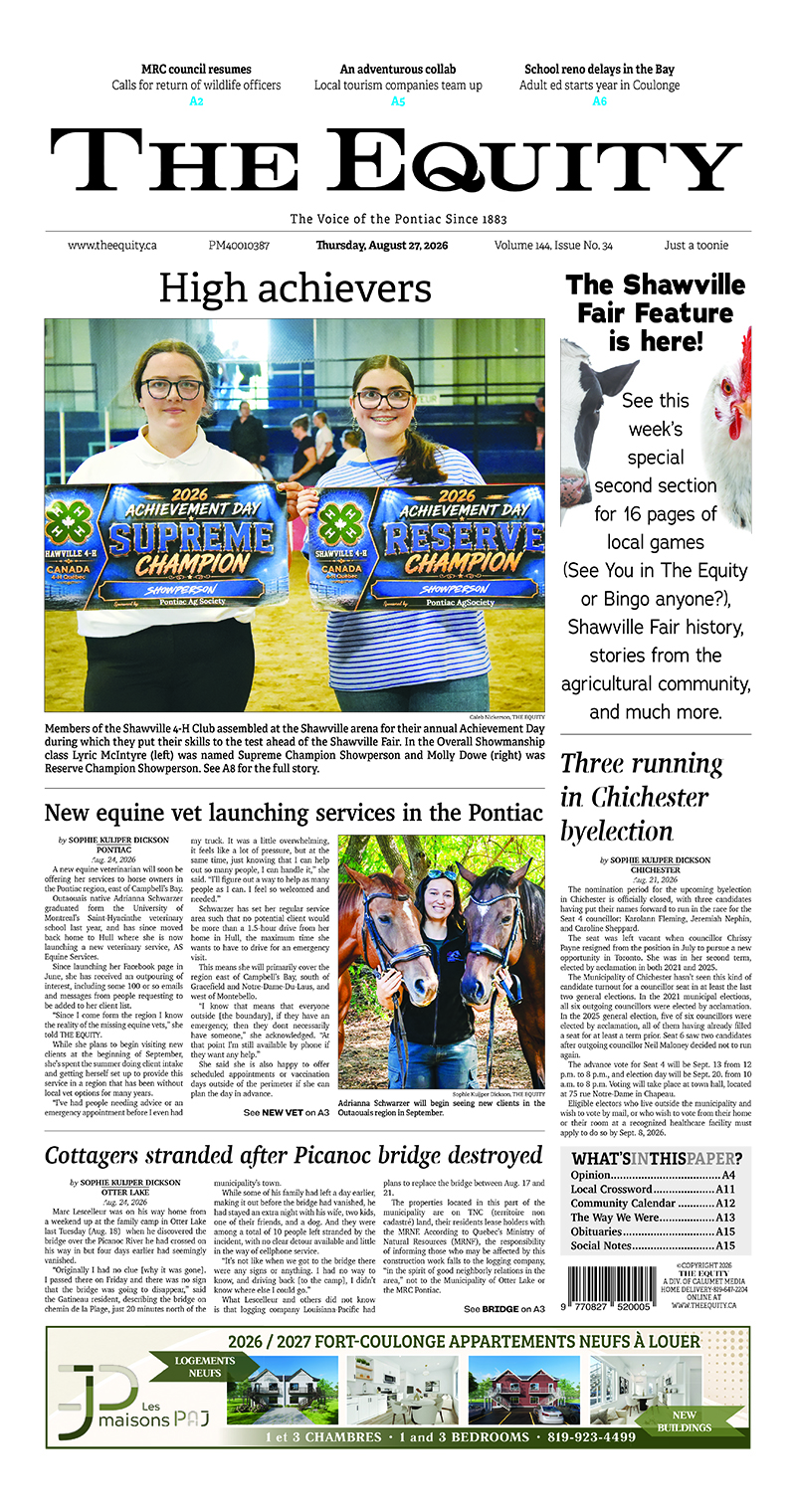






Local news was dealt another harsh blow last week when Postmedia announced that it will close several local newspapers around the country.
One of those publications that will face the chopping block is the Pembroke Daily Observer.
Four people lost their jobs and one lonely reporter is all that remains.
The paper, which was founded in 1855, will no longer offer a daily print edition. Instead, it will offer a weekly print edition and online-only content.
It’s a harsh gut punch for a bustling community with an already limited amount of local news.
Most people don’t have time to regularly go to council meeting and see for themselves what their local officials are up to.
Newspapers are the main conduit between the citizens and those that govern them. Without someone informing the population about the goings-on at a place like city hall, most citizens will be in the dark.
A line that’s often invoked when talking about the role of journalism is that “sunlight is the best disinfectant.” Bring things out in the open, let people see what’s happening so they can make a decision.
It’s how we hold those in power accountable.
But if there’s nobody there to bring the information to the public, the prospect of accountability disappears.
But local newspapers aren’t simply focused on keeping those in power honest, it’s about highlighting all of the things that happen in a municipality.
The faces of many kids light up when they get their hands on the local paper with a picture of their face on the front page.
There’s a good chance that many who are reading this have a picture or story from a local paper hanging on their fridge right now.
That’s what local news is about – connecting with the community.
But because of a changing media landscape, many publications – like the Daily Observer – are being forced to provide online content only.
This puts further strain on an already economically-challenged industry because most online advertising dollars are sucked up by large companies like Facebook and Google.
It’s not just local news that’s suffering either. Large metropolitan papers are feeling the effects of sagging revenues.
Even in a city like Ottawa – the seat of our national government – the two major papers merged with one another, which meant a less diverse range of perspectives and stories.
To make matters worse, journalists are now becoming the object of scorn from those who have been convinced that traditional media can’t be trusted. It’s to the point now where easily-verifiable facts are labeled as “fake news.”
Last week, five journalists were shot and killed when a gunman stormed into their workplace at the Capital Gazette in Annapolis, Maryland.
The gunman was upset about a story the paper published about him and had been harassing those who worked at the Gazette for years.
Thankfully, Canada’s political climate is far less toxic than the one we see south of the border.
A healthy degree of skepticism is the best tool for anyone consuming news. But to outright dismiss facts based on who reported those facts goes far beyond a healthy skepticism.
With social media, politicians have the ability to go around the press and speak directly to their constituents.
Which is why we need journalists who can cut through the political spin and bring the facts of the matter to the reader.
Chris Lowrey