






Outaouais public health network CISSSO is reminding residents to stay vigilant when it comes to protecting themselves from Lyme disease as significant numbers of ticks carrying the disease have been on the rise in the region in recent years.
“Based on an analysis of human surveillance data and tick data from recent years, almost all municipalities in the Outaouais region are now endemic for Lyme disease,” CISSSO stated in a French press release published May 14.
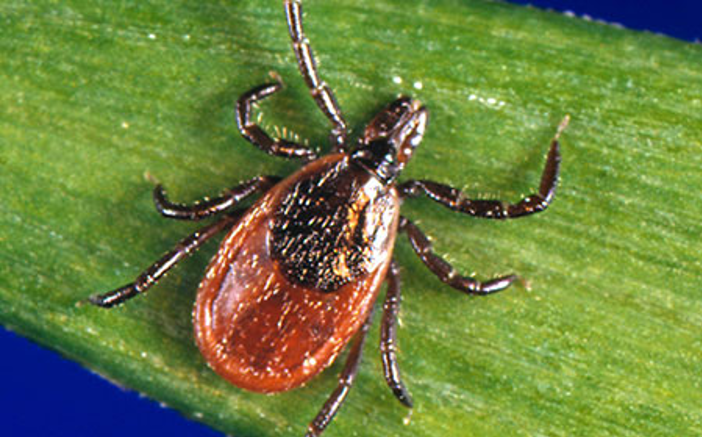
Lyme disease is an infection caused by a bacterium that is transmitted to humans through the bite of an infected blacklegged tick, also known as a deer tick. The insects are most commonly found in wooded areas and tall grasses.
The bacterial infection can have serious consequences for health and quality of life if it is not treated with antibiotics in time. Long-term effects can include chronic joint pain, neurological issues (memory loss, neuropathy, facial palsy), heart palpitations, and severe fatigue.
This year several more northern Outaouais municipalities were added to the list of those in which the disease is now considered endemic – that is to say, consistently present and no longer considered an anomaly.
Dr. Christelle Aicha Kom Mogto, a specialist doctor in public health and preventative medicine at CISSSO, explained that since 2022, reported cases of Lyme’s disease in the region have more than quadrupled.
She said that from 2010 to 2022, the health network saw an average of 15 cases per year. In 2023, there were 24 reported cases, in 2024 there were 50, and in 2025 there were 73.
Dr. Aicha Kom Mogto said the reason for this increase is twofold.
“There is the fact that there are more and more ticks, thanks to environmental changes,” she told THE EQUITY, noting Lyme-carrying ticks have slowly spread from the southern parts of the Outaouais to the north.
“But there is also an increase [in cases] due to the fact that [healthcare providers] are more and more aware so they are also diagnosed more often.”
Prevention is key
CISSSO is reminding the population that the best way to prevent the contraction of Lyme disease is to protect oneself when outdoors.
When in wooded areas or long grass, CISSSO recommends wearing a hat, closed-toe shoes, and long sleeves and pants, as well as tucking shirts into pants and pant legs into socks. The healthcare provider also suggests using DEET- or icaridin-based insect repellents.
Once inside after time outdoors, it is important to check your body, your gear, and your pets for ticks.
If a tick bite is discovered with the tick still in it, best practice is to remove the tick using tweezers, pinching it as close to the skin surface as possible and pulling straight upwards, being careful not to leave the head in the skin.
CISSSO is requesting ticks be saved in a jar and labeled with the date and location they were discovered.
If the tick has been attached for more than 24 hours, it is recommended to seek medical advice as antibiotics may be needed. This can be done by calling InfoSanté at 8-1-1 or consulting a pharmacist.
Even after the tick is removed, symptoms may appear anywhere from three to 30 days later. The most common symptom is a red ring that slowly grows around the tick bite. Other common symptoms are a fever and fatigue. “But most important is to not get bitten,” said Dr. Aicha Kom Mogto.
“The antibiotic is not a panacea, so we really need to focus on prevention.”
Le CISSSO, le réseau de santé publique de l’Outaouais, rappelle aux résidents de rester vigilants quant à la protection contre la maladie de Lyme, car le nombre de tiques porteuses de la maladie est en augmentation significative dans la région ces dernières années.
« Selon l’analyse des données de surveillance humaine et des données sur les tiques des dernières années, la quasi-totalité des municipalités de la région de l’Outaouais sont maintenant endémiques pour la maladie de Lyme », a déclaré le CISSSO dans un communiqué de presse en français publié le 14 mai.
La maladie de Lyme est une infection causée par une bactérie transmise à l’homme par la morsure d’une tique à pattes noires infectée, également connue sous le nom de tique du chevreuil. Ces insectes se trouvent le plus souvent dans les zones boisées et les herbes hautes.
L’infection bactérienne peut avoir de graves conséquences sur la santé et la qualité de vie si elle n’est pas traitée à temps avec des antibiotiques. Les effets à long terme peuvent inclure des douleurs articulaires chroniques, des problèmes neurologiques (perte de mémoire, neuropathie, paralysie faciale), des palpitations cardiaques et une fatigue sévère.
Cette année, plusieurs municipalités plus au nord de l’Outaouais ont été ajoutées à la liste de celles où la maladie est désormais considérée comme endémique – c’est-à-dire constamment présente et n’étant plus considérée comme une anomalie.
La Dre Christelle Aicha Kom Mogto, médecin spécialiste en santé publique et médecine préventive au CISSSO, a expliqué que depuis 2022, les cas signalés de maladie de Lyme dans la région ont plus que quadruplé.
Elle a précisé que de 2010 à 2022, le réseau de santé a enregistré une moyenne de 15 cas par an. En 2023, 24 cas ont été signalés, en 2024 il y en a eu 50, et en 2025, 73 cas.
La Dre Aicha Kom Mogto a indiqué que la raison de cette augmentation est double.
« Il y a le fait qu’il y a de plus en plus de tiques, grâce aux changements environnementaux », a-t-elle déclaré à THE EQUITY, notant que les tiques porteuses de la maladie de Lyme se sont lentement propagées du sud de l’Outaouais vers le nord.
« Mais il y a aussi une augmentation [des cas] due au fait que [les professionnels de la santé] sont de plus en plus conscients, de sorte que les diagnostics sont aussi plus fréquents. »
La prévention est essentielle
Le CISSSO rappelle à la population que le meilleur moyen de prévenir la contraction de la maladie de Lyme est de se protéger lors des sorties à l’extérieur.
Dans les zones boisées ou les herbes hautes, le CISSSO recommande de porter un chapeau, des chaussures fermées, des manches longues et des pantalons, ainsi que de rentrer les chemises dans les pantalons et les bas de pantalons dans les chaussettes. Le fournisseur de soins de santé suggère également d’utiliser des insectifuges à base de DEET ou d’icaridine.
Une fois à l’intérieur après avoir passé du temps dehors, il est important de vérifier votre corps, votre équipement et vos animaux de compagnie à la recherche de tiques.
Si une morsure de tique est découverte et que la tique est toujours présente, la meilleure pratique consiste à retirer la tique à l’aide d’une pince à épiler, en la pinçant aussi près que possible de la surface de la peau et en tirant droit vers le haut, en faisant attention de ne pas laisser la tête dans la peau.
Le CISSSO demande que les tiques soient conservées dans un bocal et étiquetées avec la date et le lieu de leur découverte.
Si la tique est restée attachée plus de 24 heures, il est recommandé de consulter un médecin, car des antibiotiques pourraient être nécessaires. Cela peut être fait en appelant Info-Santé au 8-1-1 ou en consultant un pharmacien.
Même après le retrait de la tique, des symptômes peuvent apparaître entre trois et 30 jours plus tard. Le symptôme le plus courant est un anneau rouge qui s’agrandit lentement autour de la morsure de la tique. D’autres symptômes courants sont la fièvre et la fatigue. « Mais le plus important est de ne pas se faire mordre », a déclaré la Dre Aicha Kom Mogto.
« L’antibiotique n’est pas une panacée, il faut donc vraiment se concentrer sur la prévention. »