






Pontiac dairy farmers are among those across the country watching closely as Canada continues trade talks with the United States ahead of a July 21 deadline. Some are worried about the fate of this country’s supply management system after President Donald Trump has once again flagged it as an issue.
At the end of June, in a post to Truth Social in which President Trump announced he would be ending all negotiations with Canada because of this country’s plans to implement a digital services tax, he also zeroed in on the supply management system as a sticking point in negotiations.
In response, Canada backed out on implementing its digital services tax, which was set to charge American tech giants like Amazon, Meta, and Apple billions of dollars for services sold in Canada, to appease the president and resume negotiations, leaving supply management untouched.
In previous trade talks, the Canadian government has vowed to protect the supply management system, which since the ‘70s has restricted the production of dairy, eggs and poultry to what Canadians are expected to consume, to guarantee Canadian farmers a stable market.
To this end, last month parliament passed the Bloc Québecois’ Bill C-202, designed to take Canada’s current supply management deal with the U.S. off the table during trade negotiations.
But now, some trade experts are saying that with supply management likely next in line as a target for Trump, this bill may not be enough to prevent the loosening of Canada’s long-standing tight rein on the dairy, egg, and poultry industries, as the two countries work to reach a trade deal.
But what is supply management, and what exactly is Trump’s beef with it? Here’s what you need to know.
A system worth protecting, say farmers
The supply management system works through three pillars: a quota system, which regulates supply; a minimum price, which regulates the price of the product; and high tariffs to eliminate foreign competition in the market.
“It’s a balanced approach to filling the Canadian need for production of milk and dairy products,” said Scott Judd, a dairy farmer in Clarendon whose family has been milking purebred holsteins since 1885.
He said when prices are predictable, it gives farmers the confidence to plan for the future. Whether it’s expanding their land, investing in the next generation, or growing their business, the price-stability it offers makes long-term business decisions possible.
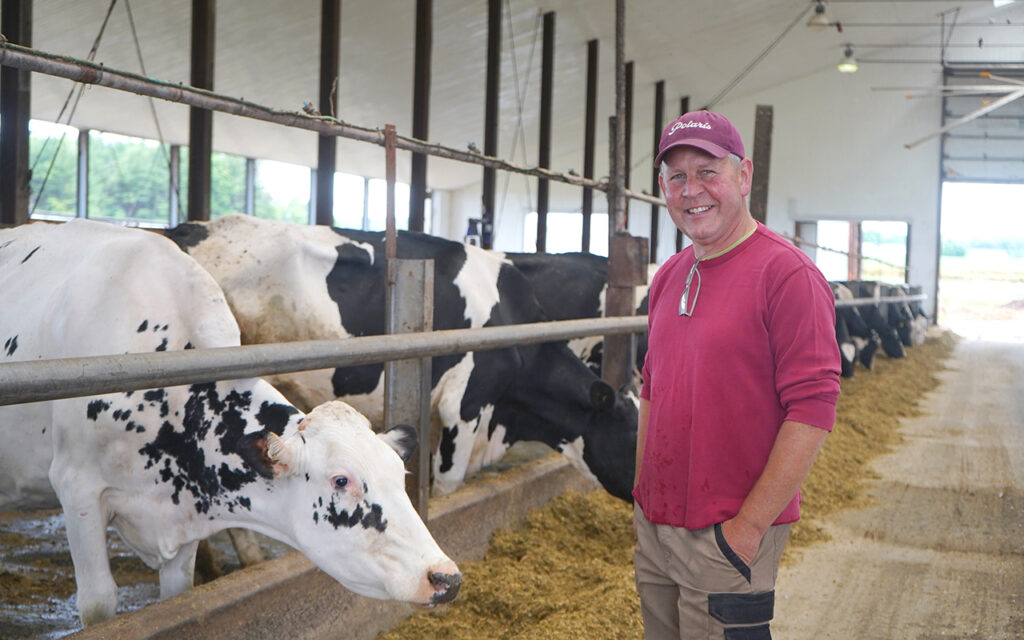
Justin Alary, a fifth-generation dairy farmer at Ferme Stépido in Luskville, said while the supply management system can make it hard for producers to grow, as farm production is limited by quota, he still believes the industry is better off because of it, and hopes the government will protect it in the ongoing trade negotiations.
“If we’re paid a stable price, the store sells at a stable price. So there’s no big spikes or crashes,” he said, adding this ensures a stable price for both farmer and consumer.
Shawville dairy farmer Dave Ingalls is the Pontiac representative to the Outaouais-Laurentides regional council for the Quebec milk producers.
Unlike Judd and Alary, Ingalls was not born into dairy farming. He and his wife, Eline Van Der Veen, got their foot in the industry in 2014, starting with 24 kilograms of quota, thanks to support from the New Entrant Program. Since then, they have managed to more than double the size of their operation.
He said any compromise of the current system is unacceptable.
“If you’ve traded any [market share] away, then you’ve not held up your end of the deal in my opinion, but that’s just my two cents.”
Trump’s beef
Trump has repeatedly claimed that Canada’s supply management system charges U.S. farmers as much as 400 per cent on products sold to Canada.
This is inaccurate. Canada charges tariffs between 200 and about 300 per cent on U.S. dairy imports that exceed certain quotas, referred to as tariff rate quotas (TRQ), that are set by the Canada-U.S.-Mexico Agreement (CUSMA) – the trade deal negotiated by Trump to replace NAFTA in 2018.
This agreement saw Canada raise its tariff rate quota on a number of different dairy, poultry and egg products, opening the Canadian market to increased American imports.
These quotas allow a set amount of dairy products to be imported at a lower tariff rate, but according to the International Dairy Foods Association, the U.S. has never come close to exceeding its quota. As a result, U.S. exporters don’t often encounter the higher tariffs.
The U.S. argues the real issue lies in how Canada allocates TRQ access. Canada maintains several TRQs across different dairy, egg and poultry products. Importers must apply for permits to access these quotas. Under Canada’s permit-based system, most of the import licenses go to Canadian processors, rather than retailers or distributors.
This means American dairy producers can sell to companies that turn dairy products into goods you can buy on Canadian shelves, but struggle to get their products directly onto the shelves of Canadian retailers. As a result, the U.S. argues it hasn’t received the full market access it was promised under CUSMA.
Tyler McCann, the managing director of the Canadian Agri-Food Policy Institute, and also a Pontiac farmer, is among the Pontiac residents watching as trade talks evolve.
“One of the three pillars of supply management is border controls, and that limits the ability of other countries to export into our market,” McCann said. “Donald Trump is generally of the view that other countries should not put any barriers up to the U.S. exports.”
“It’s important to understand that while President Trump makes all sorts of crazy claims, the U.S. dairy industry is not asking for supply management to be torn down,” he added. “They just want more access to the [Canadian market].”
New bill offers no guarantees, say experts
In anticipation of Trump’s continued attacks on supply management, the Bloc Québecois tabled Bill C-202, which received royal assent on June 26.
The bill amends the Department of Foreign Affairs, Trade and Development Act to prevent the department’s minister from making “any commitment” that would increase the limit on tariff-free dairy, egg or poultry products the U.S. can sell to Canada, or reduce the tariffs on imports that exceed these limits.
Unlike the recently rescinded digital services tax bill, C-202 was written specifically to protect the supply management system in the face of trade negotiations.
“[T]he supply management provision is clearly meant to constrain treaty negotiations. The DST didn’t have that, which is an important difference,” said Philippe Lagassé, an expert on Canadian policymaking at Carleton University, in an email, explaining why he figures it is less vulnerable to being abandoned, like the DST was.
Fen Hampson, an expert on Canada’s foreign policy and international negotiations at Carleton University, said this bill should offer a piece of mind to Canadian dairy farmers, as it was passed through the House unanimously.
This, he said, makes it very politically risky for the prime minister to change course, as doing so would threaten his political credibility. But others say side stepping it is technically possible. Lagassé is among them.
“This law makes it harder to negotiate away supply management, but laws can always be changed,” he said. “The question is whether the law truly prevents negotiations from taking place over supply management. That’s unclear to me.”
Lagassé is concerned that the current bill has a loophole, as it does not explicitly bind the Crown which, by way of the Royal Prerogative, can exercise powers outside of restrictions explicitly defined by legislation, including in foreign affairs. Prime Minister Mark Carney could choose to exercise these powers, side stepping the constrictions that Bill C-202 enforces.
“I suspect the bill was left with ambiguity around the prerogative on purpose. If the BQ didn’t insist on binding the Crown, despite several warnings about it, that seems intentional,” Lagassé said.
McCann said one of his biggest concerns with this bill is that it may give dairy producers a false sense of security.
“Thinking that this is going to prevent the government from making concessions that are necessary to get the trade deal . . . I just don’t think that’s reasonable.”
Instead, he emphasized that what really matters is the government’s political will to uphold its promises.
“And I think the prime minister and the new government have been very clear that they are very staunchly defending supply management and that is ultimately what matters the most.”
Passed unanimously, but still divisive
Hampson said that despite the bill passing unanimously, it could be potentially divisive in this country.
The U.S. cannot legally force Canada to change its supply management system. However, it can respond in other ways, such as by raising tariffs on Canadian exports like beef and grain, sectors that are export-dependent.
“We’re talking about a trade dispute, should the Americans decide to retaliate, which would threaten literally billions of dollars in sales and thousands of Canadian jobs [in other sectors],” he said.
McCann elaborated on this nuance.
“I think it is challenging when much of the discussion often comes down to supply management as the trade issue in agriculture,” McCann said, noting there are often more complex dynamics at play when it comes to trade negotiations.
“There’s an increasing expectation that Canada is going to have more tariffs across more products. That is not because we may not be prepared to make concessions on supply management. That is because the U.S. wants to put more tariffs on more products,” he said.
The complexity, McCann noted, is that supply managed sectors favour a closed market, and those that are not supply managed favour an open one. He said the vast majority of Canadian farmers are in export-dependent systems, which need strong supply chains and market access to the U.S. .
“An important dynamic to understand is that this isn’t a negotiation inside of agriculture. This is a negotiation across the economy.”
Hampson is not convinced supply management will be the issue to grind all trade negotiations to a halt, however, but warns this likely won’t be the last time the issue is on the table.
“We shouldn’t be surprised if it comes back next year,” he said, with CUSMA renegotiations set for 2026.
Hampson and McCann both agree that CUSMA talks about supply management may focus on tweaking how TRQs are administered, which is all the American dairy industry is asking for, according to McCann.
“If what we agree to in a deal is changes to how TRQs are administered, the average [Canadian] dairy farmer is probably not going to notice any difference,” he said.
“I think often it’s portrayed as, if you do anything to supply management, the whole system is going to fall apart, and that’s just not true.”
“This is where the government has some discretion,” Hampson said, predicting that during future negotiations, giving American producers direct access to Canadian distributors may be a way to achieve a deal.
Although, McCann noted, there is always a level of unpredictability when it comes to the American president.
“What we don’t know is where President Trump may go that’s above and beyond what the U.S. dairy industry is asking for, above and beyond what members of his cabinet have been asking for. That’s a giant question mark.”
Les producteurs laitiers du Pontiac font partie de ceux, partout au pays, qui suivent de près les négociations commerciales entre le Canada et les États-Unis, avant la date limite du 21 juillet. Certains s’inquiètent du sort du système de gestion de l’offre du pays, après que le président Donald Trump l’a une fois de plus signalé comme un problème.
À la fin de juin, dans une publication sur Truth Social dans laquelle le président Trump annonçait qu’il mettrait fin à toutes les négociations avec le Canada en raison des plans du pays d’instaurer une taxe sur les services numériques, il a également ciblé le système de gestion de l’offre comme un point d’achoppement dans les négociations.
En réponse, le Canada a renoncé à mettre en œuvre sa taxe sur les services numériques, qui devait facturer des milliards de dollars aux géants technologiques américains comme Amazon, Meta et Apple pour les services vendus au Canada, afin d’apaiser le président et de reprendre les négociations, laissant la gestion de l’offre intacte.
Lors de précédentes négociations commerciales, le gouvernement canadien s’est engagé à protéger le système de gestion de l’offre, qui, depuis les années 70, a restreint la production de produits laitiers, d’œufs et de volaille à ce que les Canadiens sont censés consommer, afin de garantir un marché stable aux agriculteurs canadiens.
À cette fin, le mois dernier, le Parlement a adopté le projet de loi C-202 du Bloc Québécois, visant à retirer l’accord actuel du Canada sur la gestion de l’offre avec les États-Unis de la table des négociations commerciales.
Mais maintenant, certains experts en commerce affirment qu’avec la gestion de l’offre probablement en ligne de mire de Trump, ce projet de loi pourrait ne pas suffire à empêcher le relâchement du contrôle strict et de longue date du Canada sur les industries laitière, ovicole et avicole, alors que les deux pays s’efforcent de conclure un accord commercial.
Mais qu’est-ce que la gestion de l’offre, et qu’est-ce que Trump lui reproche exactement? Voici ce qu’il faut savoir.
Un système qui vaut la peine d’être protégé, selon les agriculteurs
Le système de gestion de l’offre repose sur trois piliers : un système de quotas, qui régule l’offre; un prix minimum, qui régule le prix du produit; et des tarifs douaniers élevés pour éliminer la concurrence étrangère sur le marché.
« C’est une approche équilibrée pour répondre aux besoins canadiens en production de lait et de produits laitiers », a déclaré Scott Judd, un producteur laitier à Clarendon dont la famille trait des vaches Holstein de race pure depuis 1885.
Il a expliqué que lorsque les prix sont prévisibles, cela donne aux agriculteurs la confiance nécessaire pour planifier l’avenir. Qu’il s’agisse d’agrandir leurs terres, d’investir dans la prochaine génération ou de développer leur entreprise, la stabilité des prix qu’il offre rend possibles les décisions commerciales à long terme.
Justin Alary, producteur laitier de cinquième génération à la Ferme Stépido à Luskville, a déclaré que si le système de gestion de l’offre peut rendre difficile la croissance pour les producteurs, car la production agricole est limitée par les quotas, il croit toujours que l’industrie s’en porte mieux grâce à lui, et espère que le gouvernement le protégera dans les négociations commerciales en cours.
« Si nous sommes payés un prix stable, le magasin vend à un prix stable. Il n’y a donc pas de fortes hausses ou de baisses drastiques », a-t-il dit, ajoutant que cela assure un prix stable tant pour l’agriculteur que pour le consommateur.
Le producteur laitier de Shawville, Dave Ingalls, est le représentant du Pontiac au conseil régional Outaouais-Laurentides des Producteurs de lait du Québec.
Contrairement à Judd et Alary, Ingalls n’est pas né dans l’élevage laitier. Lui et sa femme, Eline Van Der Veen, ont fait leur entrée dans l’industrie en 2014, en commençant avec 24 kilogrammes de quota, grâce au soutien du Programme pour les nouveaux entrants. Depuis, ils ont réussi à plus que doubler la taille de leur exploitation.
Il a déclaré que tout compromis sur le système actuel est inacceptable.
« Si vous avez cédé une part de marché, alors vous n’avez pas tenu votre part de l’accord, à mon avis, mais ce n’est que mon petit grain de sel. »
Ce que Trump reproche
Trump a affirmé à plusieurs reprises que le système de gestion de l’offre du Canada impose aux agriculteurs américains jusqu’à 400 % de taxes sur les produits vendus au Canada.
C’est inexact. Le Canada impose des tarifs douaniers entre 200 et environ 300 % sur les importations laitières américaines qui dépassent certains quotas, appelés contingents tarifaires (CT), qui sont fixés par l’Accord Canada–États-Unis–Mexique (ACEUM) – l’accord commercial négocié par Trump pour remplacer l’ALENA en 2018.
Cet accord a vu le Canada augmenter son contingent tarifaire sur un certain nombre de produits laitiers, avicoles et ovicoles différents, ouvrant le marché canadien à une augmentation des importations américaines.
Ces quotas permettent d’importer une quantité déterminée de produits laitiers à un taux tarifaire inférieur, mais selon l’International Dairy Foods Association, les États-Unis n’ont jamais été près de dépasser leur quota. Par conséquent, les exportateurs américains ne rencontrent pas souvent les tarifs plus élevés.
Les États-Unis soutiennent que le véritable problème réside dans la manière dont le Canada attribue l’accès aux CT. Le Canada maintient plusieurs CT pour différents produits laitiers, ovicoles et avicoles. Les importateurs doivent demander des permis pour accéder à ces quotas. Dans le cadre du système canadien fondé sur les permis, la plupart des licences d’importation sont attribuées aux transformateurs canadiens, plutôt qu’aux détaillants ou distributeurs.
Cela signifie que les producteurs laitiers américains peuvent vendre à des entreprises qui transforment les produits laitiers en biens que l’on peut acheter sur les étagères canadiennes, mais peinent à placer leurs produits directement sur les étagères des détaillants canadiens. Par conséquent, les États-Unis affirment qu’ils n’ont pas reçu le plein accès au marché qui leur avait été promis en vertu de l’ACEUM.
Tyler McCann, directeur général de l’Institut canadien des politiques agroalimentaires et également agriculteur du Pontiac, fait partie des résidents du Pontiac qui suivent l’évolution des négociations commerciales.
« L’un des trois piliers de la gestion de l’offre est le contrôle frontalier, et cela limite la capacité des autres pays à exporter vers notre marché », a déclaré McCann. « Donald Trump est généralement d’avis que les autres pays ne devraient pas imposer de barrières aux exportations américaines. »
« Il est important de comprendre que si le président Trump fait toutes sortes d’affirmations folles, l’industrie laitière américaine ne demande pas la suppression de la gestion de l’offre », a-t-il ajouté. « Ils veulent juste un plus grand accès au marché [canadien]. »
Le nouveau projet de loi n’offre aucune garantie, selon les experts
En prévision des attaques continues de Trump contre la gestion de l’offre, le Bloc Québécois a déposé le projet de loi C-202, qui a reçu la sanction royale le 26 juin.
Le projet de loi modifie la Loi sur le ministère des Affaires étrangères, du Commerce et du Développement afin d’empêcher le ministre du ministère de prendre « tout engagement » qui augmenterait la limite sur les produits laitiers, ovicoles ou avicoles exempts de tarifs que les États-Unis peuvent vendre au Canada, ou de réduire les tarifs sur les importations qui dépassent ces limites.
Contrairement au projet de loi sur la taxe sur les services numériques récemment abrogé, le C-202 a été rédigé spécifiquement pour protéger le système de gestion de l’offre face aux négociations commerciales.
« [L]a disposition sur la gestion de l’offre vise clairement à encadrer les négociations de traités. La TSN n’avait pas cela, ce qui est une différence importante », a déclaré Philippe Lagassé, un expert en élaboration des politiques canadiennes à l’Université Carleton, dans un courriel, expliquant pourquoi il estime qu’il est moins vulnérable à l’abandon, comme l’a été la TSN.
Fen Hampson, un expert en politique étrangère et en négociations internationales du Canada à l’Université Carleton, a déclaré que ce projet de loi devrait rassurer les producteurs laitiers canadiens, car il a été adopté à l’unanimité par la Chambre.
Cela, a-t-il dit, rend très risqué politiquement pour le premier ministre de changer de cap, car cela menacerait sa crédibilité politique. Mais d’autres disent que le contourner est techniquement possible. Lagassé en fait partie.
« Cette loi rend plus difficile de négocier la suppression de la gestion de l’offre, mais les lois peuvent toujours être modifiées », a-t-il déclaré. « La question est de savoir si la loi empêche réellement la tenue de négociations sur la gestion de l’offre. Cela me semble flou. »
Lagassé craint que le projet de loi actuel comporte une lacune, car il ne lie pas explicitement la Couronne qui, par le biais de la prérogative royale, peut exercer des pouvoirs en dehors des restrictions explicitement définies par la législation, y compris en matière d’affaires étrangères. Le premier ministre Mark Carney pourrait choisir d’exercer ces pouvoirs, contournant ainsi les contraintes imposées par le projet de loi C-202.
« Je soupçonne que le projet de loi a été laissé avec une ambiguïté autour de la prérogative exprès. Si le BQ n’a pas insisté pour lier la Couronne, malgré plusieurs avertissements à ce sujet, cela semble intentionnel », a déclaré Lagassé.
McCann a déclaré que l’une de ses plus grandes préoccupations concernant ce projet de loi est qu’il pourrait donner aux producteurs laitiers un faux sentiment de sécurité.
« Penser que cela va empêcher le gouvernement de faire des concessions nécessaires pour obtenir l’accord commercial… Je ne pense tout simplement pas que ce soit raisonnable. »
Il a plutôt souligné que ce qui compte vraiment, c’est la volonté politique du gouvernement de tenir ses promesses.
« Et je pense que le premier ministre et le nouveau gouvernement ont été très clairs sur le fait qu’ils défendent très fermement la gestion de l’offre et c’est finalement ce qui compte le plus. »
Adopté à l’unanimité, mais toujours source de division
Hampson a déclaré que malgré l’adoption unanime du projet de loi, il pourrait être potentiellement source de division dans ce pays.
Les États-Unis ne peuvent pas légalement forcer le Canada à modifier son système de gestion de l’offre. Cependant, ils peuvent réagir d’autres manières, comme en augmentant les tarifs sur les exportations canadiennes de bœuf et de céréales, des secteurs qui dépendent des exportations.
« Nous parlons d’un différend commercial, si les Américains décident de riposter, ce qui menacerait littéralement des milliards de dollars de ventes et des milliers d’emplois canadiens [dans d’autres secteurs] », a-t-il déclaré.
McCann a élaboré sur cette nuance.
« Je pense que c’est difficile lorsque l’essentiel de la discussion se résume souvent à la gestion de l’offre comme enjeu commercial en agriculture », a déclaré McCann, notant qu’il y a souvent des dynamiques plus complexes en jeu lorsqu’il s’agit de négociations commerciales.
« Il y a une attente croissante selon laquelle le Canada aura plus de tarifs sur plus de produits. Ce n’est pas parce que nous ne serions pas prêts à faire des concessions sur la gestion de l’offre. C’est parce que les États-Unis veulent imposer plus de tarifs sur plus de produits », a-t-il déclaré.
La complexité, a noté McCann, est que les secteurs sous gestion de l’offre favorisent un marché fermé, et ceux qui ne sont pas sous gestion de l’offre favorisent un marché ouvert. Il a déclaré que la grande majorité des agriculteurs canadiens se trouvent dans des systèmes dépendants des exportations, qui ont besoin de chaînes d’approvisionnement solides et d’un accès au marché américain.
« Une dynamique importante à comprendre est que ce n’est pas une négociation interne à l’agriculture. C’est une négociation à l’échelle de l’économie. »
Hampson n’est pas convaincu que la gestion de l’offre sera la question qui mettra fin à toutes les négociations commerciales, cependant, mais avertit que ce ne sera probablement pas la dernière fois que la question sera sur la table.
« Nous ne devrions pas être surpris si cela revient l’année prochaine », a-t-il déclaré, les renégociations de l’ACEUM étant prévues pour 2026.
Hampson et McCann s’accordent à dire que les discussions sur la gestion de l’offre dans le cadre de l’ACEUM pourraient se concentrer sur l’ajustement de la manière dont les CT sont administrés, ce qui est tout ce que l’industrie laitière américaine demande, selon McCann.
« Si ce sur quoi nous nous entendons dans un accord est des changements à la manière dont les CT sont administrés, le producteur laitier [canadien] moyen ne remarquera probablement aucune différence », a-t-il déclaré.
« Je pense que c’est souvent dépeint comme : si vous touchez à la gestion de l’offre, tout le système va s’effondrer, et ce n’est tout simplement pas vrai. »
« C’est là que le gouvernement a une certaine discrétion », a déclaré Hampson, prédisant que lors de futures négociations, donner aux producteurs américains un accès direct aux distributeurs canadiens pourrait être un moyen de parvenir à un accord.
Bien que, comme l’a noté McCann, il y a toujours un niveau d’imprévisibilité lorsqu’il s’agit du président américain.
« Ce que nous ne savons pas, c’est jusqu’où le président Trump pourrait aller au-delà de ce que l’industrie laitière américaine demande, au-delà de ce que les membres de son cabinet ont demandé. C’est un énorme point d’interrogation. »