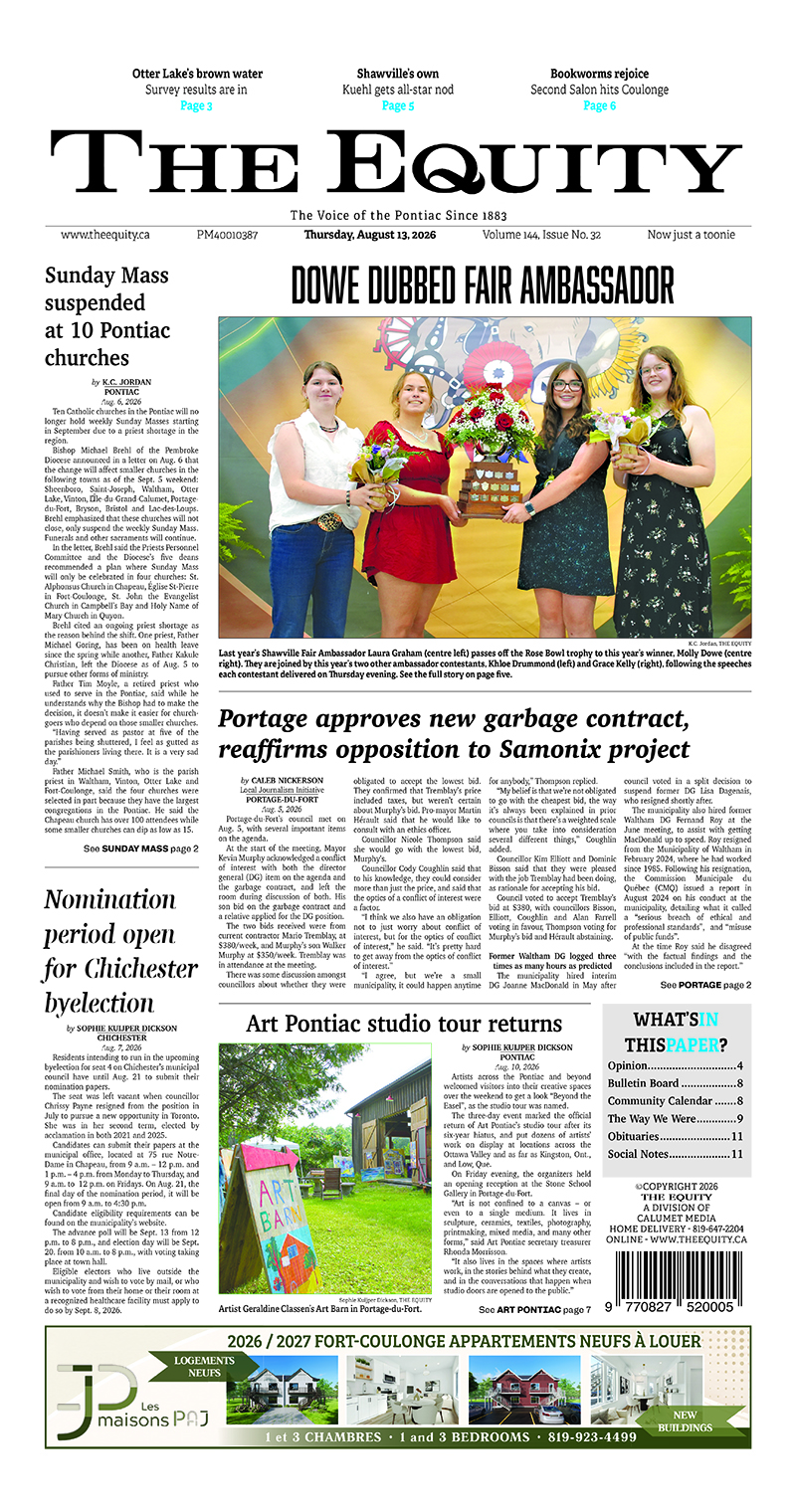






The story of what compelled my grandparents, David and Rosaleen Dickson, to pack up their life in the city and swap it for running a community newspaper here in the Pontiac was never one I got to hear from the horse’s mouth. When I came into this world they had long retired, after some 30 years running the business, and had passed it on to my uncle Ross and his then-wife Heather.
This newspaper’s presence in our family just was. Like the sky and ground, THE EQUITY, for many years, was elemental in the world into which I was born. I never understood it to be something that two people had, at one time, chosen for themselves and their young family.
After some two years with this newspaper, I’ve come to understand all that my grandparents were choosing when they took on this crazy adventure those 72 years ago. I’m grateful to my dad, to Ross and to Heather for keeping this newspaper going long enough that I could come to realize I wanted to be a part of it.
I’ll try to keep my blabbing about the important role of community newspapers to a minimum here. But I will say this. Yes, the leading story about local news in this country is that it’s dying.
Recent research from the Canadian Centre for Policy Alternatives found that since 2008 we’ve lost, on average, 25 local print media outlets a year. Local radio and TV stations are doing marginally better, but not much. As a result, 2.5 million Canadians now live in a postal code with, at best, one local news outlet.
My perhaps embarrassingly naive take on this is that local news will never die. It just needs to be reimagined.
I don’t have the stats or research to back this up. This hunch is based only on what I think I know about humans, and that is that sharing information about each other is at the core of who we are. It is survival.
“To be human is to talk about other humans,” one journalist recently suggested in a review of the book You Didn’t Hear This From Me: (Mostly) True Notes on Gossip. According to some evolutionary psychologists, gossiping – the act of staying up to speed on what your neighbours are up to so as to understand potential dangers to you or your community’s existence – can prolong your life.
There’s a critical distinction to be made here. Gossip is, of course, not the business we are in. Our dedication to reporting only facts, and to citing our sources, especially in cases where we cannot confirm the facts, is what sets us apart from gossip, as well as the wild world of social media-style information sharing.
But at the core of gossip is a sentiment, an impulse, that gives me hope. This desire to know what’s happening with our neighbours, the people whose lives touch our own, and to process shared changes, challenges, and joys, together – that’s what keeps us alive. Supporting this sharing, and bringing accuracy to it, is what local news, community news, does best.
While this newspaper has done this for over 140 years, under my own family’s leadership and that of others, we are still learning the new ways we need to be showing up for the community we represent.
Part of my job as editor is to figure out how to reach a new generation of readers, perhaps those who have grown used to reading their parents’ copy of THE EQUITY to catch up on their local news, but who haven’t taken that next step, for whatever reason, to subscribe themselves. What are we missing? What matters, here, that we have yet to represent? We have our hunches, but we need your help.
Subscriber or not, this is your newspaper. It’s filled, every week, with your stories – stories that won’t be told anywhere else.
Its long-term survival is dependent on your imagining of what more you want it to be.
Sophie Kuijper Dickson