The following is an abridged version of a submission by Pontiac Environment Protection (PEP) to the public hearings being convened on May 30 by the Canadian Nuclear Safety Commission (CNSC) on the proposal by Canadian Nuclear Laboratories (CNL) to construct a Near-Surface Disposal Facility (NSDF) at Chalk River for thedisposal of radioactive wastes.
The proposed Near Surface Disposal Facility (NSDF) for nuclear waste at Chalk River is a project of high concern for residents of West Quebec. While recognizing that the safe storage of nuclear waste is an immediate and pressing issue, we . . .
submit that it must be done with respect for and adherence to best practices and international standards to ensure the safety of future generations and a healthy environment.
To this end we draw upon standards of the International Atomic Energy Agency (IAEA) and commitments under the United Nations Declaration on the Rights of Indigenous Peoples (UNDRIP) to underline the significance of recent decisions by the Supreme Court of Canada related to administrative law decision by Boards and Commissions such as the Canadian Nuclear Safety Commission (CNSC).
The Court established a new regime for international legal considerations in the case of Minister of Citizenship and Immigration v. Vavilov. Vavilov requires administrative decision makers to take an “interpretive presumption of conformity” when it comes to applying international law to Canadian decisions.
It is our understanding that the proposed NSDF fails to meet the IAEA’s Safety Standards for the Disposal of Radioactive Waste. It also fails to satisfy provisions of UNDRIP. On both counts it thereby fails to fulfill commitments recognized in Canadian law.
We therefore urge the CNSC to deny the license for the proposed NSDF and require the proponent to bring forward a project in full compliance with all international standards and guidelines. Until this is done, it would be unreasonable for Canadian Nuclear Laboratories (CNL) and the CNSC to assert that the proposed NSDF is unlikely to cause any significant harm to human health and the environment, and unreasonable to license the project.
The IAEA Safety Standards set out recommendations to ensure nuclear safety for the environment and citizens around the world. Canada ratified the IAEA statute in 1957 with the aim to harmonize the global standard of safety.
As it fails to meet international obligations set out in the IAEA Safety Standards, in our view the proposed NSDF violates the fundamental principle established in Vavilov. The Nuclear Safety and Control Act of 2000 (NSCA) establishes the CNSC as the regulatory body responsible to oversee the use of nuclear energy and to ensure compliance with the NSCA. The NSCA delegates a high level of decision-making responsibility to the CNSC spanning “the use, possession and storage of all nuclear substances in Canada.”
Under its mandate, the CNSC must assess and regulate the risks associated with “the development, production and use of nuclear energy and the production, possession and use of nuclear substances” to a “reasonable level” that is consistent with international obligations.
The conclusions in the Environmental Assessment Report prepared by CNSC staff on what constitutes a “reasonable level” of exposure to ionizing radiation are inconsistent with the IAEA Safety Standards, as set out in a submission to CNSC by Pontiac Environment Protection:
The Environmental Assessment fails to consider long-lived radionuclides.
CNSC fails to consider deficiencies in the proponent’s siting process.
The report prepared by the CNSC fails to assess the need for alternative disposal facilities which would contain the wastes more effectively than an NSDF
Inadequate information about and consideration of the characteristics and quantities of the wastes that would go into the mound
The proposed technology does not conform to the standards set out by the IAEA for Intermediate level waste or low-level waste.
There are discrepancies between the type of waste reported to go in the dump (“only low-level waste”) and the actual waste.
United Nations Declaration on
the Rights of Indigenous Peoples
UNDRIP is a mechanism for recognizing self-determination of Indigenous peoples. Article 31(1) recognizes that “Indigenous peoples have the right to determine and develop priorities and strategies for the development or use of their lands or territories and other resources.” In addition, Article 31(2) says that “states shall consult and cooperate in good faith with the
Indigenous peoples concerned through their own representative institutions in order to obtain their free and informed consent prior to the approval of any project affecting their lands or territories and other resources, particularly in connection with the development, utilization or exploitation of mineral, water or other resources.”
Moreover, Article 29(2) says: “States shall take effective measures to ensure that no storage or disposal of hazardous materials shall take place in the lands or territories of Indigenous peoples without their free, prior and informed consent.”
Recently, the federal government adopted UNDRIP into Canadian law through Bill C-15. This means that the government now has a domestic legal obligation as well as an international one to uphold the provisions set out in UNDRIP. However, in the case of the Chalk River NSDF, these provisions of UNDRIP have not been fulfilled.
Many First Nations communities have spoken out against the Chalk River project including the grand council chief of the Anishinabek Nation, Patrick Madahbee, who stated that “Trying to build this giant mound of radioactive waste … is insanity.” Madahbee advocated for around 40 communities representing around 65,000 people across Ontario. He said CNL has an obligation under UNDRIP to consult Indigenous people about storing hazardous materials in their territory, but CNL hasn’t talked to them about it.
Moreover, Kebaowek First Nation has objected to the continuation of the nuclear industry on its lands without its free prior and informed consent, as stated in the UNDRIP articles cited above.
Article 29(2) of UNDRIP, that says “States shall take effectivemeasures to ensure that no storage or disposal of hazardous materials shall take place in the lands or territories of Indigenous peoples without their free, prior and informed consent” has not been respected, as demonstrated above.
In the case of this nuclear disposal facility, it is clear from the comments made by numerous Indigenous leaders that the CNSC acting as an agent of government did not receive the consent required from Indigenous communities for the continuation of the Chalk River project.
Likewise, in 2018, during the commission’s public hearings, First Nation communities including the Algonquins of Ontario submitted that they opposed the project. Therefore, we are convinced that the CNSC did not fulfill the government’s obligations set out in UNDRIP that pertain to free, prior and informed consent.
In sum, we recommend that the CNSC refuse the license for the proposed NSDF and ensure that future proposals require CNL to revise both its site selection process and facility design to ensure conformity with international standards and best practices, with the aim of identifying a site and design facility suited for the types, form, long-lived characteristics and volume of wastes intended to be stored, which ensures safety as a first consideration prior to consideration of other factors such as costs. A future proposal should adhere to international standards set out by the IAEA and respect the provisions set out in UNDRIP to engage meaningfully with Indigenous peoples prior to licensing decisions, and take effective measures to ensure that no storage or disposal of hazardous materials shall take place in the lands or territories of Indigenous peoples without their free, prior and informed consent.
In our view, for the CNSC to make findings that respect its responsibilities as the sole regulator, and accord with their authority and IAEA Safety Standards, the presumption of conformity determined in the Vavilov case must be applied. Under the precedent of Vavilov, it is clear that “international law will operate as an important constraint on an administrative decision maker.”
Because the CNSC’s Environmental Assessment Report contains significant flaws and omissions in the assessment of CNL’s proposal for disposal of nuclear waste in a near surface landfill type facility at Chalk River, we submit that the proposal cannot be said to be in compliance with Canada’s international obligations and is likely to pose a significant risk to human health and the environment.
As a result of their non-conformity with IAEA Safety Standards, the CNSC’s conclusions and recommendations regarding the proposals are unreasonable because they disregard established “principles of customary and conventional international law.” It would equally be unreasonable to approve the EA and licence the project in the face of such non-conformity.
Moreover, the continuation of nuclear energy production and nuclear waste storage and disposal on unceded Indigenous territory without meaningful dialogue is not only a demonstration of continued colonial practices, but a violation domestically as well as internationally of articles 29(2) and 31 of UNDRIP.
We must move away from colonial practices in our energy systems toward meaningful actions to respect Indigenous rights.



Proposed nuclear waste dump clashes with Canada’s international commitments
Proposed nuclear waste dump clashes with Canada’s international commitments
‘Nobody was ever stuck for a dollar or for groceries’ Francis Conroy wraps up 54 years of feeding the community
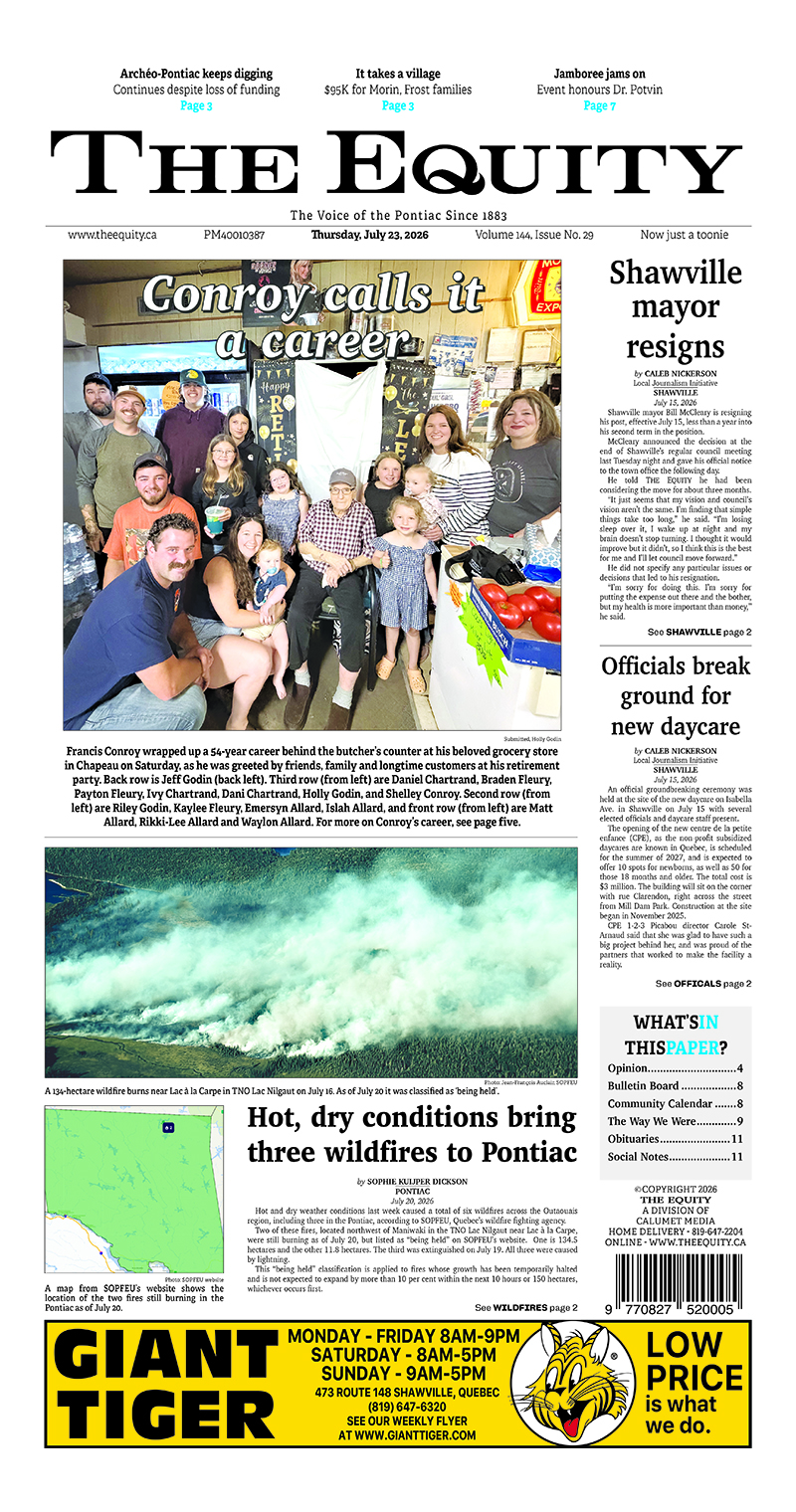
Hot, dry conditions bring three wildfires to Pontiac
Cones for Kendyl CHEO fundraiser back for 2nd year
Campbell’s Bay celebrates 100 years of the Legion
Portage RA back in business with summer festival
La Pêche hosts first ball tourney in honour of Benoit Moreau
Friends of Chats Falls: Archéo-Pontiac digs to continue despite losing funding
Lions Jamboree turns 13, honours Dr. Earle Potvin
Pontiac Lions present $95,000 to Frost, Morin families
County-wide fire ban in place, two new forest fires in the upper reaches of Pontiac territory
Shawville mayor resigns, byelection planned for fall
Officials break ground for new daycare
The following is an abridged version of a submission by Pontiac Environment Protection (PEP) to the public hearings being convened on May 30 by the Canadian Nuclear Safety Commission (CNSC) on the proposal by Canadian Nuclear Laboratories (CNL) to construct a Near-Surface Disposal Facility (NSDF) at Chalk River for thedisposal of radioactive wastes.
The proposed Near Surface Disposal Facility (NSDF) for nuclear waste at Chalk River is a project of high concern for residents of West Quebec. While recognizing that the safe storage of nuclear waste is an immediate and pressing issue, we . . .
submit that it must be done with respect for and adherence to best practices and international standards to ensure the safety of future generations and a healthy environment.
To this end we draw upon standards of the International Atomic Energy Agency (IAEA) and commitments under the United Nations Declaration on the Rights of Indigenous Peoples (UNDRIP) to underline the significance of recent decisions by the Supreme Court of Canada related to administrative law decision by Boards and Commissions such as the Canadian Nuclear Safety Commission (CNSC).
The Court established a new regime for international legal considerations in the case of Minister of Citizenship and Immigration v. Vavilov. Vavilov requires administrative decision makers to take an “interpretive presumption of conformity” when it comes to applying international law to Canadian decisions.
It is our understanding that the proposed NSDF fails to meet the IAEA’s Safety Standards for the Disposal of Radioactive Waste. It also fails to satisfy provisions of UNDRIP. On both counts it thereby fails to fulfill commitments recognized in Canadian law.
We therefore urge the CNSC to deny the license for the proposed NSDF and require the proponent to bring forward a project in full compliance with all international standards and guidelines. Until this is done, it would be unreasonable for Canadian Nuclear Laboratories (CNL) and the CNSC to assert that the proposed NSDF is unlikely to cause any significant harm to human health and the environment, and unreasonable to license the project.
The IAEA Safety Standards set out recommendations to ensure nuclear safety for the environment and citizens around the world. Canada ratified the IAEA statute in 1957 with the aim to harmonize the global standard of safety.
As it fails to meet international obligations set out in the IAEA Safety Standards, in our view the proposed NSDF violates the fundamental principle established in Vavilov. The Nuclear Safety and Control Act of 2000 (NSCA) establishes the CNSC as the regulatory body responsible to oversee the use of nuclear energy and to ensure compliance with the NSCA. The NSCA delegates a high level of decision-making responsibility to the CNSC spanning “the use, possession and storage of all nuclear substances in Canada.”
Under its mandate, the CNSC must assess and regulate the risks associated with “the development, production and use of nuclear energy and the production, possession and use of nuclear substances” to a “reasonable level” that is consistent with international obligations.
The conclusions in the Environmental Assessment Report prepared by CNSC staff on what constitutes a “reasonable level” of exposure to ionizing radiation are inconsistent with the IAEA Safety Standards, as set out in a submission to CNSC by Pontiac Environment Protection:
The Environmental Assessment fails to consider long-lived radionuclides.
CNSC fails to consider deficiencies in the proponent’s siting process.
The report prepared by the CNSC fails to assess the need for alternative disposal facilities which would contain the wastes more effectively than an NSDF
Inadequate information about and consideration of the characteristics and quantities of the wastes that would go into the mound
The proposed technology does not conform to the standards set out by the IAEA for Intermediate level waste or low-level waste.
There are discrepancies between the type of waste reported to go in the dump (“only low-level waste”) and the actual waste.
United Nations Declaration on
the Rights of Indigenous Peoples
UNDRIP is a mechanism for recognizing self-determination of Indigenous peoples. Article 31(1) recognizes that “Indigenous peoples have the right to determine and develop priorities and strategies for the development or use of their lands or territories and other resources.” In addition, Article 31(2) says that “states shall consult and cooperate in good faith with the
Indigenous peoples concerned through their own representative institutions in order to obtain their free and informed consent prior to the approval of any project affecting their lands or territories and other resources, particularly in connection with the development, utilization or exploitation of mineral, water or other resources.”
Moreover, Article 29(2) says: “States shall take effective measures to ensure that no storage or disposal of hazardous materials shall take place in the lands or territories of Indigenous peoples without their free, prior and informed consent.”
Recently, the federal government adopted UNDRIP into Canadian law through Bill C-15. This means that the government now has a domestic legal obligation as well as an international one to uphold the provisions set out in UNDRIP. However, in the case of the Chalk River NSDF, these provisions of UNDRIP have not been fulfilled.
Many First Nations communities have spoken out against the Chalk River project including the grand council chief of the Anishinabek Nation, Patrick Madahbee, who stated that “Trying to build this giant mound of radioactive waste … is insanity.” Madahbee advocated for around 40 communities representing around 65,000 people across Ontario. He said CNL has an obligation under UNDRIP to consult Indigenous people about storing hazardous materials in their territory, but CNL hasn’t talked to them about it.
Moreover, Kebaowek First Nation has objected to the continuation of the nuclear industry on its lands without its free prior and informed consent, as stated in the UNDRIP articles cited above.
Article 29(2) of UNDRIP, that says “States shall take effectivemeasures to ensure that no storage or disposal of hazardous materials shall take place in the lands or territories of Indigenous peoples without their free, prior and informed consent” has not been respected, as demonstrated above.
In the case of this nuclear disposal facility, it is clear from the comments made by numerous Indigenous leaders that the CNSC acting as an agent of government did not receive the consent required from Indigenous communities for the continuation of the Chalk River project.
Likewise, in 2018, during the commission’s public hearings, First Nation communities including the Algonquins of Ontario submitted that they opposed the project. Therefore, we are convinced that the CNSC did not fulfill the government’s obligations set out in UNDRIP that pertain to free, prior and informed consent.
In sum, we recommend that the CNSC refuse the license for the proposed NSDF and ensure that future proposals require CNL to revise both its site selection process and facility design to ensure conformity with international standards and best practices, with the aim of identifying a site and design facility suited for the types, form, long-lived characteristics and volume of wastes intended to be stored, which ensures safety as a first consideration prior to consideration of other factors such as costs. A future proposal should adhere to international standards set out by the IAEA and respect the provisions set out in UNDRIP to engage meaningfully with Indigenous peoples prior to licensing decisions, and take effective measures to ensure that no storage or disposal of hazardous materials shall take place in the lands or territories of Indigenous peoples without their free, prior and informed consent.
In our view, for the CNSC to make findings that respect its responsibilities as the sole regulator, and accord with their authority and IAEA Safety Standards, the presumption of conformity determined in the Vavilov case must be applied. Under the precedent of Vavilov, it is clear that “international law will operate as an important constraint on an administrative decision maker.”
Because the CNSC’s Environmental Assessment Report contains significant flaws and omissions in the assessment of CNL’s proposal for disposal of nuclear waste in a near surface landfill type facility at Chalk River, we submit that the proposal cannot be said to be in compliance with Canada’s international obligations and is likely to pose a significant risk to human health and the environment.
As a result of their non-conformity with IAEA Safety Standards, the CNSC’s conclusions and recommendations regarding the proposals are unreasonable because they disregard established “principles of customary and conventional international law.” It would equally be unreasonable to approve the EA and licence the project in the face of such non-conformity.
Moreover, the continuation of nuclear energy production and nuclear waste storage and disposal on unceded Indigenous territory without meaningful dialogue is not only a demonstration of continued colonial practices, but a violation domestically as well as internationally of articles 29(2) and 31 of UNDRIP.
We must move away from colonial practices in our energy systems toward meaningful actions to respect Indigenous rights.
More Local News
‘Nobody was ever stuck for a dollar or for groceries’ Francis Conroy wraps up 54 years of feeding the community
Hot, dry conditions bring three wildfires to Pontiac
Cones for Kendyl CHEO fundraiser back for 2nd year
Campbell’s Bay celebrates 100 years of the Legion
Portage RA back in business with summer festival
La Pêche hosts first ball tourney in honour of Benoit Moreau
Friends of Chats Falls: Archéo-Pontiac digs to continue despite losing funding
Lions Jamboree turns 13, honours Dr. Earle Potvin
Pontiac Lions present $95,000 to Frost, Morin families
County-wide fire ban in place, two new forest fires in the upper reaches of Pontiac territory
Shawville mayor resigns, byelection planned for fall
Officials break ground for new daycare
‘Nobody was ever stuck for a dollar or for groceries’ Francis Conroy wraps up 54 years of feeding the community
Hot, dry conditions bring three wildfires to Pontiac
Cones for Kendyl CHEO fundraiser back for 2nd year
Campbell’s Bay celebrates 100 years of the Legion
Portage RA back in business with summer festival
La Pêche hosts first ball tourney in honour of Benoit Moreau
Friends of Chats Falls: Archéo-Pontiac digs to continue despite losing funding
Lions Jamboree turns 13, honours Dr. Earle Potvin
Pontiac Lions present $95,000 to Frost, Morin families
County-wide fire ban in place, two new forest fires in the upper reaches of Pontiac territory
Shawville mayor resigns, byelection planned for fall
Officials break ground for new daycare
Proposed nuclear waste dump clashes with Canada’s international commitments