






Chris Lowrey
SHAWVILLE April 30, 2018
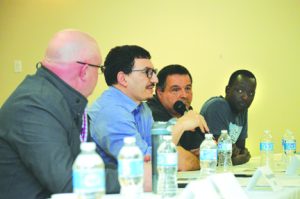
Local politicians, farmers, citizens, and representatives from Shawville’s proposed abattoir filled the Shawville R.A. Hall on April 30 to get some answers on the town’s newest business.
The event kicked off with a quick address from both Shawville Mayor Sandra Murray as well as MRC Warden Jane Toller.
The abattoir was represented by Sofiane El Ketroussi, Ibrahim Daigne and Alain Lauzon.
Those in attendance were given a question-and-answer sheet that provided answers to the most common questions from the last information session on March 27.
The event was moderated by Ministry of Science, the Economy and Innovation representative Jeffrey MacHan.
The first question addressed by the panel was about the zoning for the abattoir’s land. Residents were told that the land is zoned for light manufacturing use. The plans for the abattoir are in compliance with the requirements of both the municipality as well as the province.
Another major topic of discussion was the environmental impact of the slaughterhouse.
Again, those in attendance were told that the abattoir is in full compliance with all environmental regulations.
Representatives were also asked about whether or not the animals that will be slaughtered are going to be kept outside. The animals will go directly from the trucks into the slaughterhouse.
The abattoir representatives also assured the crowd that there would be no odours associated with the facility.
“Our promoters are making a guarantee that there will be no odours,” MacHan said.
The question-and-answer period also addressed the extra cost associated with the water treatment facility upgrades associated with the previous attempt to bring a slaughterhouse to Shawville.
The total cost of the water treatment facility upgrades was $1,097,204. The federal and provincial governments covered $932,622 of the costs while the municipality of Shawville covered $164,582.
Residents were also keen to know what economic spinoffs would be associated with the abattoir.
The abattoir’s representatives said that they will be hiring 12 full-time employees to work a five-day workweek at the facility.
During the start-up phase, which will last about three months, the facility will slaughter three head of cattle per day for a total of 15 head per week. They will also be able to process three head of sheep per day, which also adds up to 15 head per week.
Once the facility is running at full capacity, it will be able to process 32 head of beef per day, which adds up to a total of 160 head per week.
When it comes to the facility’s ability to process sheep at full capacity, the representatives say they will be able to process 10 sheep per day for a total of 50 per week.
In terms of local producers, the abattoir’s representatives highlighted the dramatic decrease in transportation costs for farmers in the Pontiac.
The example given was the $2,000 average cost to transport a full shipment of 40 animals to Toronto. If the abattoir eventually gets up to full capacity, it could process 160 head per week, which would represent a savings of about $8,000.
Clarendon farmer Scott Stephens said that the facility will allow him to make more than 30 per cent more money off every animal he produces.
He pointed to the fact that although he lives in Clarendon, 90 per cent of his suppliers are in Shawville.
Stephens said that as the abattoir grows, the facility will need more suppliers to keep it at full capacity. He said that will create a trickle down effect for farmers in the region.
The representatives also said the facility will butcher meat for hunters.
Another hot-button issue was the fact that the facility was billed as a Halal slaughterhouse.
The representatives stressed the fact that it will not be a Halal-exclusive facility. They wanted to increase the viability of the project and so they figured that adding a Halal component would give it a niche market on which to capitalize.
“By having a Halal component, it guarantees sales,” said El Ketroussi
The facility will feature a segregation system to make sure the non-Halal meat and the Halal meat don’t touch.
However, the facility will not slaughter hogs. The reason they won’t be doing this is because if hogs are slaughtered at the facility, it will lose it’s Halal certification.
Another major concern was the impact the facility would have on the water treatment facility. Would trace amounts of animal byproduct make it into the water system?
Residents were told that the larger pieces of animal byproduct would be sifted out by a rotary drum. The leftover fat and water goes to a grease trap where enzymes are added that digest the fat. The remaining water is then sent to the treatment facility.
The representatives said that they have already received 11 applications to work at the facility. Those that are hired will go through a condensed four month training period that will allow them to have more responsibilities.
In terms of the financing, the total cost of the project is $3.4 million. The owners put up $875,000; they got a loan from the Business Development Bank of Canada (BDC) in partnership with Investment Quebec and Caisse Desjardins for $828,625; another $828,625 came from a loan from Caisse Desjardins; $700,000 came from BDC and Desjardins in the form of a zero per cent loan; the MRC Pontiac kicked in $83,875 and the SADC also contributed $83,875.
It seemed like a majority of the 100 people in attendance were supportive of the project, including local representatives.
05.02 abattoir