



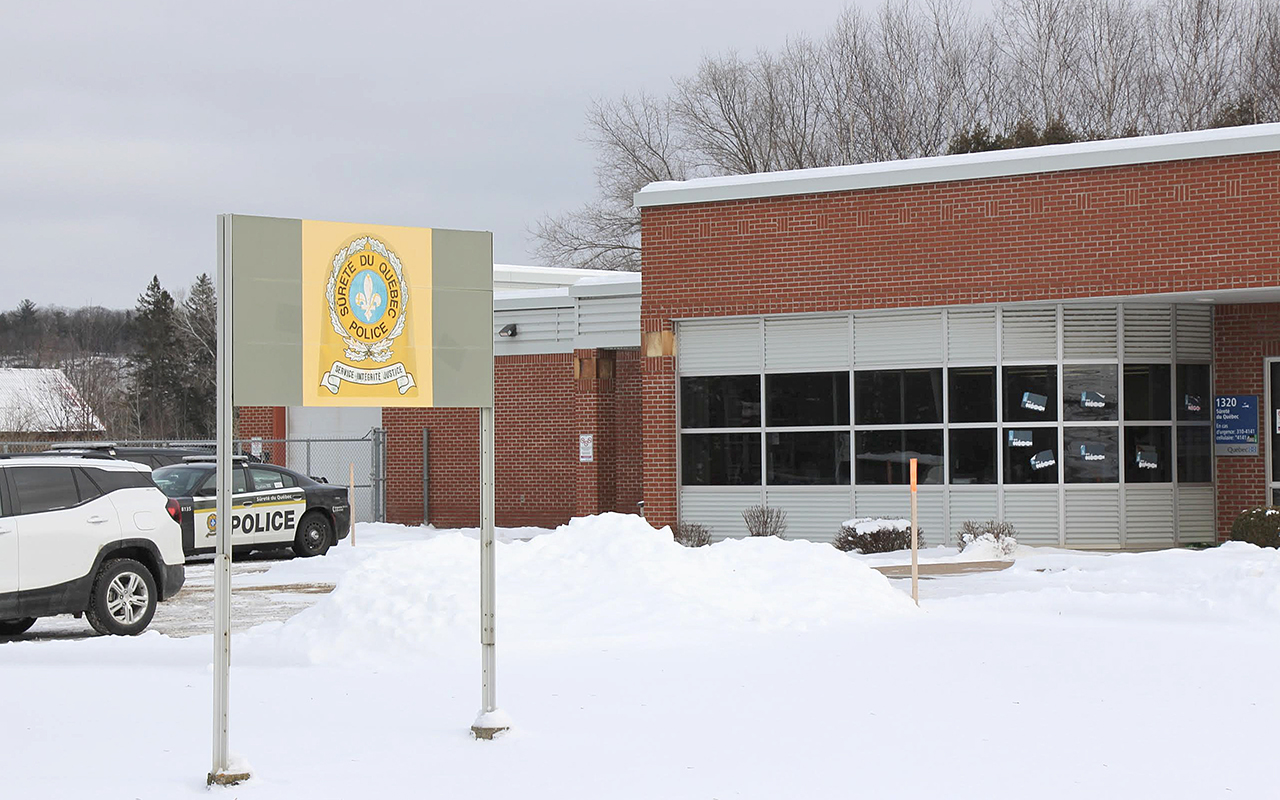



Quebec’s police watchdog has announced the province’s Director of Criminal and Penal Prosecutions (DPCP) has decided not to file charges against Sûreté du Québec (SQ) officers in connection with a Mar. 2024 incident in which a woman fell unconscious while being detained at the Campbell’s Bay police station and died in hospital days later.
“Based on the information obtained during the investigation, it can be concluded that the obligations of the police officers and the director of the police department involved . . . were met,” said a July 10 press release from the Bureau des enquêtes indépendantes (BEI), which conducted the investigation into the incident, and later provided its findings to the DPCP for its analysis.
The BEI’s investigation, launched on the afternoon of Mar. 1, 2024, only a few hours after the incident occurred, provided a detailed account of the events that lead to the woman’s death, which was published in the DPCP’s press release.
According to the report, the woman was arrested by SQ police officers during a search conducted at her home the morning of Mar. 1, and subsequently taken to the Campbell’s Bay police station.
After being placed in an interrogation room, the woman asked for her medication, which was still at her home. When an officer brought her the medication, she took it and placed a few tablets in her pockets, which an officer then retrieved, along with the medication container.
For the next 40 or so minutes, the woman was alone in the interrogation room, and was described as screaming and banging on the table. The report indicates she appeared to convulse and fall to the floor, breathing heavily.
An officer then returned to the room to find the woman on the ground, and a second officer helped sit her down on a chair, noting she was minimally conscious and not responding to the agents’ questions. At that point the paramedics were called.
When the paramedics arrived, the woman convulsed again. The paramedics transported her to hospital.
The woman was pronounced dead on Mar. 4, 2024, the autopsy revealing the woman had died as a result of “polyintoxication to drugs of abuse,” according to the DPCP.
The BEI’s report to the DPCP contained no information about the location of the officers or their duties during this period.

This is because as of Apr. 2024, police officers are no longer required by law to prepare a report on the facts of the incident being investigated by the BEI.
While the BEI had already obtained the police officers’ reports in the Campbell’s Bay investigation two months earlier, it withdrew them from the final file submitted to the DPCP.
Using the above account, as well as additional information from the investigation, the DPCP analyzed the incident, ultimately determining that the police officers would not be charged with a criminal offence.
The report explained its decision to not file charges against the officers, saying that under Section 215(c) of the Criminal Code, officers must provide the “necessities of life” to those in custody, including medical care.
“It is an offence to fail, without lawful excuse, to perform that duty, and if the failure to perform the duty endangers the life of the person or is likely to cause permanent harm to the health of the person,” reads the report.
To file charges against the officers, the DPCP would have had to prove beyond reasonable doubt the following items: that the officer was under a legal obligation to provide the necessaries of life while the person was in his custody; that the police officer failed to provide the necessities of life; that the officer failed to provide the necessities of life endangered the person’s life or was likely to cause permanent harm to the person’s health; and that the officer’s conduct represented a marked departure from the conduct of a reasonable police officer in circumstances where it was objectively foreseeable that the failure to provide medical care to the person endangered his life or was likely to cause permanent harm to that person’s health.
The report says that throughout the intervention officers remained respectful towards the woman, and that the officer only became aware of her precarious state of health upon re-entering the interrogation room, at which point he went to her aid and contacted the emergency services.
“The available evidence does not support a finding of a marked departure from the behaviour of a reasonable police officer in the same circumstances, nor does it support a finding that they failed to provide the necessities of life for a dependent.

Consequently, following its analysis, the DPCP is of the opinion that the evidence does not reveal the commission of a criminal offence by the SQ officers involved in this event,” concluded the report.
Le Bureau des enquêtes indépendantes (BEI) a annoncé que le Directeur des poursuites criminelles et pénales (DPCP) de la province a décidé de ne pas porter d’accusations contre des agents de la Sûreté du Québec (SQ) en lien avec un incident survenu en mars 2024 au cours duquel une femme est tombée inconsciente alors qu’elle était détenue au poste de police de Campbell’s Bay et est décédée à l’hôpital quelques jours plus tard.
« D’après les informations obtenues lors de l’enquête, on peut conclure que les obligations des policiers et du directeur du service de police impliqués . . . ont été respectées », a indiqué un communiqué de presse du 10 juillet du Bureau des enquêtes indépendantes (BEI), qui a mené l’enquête sur l’incident et a ensuite transmis ses conclusions au DPCP pour son analyse.
L’enquête du BEI, lancée dans l’après-midi du 1er mars 2024, quelques heures seulement après l’incident, a fourni un compte rendu détaillé des événements qui ont conduit au décès de la femme, lequel a été publié dans le communiqué de presse du DPCP.
Selon le rapport, la femme a été arrêtée par des policiers de la SQ lors d’une perquisition menée à son domicile le matin du 1er mars et a ensuite été conduite au poste de police de Campbell’s Bay.
Après avoir été placée dans une salle d’interrogatoire, la femme a demandé ses médicaments, qui se trouvaient encore chez elle. Lorsqu’un agent lui a apporté les médicaments, elle les a pris et a placé quelques comprimés dans ses poches, qu’un agent a ensuite récupérés, ainsi que le contenant des médicaments.
Pendant les quelque 40 minutes suivantes, la femme est restée seule dans la salle d’interrogatoire et a été décrite comme criant et frappant sur la table. Le rapport indique qu’elle a semblé convulser et est tombée par terre, respirant difficilement.
Un agent est ensuite retourné dans la pièce et a trouvé la femme par terre, et un second agent l’a aidée à s’asseoir sur une chaise, constatant qu’elle était à peine consciente et ne répondait pas aux questions des agents. À ce moment, les ambulanciers ont été appelés.
À l’arrivée des ambulanciers, la femme a convulsé à nouveau. Les ambulanciers l’ont transportée à l’hôpital.
La femme a été déclarée morte le 4 mars 2024, l’autopsie révélant que la femme était décédée des suites d’une « polyintoxication aux drogues d’abus », selon le DPCP.
Le rapport du BEI au DPCP ne contenait aucune information sur la localisation des agents ou leurs fonctions pendant cette période.
C’est parce qu’à partir d’avril 2024, les policiers ne sont plus tenus par la loi de préparer un rapport sur les faits de l’incident faisant l’objet d’une enquête du BEI.
Bien que le BEI ait déjà obtenu les rapports des policiers dans le cadre de l’enquête de Campbell’s Bay deux mois plus tôt, il les a retirés du dossier final soumis au DPCP.
En se basant sur le compte rendu ci-dessus, ainsi que sur des informations supplémentaires de l’enquête, le DPCP a analysé l’incident, déterminant finalement que les policiers ne seraient pas accusés d’une infraction criminelle.
Le rapport a expliqué sa décision de ne pas porter d’accusations contre les agents, indiquant qu’en vertu de l’article 215(c) du Code criminel, les agents doivent fournir les « nécessités de la vie » aux personnes sous leur garde, y compris les soins médicaux.
« C’est une infraction de ne pas, sans excuse légitime, remplir ce devoir, et si le défaut de remplir ce devoir met en danger la vie de la personne ou est susceptible de causer un préjudice permanent à sa santé », indique le rapport.
Pour porter des accusations contre les agents, le DPCP aurait dû prouver hors de tout doute raisonnable les éléments suivants : que l’agent était légalement tenu de fournir les nécessités de la vie pendant que la personne était sous sa garde; que le policier n’a pas fourni les nécessités de la vie; que le fait que l’agent n’ait pas fourni les nécessités de la vie a mis en danger la vie de la personne ou était susceptible de causer un préjudice permanent à sa santé; et que la conduite de l’agent représentait un écart marqué par rapport à la conduite d’un policier raisonnable dans des circonstances où il était objectivement prévisible que le défaut de fournir des soins médicaux à la personne mettait sa vie en danger ou était susceptible de causer un préjudice permanent à la santé de cette personne.
Le rapport indique que tout au long de l’intervention, les agents sont restés respectueux envers la femme, et que l’agent n’a pris conscience de son état de santé précaire qu’en rentrant dans la salle d’interrogatoire, moment auquel il lui est venu en aide et a contacté les services d’urgence.
« Les éléments de preuve disponibles ne permettent pas de conclure à un écart marqué par rapport au comportement d’un policier raisonnable dans les mêmes circonstances, ni de conclure qu’ils n’ont pas fourni les nécessités de la vie à une personne à charge.
Par conséquent, suite à son analyse, le DPCP est d’avis que la preuve ne révèle pas la commission d’une infraction criminelle par les agents de la SQ impliqués dans cet événement », a conclu le rapport.