




This week, we almost lost another member of our Canadian newspaper family. The Eganville Leader, which about a year ago announced it would be going out of print this month, found a buyer just a week short of its planned closure. It’s a good news story for our industry which has, since 2008, seen on average 36 newspapers a year cease publication as they struggle through monumental digital transformation while advertising dollars flow south of the border into the pockets of Facebook and Google.
The news industry is in a precarious position. Readership habits have changed, and adapting to those realities takes time, effort, and investment. It means reporting news as it happens rather than waiting for the ink to dry. It means using technology to ensure people know what’s happening in their own communities. At the same time it means maintaining an increasingly costly distribution method of printing a physical newspaper and getting it in your hands 50 times a year.
Technology can help us fulfill our mission, but it can also put major obstacles in our path. Artificial intelligence, when used responsibly, can improve the quality and reach of our reporting. But online, it has also fueled the spread of fake news, substandard journalism, and a steady erosion of trust, even in legitimate news organizations.
We now live in an era where “truth” often becomes whatever generates the most engagement in a Facebook group, or comes from an algorithm that sometimes doesn’t understand, for example, that the Municipality of Pontiac and the MRC Pontiac are two different areas. As we continue to lose trusted sources of information, an increasing number of the social media groups filling the void seem to be using AI to gather and report stories before the facts are known.
At the same time, there seems to be less interest in hearing and understanding more than one side to a story. Content is praised when it confirms existing beliefs or convenient narratives, and criticized when it challenges these biases. In this context, a news organization dedicated to trying to understand both sides of any story, no matter how inconvenient, is needed more than ever.
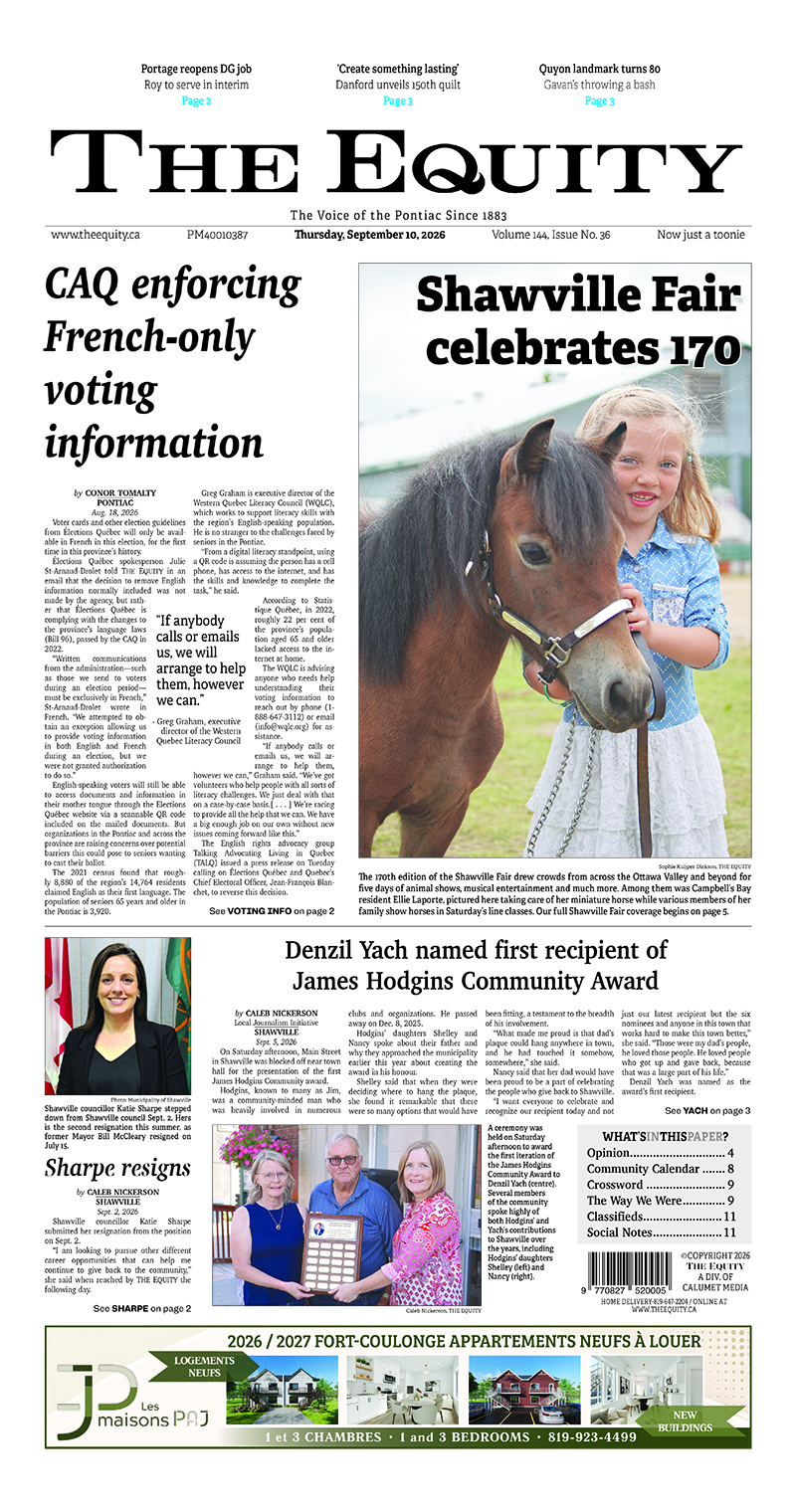
For nearly 143 years, THE EQUITY has chronicled our collective history. We want to serve this community for another 143 years—but longevity is not a birthright. It depends on an ongoing contract between a publication and its people, one that requires real, financial commitment.
When I purchased THE EQUITY a year ago, it was to help save it from the same fate that has befallen many local newspapers across Canada. Although readership across both print and online remains incredibly strong, the small businesses that used to grace our pages either no longer exist, can’t support an advertising budget on thin margins, or have decided to spend their money with American tech giants who don’t employ people in our communities.
Local journalism has reached an economic breaking point. To maintain integrity, we must pay fair, living wages to the people who are up late every Monday night putting the paper together, and who sit through four-hour council meetings and stand in the rain at high school soccer games so you don’t have to.
A local newspaper is not a guaranteed public utility. It is a choice. If you believe your government should be watched, your children’s achievements recorded, and your neighbours’ stories told with accuracy and dignity, you must act.
Thank you to all our readers and advertisers who continue to invest in quality local journalism. And if you think we’re doing good work but haven’t yet subscribed, we hope you consider it, because the cost of a paper is far less than the cost of losing it.
Jon Stewart