



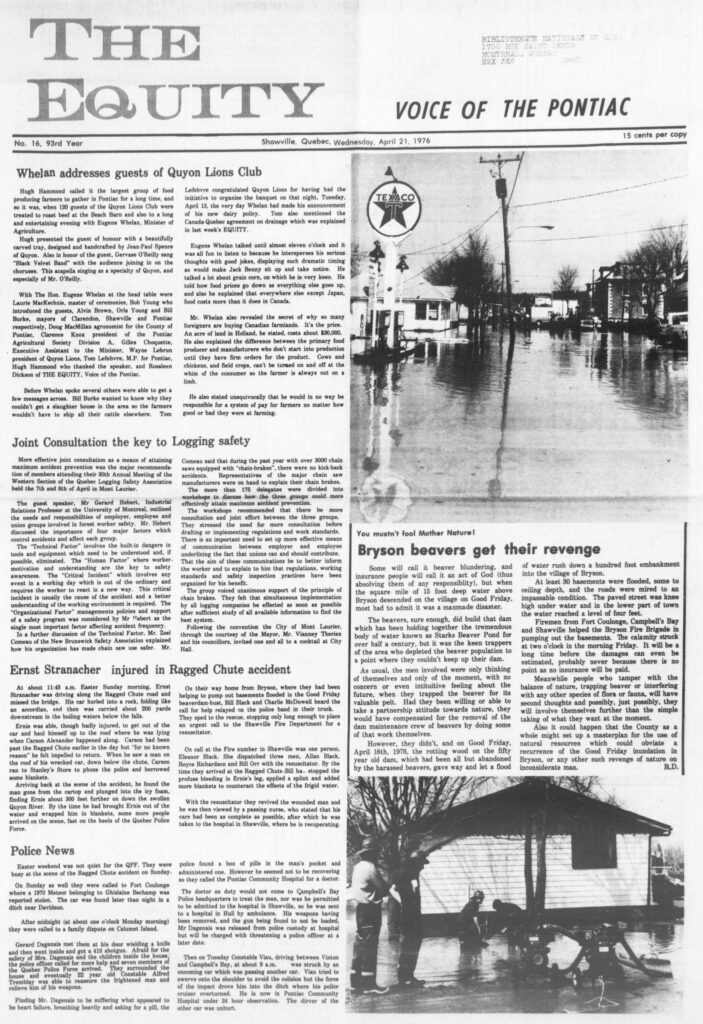
Bryson flood: Some will call it beaver blundering, and insurance people will call it an act of God (thus absolving them of any responsiblity), but when the square mile of 15 foot deep water above Bryson descended on the village on Good Friday, most had to admit it was a manmade disaster.
The beavers, sure enough, did build that dam which has been holding together the tremendous body of water known as Starks Beaver Pond for over half a century, but it was the keen trappers of the area who depleted the beaver population to a point where they couldn’t keep up their dam.
The rotting wood on the fifty year old dam, which had been all but abandoned by the harassed beavers, gave way and let a flood of water rush down a hundred foot embankment into the village of Bryson.
At least 30 basements were flooded, some to ceiling depth, and the roads were mired to an impassable condition. The paved street was knee high under water and in the lower part of town the water reached a level of four feet.
Firemen from Fort Coulonge, Campbell’s Bay and Shawville helped the Bryson Fire Brigade in pumping out the basements.
Whelan addresses guests of Quyon Lions Club: Hugh Hammond called it the largest group of food producing farmers to gather in Pontiac for a long time, and so it was, when 120 guests of the Quyon Lions Club were treated to roast beef at the Beach Barn and also to a long and entertaining evening with Eugene Whelan, Minister of Agriculture.
Before Whelan spoke several others were able to get a few messages across. Bill Burke wanted to know why they couldn’t get a slaughter house in the area so the farmers wouldn’t have to ship all their cattle elsewhere. Tom Lefebvre congratulated Quyon Lions for having had the initiative to organize the banquet on that night, Tuesday, April 13, the very day Whelan had made his announcement of his new dairy policy.
Whelan talked a lot about grain corn, on which he is very keen. He told how food prices go down as everything else goes up, and also he explained that everywhere else except Japan, food costs more than it does in Canada.
Whelan also revealed the secret of why so many foreigners are buying Canadian farmlands. It’s the price. An acre of land in Holland, he stated, costs about $30,000. He also explained the difference between the primary food producer and manufacturers who don’t start into production until they have firm orders for the product. Cows and chickens, and field crops, can’t be turned on and off at the whim of the consumer so the farmer is always out on a limb.
He also stated unequivocally that he would in no way be responsible for a system of pay for farmers no matter how good or bad they were at farming.