





An unusual outdoor event venue is in the works for Allumette Island which, when completed, will invite locals to catch a film, see some live music, or even get hitched amidst towering rows of hops plants.
After 15 years growing hops, brother-sister duo Charles and Mireille Allard are beginning to expand their farm, Houblonnière Lupuline, to include a wedding venue and event space, which they hope to open to the public by next summer.
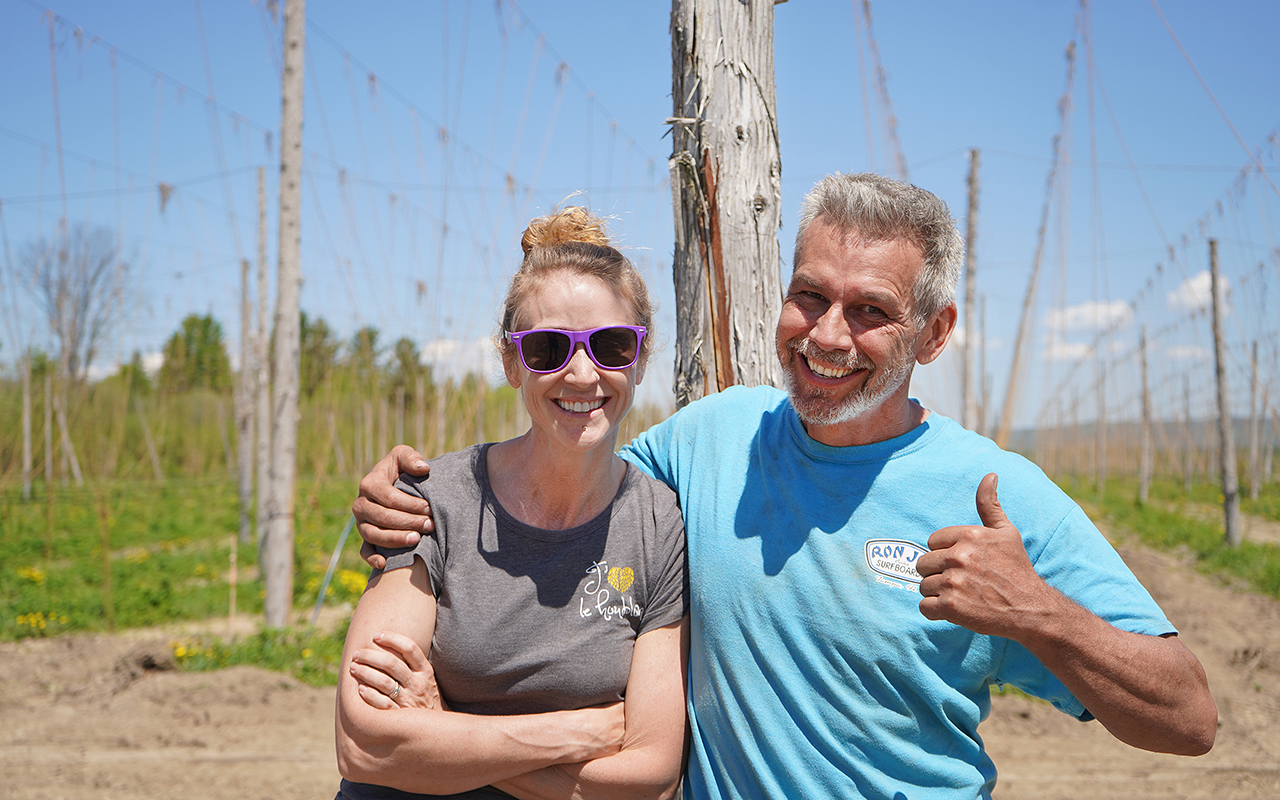
Standing in their hop field on a late May morning, the siblings laid out their vision for their new event space, describing a large tent they plan to install in front of the hop yard as well as a hosting space carved out of the middle of the field with fire pits, tables and an outdoor bar.
“People don’t necessarily know what a hop yard is or how hops grow or how impressive it can be to be in the hop yard,” Mireille said.
Lights, they said, will be hung across the hop terraces, which by early July will be covered in the bright green foliage of the plants, forming massive living walls that will guide visitors to the outdoor boor in the middle of the field.
Their dream is to one day make it possible for visitors to enjoy a beer in the very hop field that produced it, and to offer a space for local producers and artisans to put on workshops and events.
“We want to hold concert events, and workshops like bee keeping or basket weaving or felting, all kinds of neat workshops like that. And especially support local producers as well,” Mireille said.
The siblings have already announced their plans to host their first festival at the farm next summer – the Hop Harvest Fest – which they would like to make an annual event.
“[It’s] a type of Oktoberfest, but in August and September,” Charles said, adding they’re imagining there would be live music and a corn or pig roast.
“The whole island is cottages. Sheen [Sheenboro] and Chichester, they’re all cottages too and we’ve got the Fort (William) there too. So we just wanted to add another activity in the region so people have something to do,” Charles said.

Hosting weddings is also in the plans for the future. Right now, the pair is working hard to get the space ready for Mireille’s wedding this August which they said will act as a trial run for the space.
Challenges
The Allard’s said after a decade and a half in the business, they needed to diversify their revenue streams to continue to make their hops production feasible.
“I think there’s only two hop yards left, and there used to be probably 12,” said Charles referring to hop yards in the Pontiac region.
When they began their hop yard in 2010, neither planned on transforming their multi-generational family farm into an agritourism destination.
Leftover debts accumulated through covid, combined with decreasing demand for their hops, forced the pair to take a critical look at the survivability of their farm.
Currently, the farm sells hops to a handful of local breweries across the Ottawa Valley and Quebec, including Dominion City and Spark Brewery in Ottawa, and Dog House in Petawawa.
This year, they had their customers sign commitment contracts, locking them into what they have promised to buy. This has resulted in a 50 per cent decrease in field production.

“We’re just growing what we can sell because we can’t afford to sit on old crop,” Mireille said. “Right now the 2025 hop crop is coming in and our 2023 hops sitting in storage is going to be really hard to sell.”
She said at a certain point she and Charles weren’t sure they could continue with the business because they couldn’t find the customer-base they needed to make it viable.
“And then we thought about agritourism and thought, ‘Oh, you know what . . . we’ll keep it going. We’ll do the agritourism and give it a shot.”
A hyper-local brew
“If things go well we will look into making our own beer,” Mireille said, noting that to do this, they will need to purchase some serious machinery.
Right now, the harvested hops are driven to Quebec City to be processed into pellets, which can then be used to make beer.
The farm is seeking financial help to purchase a pelletizer to have at the farm.
“It would be nice to have that pelletizer here, that way when the client comes here on site, then we can really show them the plant of hops, and that everything is done here, it’s grown here, it’s transformed here, and you can taste the final product here,” Mireille said.
The pair has been applying for government grants for the project since November, still without any monetary yield.
Last month they launched a fundraising campaign with crowdfunding platform La Ruche.
Their goal is to raise $46,000 in 30 days, and if successful, this amount will be matched by the non-profit organization. The fundraiser ends in the second week of June.
If the fundraising target is not met, the project will not receive any of the funds that have been offered as pledges, which would then be returned to the pledger.
By June 2 they had raised $3,425, with only nine days left until the fundraiser closes.
“It’s a little bit disheartening [ . . . ] Maybe we’re more farmers than publicists,” joked Charles, who used to run a cow-calf operation before getting into hops.
“But we’re definitely not losing hope on that. We’ll keep pushing,” Mireille said, referring to their attempts to find funding for this dream.
“I think it’s important for the community. Participating in and growing the community by offering something interesting other than, I don’t know . . . hay,” she joked.
With or without the money from the crowd funding, they will be open next summer, “but it will just take much longer to achieve the final goal,” Mireille said.
Un nouveau lieu événementiel extérieur, plutôt inusité, est en préparation pour l’île aux Allumettes et, une fois terminé, il invitera les habitants à assister à un film, à écouter de la musique en direct ou même à se marier au milieu d’imposantes rangées de plants de houblon.
Après 15 ans de culture de houblon, le duo frère-sœur Charles et Mireille Allard commence à étendre leur ferme, la Houblonnière Lupuline, pour y inclure un lieu de mariage et un espace événementiel, qu’ils espèrent ouvrir au public d’ici l’été prochain.
Debout dans leur champ de houblon par une fin de matinée de mai, les frères et sœurs ont présenté leur vision pour leur nouvel espace événementiel, décrivant une grande tente qu’ils prévoient installer devant la houblonnière, ainsi qu’un espace d’accueil aménagé au milieu du champ avec des foyers, des tables et un bar extérieur.
« Les gens ne savent pas nécessairement ce qu’est une houblonnière, comment le houblon pousse ni à quel point il peut être impressionnant de s’y trouver », a déclaré Mireille.
Des lumières, ont-ils expliqué, seront suspendues au-dessus des terrasses de houblon qui, début juillet, seront couvertes du feuillage vert vif des plantes, formant des murs vivants massifs qui guideront les visiteurs vers le bar extérieur au milieu du champ.
Leur rêve est de permettre un jour aux visiteurs de déguster une bière dans le même champ de houblon qui l’a produite, et d’offrir un espace aux producteurs et artisans locaux pour organiser des ateliers et des événements.
« Nous voulons organiser des concerts et des ateliers comme l’apiculture, le tressage de paniers ou le feutrage, toutes sortes d’ateliers intéressants comme ça. Et surtout, soutenir également les producteurs locaux », a déclaré Mireille.
Les frères et sœurs ont déjà annoncé leur intention d’organiser leur premier festival à la ferme l’été prochain – le « Hop Harvest Fest » – qu’ils aimeraient rendre annuel.
« C’est une sorte d’Oktoberfest, mais en août et en septembre », a déclaré Charles, ajoutant qu’ils imaginent qu’il y aurait de la musique en direct et une épluchette de blé d’Inde ou une méchoui.
« Toute l’île est remplie de chalets. Sheen [Sheenboro] et Chichester sont également toutes des régions de chalets, et nous avons aussi le Fort (William) là-bas. Nous voulions donc simplement ajouter une autre activité dans la région pour que les gens aient quelque chose à faire », a déclaré Charles.
L’organisation de mariages est également prévue pour l’avenir. Actuellement, le couple travaille d’arrache-pied pour préparer l’espace pour le mariage de Mireille en août, qui, selon eux, servira de répétition générale pour l’endroit.
Défis
Les Allard ont déclaré qu’après une décennie et demie dans le secteur, ils devaient diversifier leurs sources de revenus pour continuer à rendre leur production de houblon réalisable.
« Je pense qu’il ne reste que deux houblonnières, et il y en avait probablement 12 auparavant », a déclaré Charles, faisant référence aux houblonnières de la région de Pontiac.
Lorsqu’ils ont lancé leur houblonnière en 2010, aucun d’eux n’avait prévu de transformer leur ferme familiale multigénérationnelle en une destination agrotouristique.
Les dettes résiduelles accumulées pendant la COVID, combinées à la diminution de la demande pour leur houblon, ont forcé le couple à examiner de manière critique la viabilité de leur ferme.
Actuellement, la ferme vend du houblon à quelques brasseries locales de la Vallée de l’Outaouais et du Québec, notamment Dominion City et Spark Brewery à Ottawa, et Dog House à Petawawa.
Cette année, ils ont fait signer des contrats d’engagement à leurs clients, les obligeant à acheter ce qu’ils avaient promis. Cela a entraîné une diminution de 50 % de la production sur le terrain.
« Nous cultivons uniquement ce que nous pouvons vendre, car nous ne pouvons pas nous permettre de conserver de vieilles récoltes », a déclaré Mireille. « Actuellement, la récolte de houblon de 2025 arrive, et notre houblon de 2023 stocké sera très difficile à vendre. »
Elle a déclaré qu’à un certain point, Charles et elle n’étaient plus sûrs de pouvoir continuer l’entreprise, car ils ne trouvaient pas la clientèle nécessaire pour la rendre viable.
« Et puis nous avons pensé à l’agrotourisme et nous nous sommes dit : “Oh, vous savez quoi… on va continuer. Nous allons faire de l’agrotourisme et tenter notre chance.” »
Une bière hyper-locale
« Si les choses se passent bien, nous envisagerons de brasser notre propre bière », a déclaré Mireille, notant que pour ce faire, ils devront acheter des machines importantes.
Actuellement, le houblon récolté est transporté à Québec pour être transformé en granulés, qui peuvent ensuite être utilisés pour brasser de la bière.
La ferme cherche une aide financière pour acheter une granuleuse à installer sur la ferme.
« Ce serait bien d’avoir cette granuleuse ici, ainsi lorsque le client viendra sur place, nous pourrons vraiment lui montrer le plant de houblon, et que tout est fait ici, qu’il est cultivé ici, transformé ici, et que vous pouvez goûter le produit final ici », a déclaré Mireille.
Le couple a fait des demandes de subventions gouvernementales pour le projet depuis novembre, toujours sans aucun rendement monétaire.
Le mois dernier, ils ont lancé une campagne de financement avec la plateforme de sociofinancement La Ruche.
Leur objectif est de recueillir 46 000 $ en 30 jours, et si la campagne réussit, ce montant sera égalé par l’organisme à but non lucratif. La campagne se termine la deuxième semaine de juin.
Si l’objectif de financement n’est pas atteint, le projet ne recevra aucune des sommes offertes en promesses de dons, qui seraient alors restituées aux donateurs.
Au 2 juin, ils avaient recueilli 3 425 $, avec seulement neuf jours restants avant la clôture de la campagne.
« C’est un peu décourageant [ . . . ] Peut-être que nous sommes plus agriculteurs que publicistes », a plaisanté Charles, qui gérait une exploitation vache-veau avant de se lancer dans le houblon.
« Mais nous ne perdons absolument pas espoir. Nous allons continuer à nous battre », a déclaré Mireille, faisant référence à leurs tentatives de trouver du financement pour ce rêve.
« Je pense que c’est important pour la communauté. Participer et faire croître la communauté en offrant quelque chose d’intéressant autre que, je ne sais pas… du foin », a-t-elle plaisanté.
Avec ou sans l’argent du sociofinancement, ils seront ouverts l’été prochain, « mais il faudra beaucoup plus de temps pour atteindre l’objectif final », a déclaré Mireille.